English
 Español
 Français
 Deutsch
 Italiano
 Português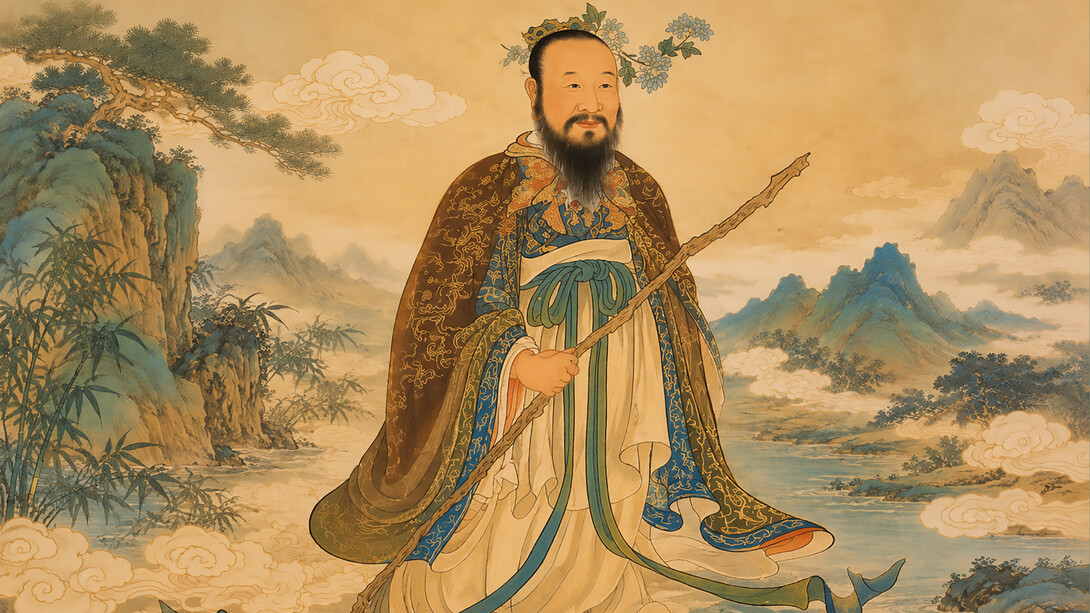
Throughout history, poets have taken differing stances on wars and revolutions, as I argued in my talk, “On Geopolitics, War and the Role of the Poets", invited by the Rising Tide Foundation.1 Many great poems have been written in response to geopolitical struggles.
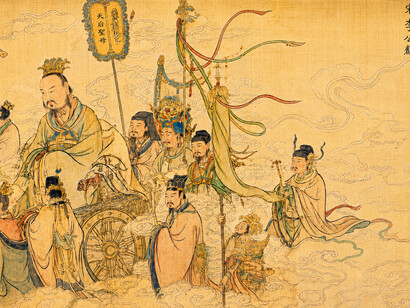
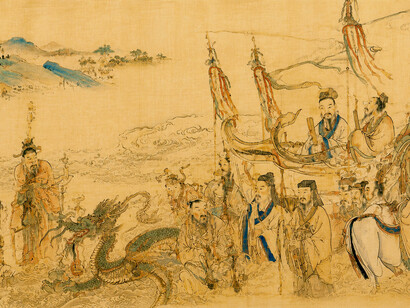
The great poem by Qu Yuan, “Heavenly Questions"2—which I called the “Cosmic Questions” in my first novel, Year of the Earth Serpent Changing Colours—is not only about the origins of being and existence, but the poem also deals with the fate of the Kingdom of Chu and its defeat by the Qin Empire.
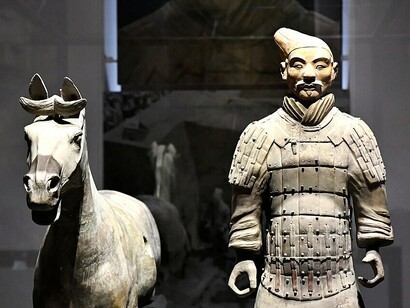
The great statesman and poet Qu Yuan laments his inability to convince his king to initiate alternative policies to prevent the Kingdom of Chu’s defeat by the Qin leader, Ying Zheng, who forced the unification of China to become emperor of all China under the name Qin Shi Huang-di.
As narrated in my first novel, Year of the Earth Serpent Changing Colours: “It was Qu Yuan who had tried to warn his Highness, King Huai, of the treachery and lies of the Qin leader, Ying Zheng—the man with a nose like a stinging wasp, eyes like chiselled dagger points, voice like a shining jackal, heart of a starving wolf, and survivor of many assassination attempts who would ravage all of China. Qu Yuan then took his own life once the Chu kingdom was vanquished by the Qin dynasty led by Chu’s devious rival, Ying Zheng, the King of the Qin dynasty.”3
In both of my novels, Year of the Earth Serpent Changing Colours, and Year of the Horseshoe Bat―In Exile, Qu Yuan becomes a symbol, a hero, for those who protest against totalitarianism and authoritarian rule from ancient China to the present―even without hope of immediate success in defeating tyranny. And not just in China alone. See the "Coda: When It Really All Began," dedicated to Qu Yuan, in my novel, Year of the Earth Serpent Changing Colors.
As has almost always been the case with dictatorial regimes, it took years to bring down the Qin Empire and its regime propagandists, “the Legalists”. And even then, once the dictator is defeated, it does not necessarily mean that “justice” and a better system of governance will be established―as acts of violence generally beget more violence against new targets.
As the teacher, Tao Bai Qing, explains to the novel’s pro/antagonist, the American Maoist, Myles Galvin, who denies the relevance of Chinese history for the new post-1949 Socialist era:
“The methods and tactics of Qin Shi Huangdi had marched the warring Chinese states into the establishment of an empire by means of violence, cruelty and repression. Those same methods, however, could not preserve that empire. In the words of the great eunuch palace historian, Sima Qian4, the Qin had become the laughing stock of the world because it failed to rule with humanity and righteousness. The leadership did not realise that the power to attack and the power to retain what had thereby been won were not the same. Likewise, the historian Jia I (201–169 BC), who wrote the “Faults of Qin", argued that Qin Shi Huang-di had abandoned the true ways of monarchy by making private deals, banning freedom of expression, and making repressive laws, thus putting deceit first and humanity and justice last.
Despite their proclaimed craving for power and order as a way to stay alive for as long as possible, the Legalists ultimately met a gruesome fate. Shang Yang was drawn and quartered, accused of fomenting rebellion. Han Fei Tzu was forced to drink poison after being accused of keeping secret ties to his home state. Did the deaths of these regime propagandists represent justice? Or some form of revenge? Or did the totalitarian Qin dynasty simply rule—quite arbitrarily through terror—whether or not men and women were loyal to the Fearless Leader or not?”
Tao cited Lao Tzu:
As others have taught, so do I teach. "Violent people do not die a natural death.” This is the root of my teaching.”5
Chia Pao-yu Escapes to France
In the second novel, Year of the Horseshoe Bat―In Exile, the protagonist, Chia Pao-yu, is lucky to escape China to France after helping to lead the Chinese democracy and anti-corruption protests of April-June 1989 in opposition to the rule of the Communist Party―but also against the Chinese “New Authoritarians” who were also challenging Communist rule at the time.6
Chia’s friends honoured him by naming him "Qu Yuan" – after the author of the Cosmic Questions. Yet Chia responds, "As powerless and impotent as I felt, however, it was difficult for me to accept the honour of bearing the moniker of the great poet and diplomat, Qu Yuan…”
Sponsored by the activist non-profit group Human Values Forever, Chia is able to attend a conference on the rise of China in the USA under a French pseudonym, Jean Valjaur. There, he is stunned to witness the US President Donald Drumpf’s media personality praise the Chinese neo-authoritarian leader, Xi Jinping, during Drumpf’s first term.
As Chia Pao-yu, alias Jean Valjaur, laments:
On the one hand, Drumpf, by praising the Benevolent Red Emperor, praised one of the totalitarian fruits of Maoist one-party rule as it shifted from oligarchy to autocracy. On the other hand, Drumpf denounced those who saw themselves as pursuing Maoist ideology in opposition to outrageous inequities in power and wealth in the US and Europe. Two wrongs don’t make a right!
At the same time, Trump also took steps to undermine more than 700 years of Chinese-European-American trade and political-economic cooperation since Marco Polo—by mandating tough protectionist measures. It was an outrageous “contradiction”—but one that was not at all in the Leninist-Maoist sense of the term. All in a not-so-friendly effort by Republicans and Democrats to sustain American global hegemony against the Red Dragon’s challenge—thereby proving the Maoist critique!!
As a TV “You’re fired” buffoon, Drumpf has followed in the footsteps of movie star Ronnie “the Gipper” Raygun. As “Teffylon” presidents, all criticism, even if most strident, bounces right off them. While it appears that everyone on the planet now has some degree of Teflon polytetrafluoroethylene molecules of “better living through forever chemistry” in their bloodstreams, it also seems that only a few individuals have actually been able to adapt to this new bodily chemistry. Despite engaging in evidently corrupt, repressive, warmongering, and self-serving policies—that have nothing to do with the national or international interests of the people and the country—nothing to stick to them! Seems Pootin and Winnie the Pooh also have Teflon in their blood as well!”
How was it possible for an American president to praise the Chinese leader who represents everything the Americans have opposed since their revolution against tyranny—and who represents everything in China that I have struggled against in the hope of achieving a much better and more free China?"7
China’s “New Authoritarians”
While the Chinese Communist Party was able to repress those who argued for multiparty democracy and greater freedom of speech and the press after the nationwide crackdown on June 4th, 1989, the “New Authoritarians” were able to gather strength and seize control over the country―overthrowing the Communist oligarchy to establish an autocracy. Xi Jinping has been the “New Authoritarian” ruler of China since 2013―thereby embodying what Chia Pao-yu would consider to be "New Legalism".
And now, in May 2026, long after Chia Pao-yu disappeared from the face of the earth without a trace as depicted in the novel, President Drumpf has met directly with Xi Jinping.
Ironically, Trump and Xi visited the Hall of Prayer for Good Harvests in Beijing’s Temple of Heaven, which symbolises the connection between Heaven and Earth, the emperor’s role as the Son of Heaven, and the belief that cosmic harmony would produce fruitful harvests.
Will the May 2026 Trump-Xi encounter result in positive cooperation and sustainable peace between the US and China that leads to a fruitful domestic and international "harvest" that ultimately reduces international tensions and puts an end to domestic repression?
Or will their encounter exacerbate conflicts between the US and Europeans versus Russia over Ukraine and the US and Israel versus Iran and then ultimately lead to a direct US-China confrontation over Taiwan and the South and East China Seas?
Or could Trump's and Xi’s meeting initiate a US-China condominium of “no peace, no war”―that would permit Xi to expand China’s dictatorial controls over Taiwan―as has already been the case for Hong Kong, and then over other populations? Will Beijing, with Trump and US acquiescence, be able to seize control over the sea lanes of communication from the Pacific to the Arabo-Persian Gulf – in linking with Iranian controls over the Straits of Hormuz?
How will the geopolitical relationship between the US, Europe, and China impact the planet’s citizens in the near future?
Notes
1 Rising Tide Foundation, “On Geopolitics, War and the Role of the Poets.”
2 Qu Yuan, “The Heavenly Questions.”
3 Hall Gardner, Year of the Earth Serpent Changing Colours (Ibidem. Columbia University Press, 2023).
4 Footnote in Hall Gardner, Year of the Earth Serpent: Changing Colours Considered a “suspect” academic by the regime, in 99 BC, the historian Sima Qian was arrested for supporting his friend General Li Ling, who had been condemned as a traitor. But because he wanted to finish writing his history of China, Sima Qian refused to commit suicide; instead, he was jailed for three years and castrated—he was not wealthy enough to buy his way out. Intellow, Vol I. 39-56.
5 Hall Gardner, Year of the Earth Serpent Changing Colours.
6 Hall Gardner, “A Troubled China Needs Democracy” LA Times (April 23, 1989)
Hall Gardner, “Far From Beijing, the Students Stand Up", LA Times (May 18, 1989).
7 Hall Gardner, Year of the Horseshoe Bat―In Exile (Ibidem/Columbia University Press, 2024).