English
 Español
 Français
 Deutsch
 Italiano
 Português
The familiar provocation of Roland Barthes—that the author must be “dead” for the reader to be born—now feels curiously incomplete. If the twentieth century dismantled the sovereignty of the author, the twenty-first appears poised to erode the authority of the reader. For the reader's view audience. What emerges in such a double erasure is not merely a redistribution of interpretive power but a more unsettling question: what becomes of meaning itself when both its presumed origin and its destination dissolve? I am reminded here of the immaterialism of the 17th/18th-century bishop/philosopher George Berkeley (1685-1753), who stated:
The objects of sense exist only when they are perceived; the trees, therefore, are in the garden... no longer than while there is somebody by to perceive them.
If you are wondering where I am going with this, look no further than the reader exhaustion/surrender brought about by the genius outputs of content creators, human or artificial, that now bury us with a tsunami of unmitigated media 24/7, enough to eat a million lifetimes of attention every day. Let’s be clear, we are not consumers of online content anymore; it is we, and our precious lives, that are being consumed.
Barthes’ engagement with Marcel Proust can help us clarify our predicament here, not least because it complicates the very gesture of authorial death. In S/Z and elsewhere, Barthes does not so much discard Proust as disassemble him; the author becomes a tissue of citations, a relay point within a broader textual system. Proust’s Recherche is not a confession but a labyrinth—its “I” neither stable nor sovereign. Authority fractures into codes, and meaning becomes plural, deferred, and contingent upon the reader’s traversal. Yet even in this dispersal, Barthes quietly retains a faith in the reader as the site where meaning coheres, however provisionally.
Skipping playfully ahead, and as if to enforce the anomie even further, enter Jacques Derrida (1930-2004). Derrida’s deconstructive project renders even the most residual author/reader confidence suspect. If meaning is always already ‘différance’1—deferred and differentiated—then the reader cannot stabilise what the author has relinquished. The text is not a field awaiting cultivation but an endless play of traces, resistant to final interpretation. The reader, like the author, becomes de-centred, caught within the same unstable system of signification. Authority does not shift; it evaporates.
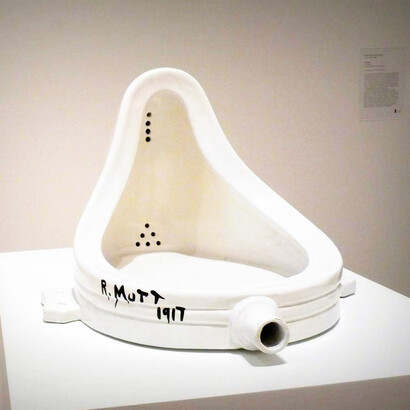
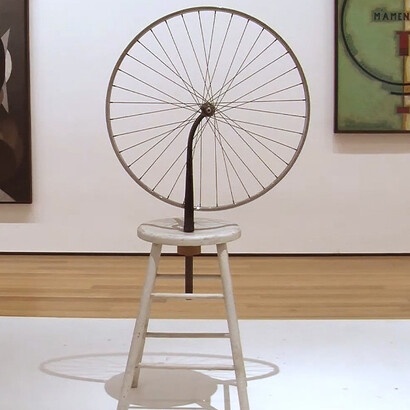
This near-theosophical impasse finds a striking analogue in the strategies of twentieth- and twenty-first-century visual artists. Duchamp’s readymades—those urges/gestures of conceptual displacement—eloquently announce the redundancy of both authorial craft and interpretive mastery. Fountain is neither made nor explained; it is designated. Its meaning is not inherent, nor is it recoverable through traditional hermeneutics. Instead, it hovers in a liminal space, activated (or not) by institutional context and discursive framing. Duchamp does not simply kill the author; he renders authorship procedural. More nuanced negotiations of authorship and readership appear in the practices of Sophie Calle and Martha Rosler.
Calle’s works—part surveillance, part confession—blur the boundary between lived experience and constructed narrative. The “author” becomes a character within her own textual-visual apparatus, while the viewer is implicated as a voyeur, detective, and judge. Rosler, by contrast, foregrounds the ideological structures that govern representation, particularly in her photomontages addressing war and domesticity. In both cases, meaning is neither given nor entirely open; it is staged, contested, and ethically charged.
The textual interventions of Jenny Holzer and Barbara Kruger further complicate the Barthesian paradigm. Holzer’s aphorisms—“Protect Me From What I Want”—circulate in public and digital spaces, detached from any stable authorial voice. Kruger’s declarative slogans—“Your Body is a Battleground”—appropriate the visual language of advertising to expose its coercive power. In both practices, the “reader” is addressed directly, even aggressively, yet their role is less to interpret than to confront. Meaning is not discovered but imposed, only to be questioned in the same gesture.
The photographic self-fashioning of Cindy Sherman and the punk-inflected collages of Linder extend this destabilisation into the realm of identity. Sherman’s proliferating personas dissolve the notion of a coherent authorial subject, while Linder’s cut-and-paste aesthetics fracture the visual codes of gender and consumption. In both cases, the viewer’s interpretive labour is foregrounded, yet also undermined: there is no authentic subject to recover, no definitive meaning to secure.
If these artistic practices collectively enact the death of the author and the destabilisation of the reader, the advent of artificial intelligence threatens to render all positions obsolete. AI systems do not “author” in the traditional sense; they generate. They are the ultimate bricoleurs. Nor do they “read” as humans do; they process, predict, and recombine. The interpretive act is replaced by statistical inference, the slow labour of meaning supplanted by instantaneous algorithmic outputs.
This presents us with a profound risk: that meaning itself becomes a byproduct of algorithmic efficiency rather than human engagement. In such a scenario, the text—or the artwork—no longer demands to be read or interpreted; it is simply consumed by being ‘looked at’. Any and all “significance” pre-packaged by systems trained on vast corpora of prior expression. The reader’s role as co-creator of meaning, already tenuous in post-structuralist theory, is gone. We are left not with a liberated plurality of interpretations but with a homogenised field of probable meanings.
But it’s too luddite and too simple to cast AI as merely the latest agent in a long history of interpretive erosion. One might more optimistically ask instead whether the disappearance of both author and reader creates a “significance vacuum” that demands new forms of engagement. If meaning is no longer anchored in intention or reception, perhaps it emerges elsewhere—in networks, in interactions, in the unpredictable dynamics of cultural circulation.
Here, the more ‘real’ geopolitical and economic complexities of the early twenty-first century cannot be ignored. Global flows of information, capital, and power shape not only what is produced and consumed but also how it is understood. In a world marked by algorithmic governance, surveillance capitalism, and persistent military tensions, the question of meaning is inseparable from the question of control. Who—or what—determines significance when traditional human agents are sidelined?
One possibility is that meaning becomes increasingly situational, contingent upon context rather than origin or destination. Another is that it becomes instrumentalised, harnessed for political or economic ends with minimal regard for interpretive nuance. A less sceptical view might suggest that new forms of collective intelligence—distributed, participatory, and hybrid—could fill the vacuum left by the author and the reader.
What remains clear is that our own post-Barthesian drama has entered a new phase. We can see that the death of the author was never an endpoint but a portent—a reconfiguration of the conditions under which meaning is produced and received. The potential death of the reader extends this reconfiguration into our current uncharted territory. Between them lies a space of both danger and possibility, where the future of interpretation—and perhaps of thought itself—will be negotiated.
In this emerging landscape, the challenge is not to resurrect the author/artist or to defend the reader, but to rethink the very terms of their disappearance. For if meaning is no longer guaranteed by either, it must be forged anew, under conditions that are as unstable as they are unprecedented. As Ivan Chtcheglov said so brilliantly: “The Haçienda Must Be Built"2. And probably by artists, as it most certainly will not exist of its own accord.
References
1 In the essay "Différance", Derrida states that différance posits several heterogeneous drivers that govern textual meaning. In this deliberate misspelling, words and signs are defined as being not identical with what they signify and only acquire meaning through their differences from other words and signs. See also Joseph Kosuth, Three Chairs.
2 Ivan wrote Formulaire pour un urbanisme nouveau (Formulary for a New Urbanism) in 1953, at age nineteen, under the name Gilles Ivain, which was an inspiration to the Situationist International. "And you, forgotten, your memories ravaged by all the consternations of two hemispheres, stranded in the Red Cellars of Pali-Kao, without music and without geography, no longer setting out for the hacienda where the roots think of the child and where the wine is finished off with fables from an old almanack. That’s all over. You’ll never see the hacienda. It doesn’t exist. The hacienda must be built."