English
 Español
 Français
 Deutsch
 Italiano
 Português
My most recent written work has been exploring the theme of remaining human and humane in an age of dehumanising artifice. Which aspects of our human essence do we need to protect from the potentially erosive qualities of the digital realm and the algorithms that paint a false picture of the reality most of us encounter daily? Does such inquiry make a logical step toward a wider understanding of the nature of reality itself, which, whether experienced through an analogue or digital prism, remains subject to the vicissitudes of human perception? How do we ‘know’ what we know? Can we ‘unknow’ what we think we know (the summation of human constructs, social and cultural conditioning) in order to find Truth (with a capital T)?
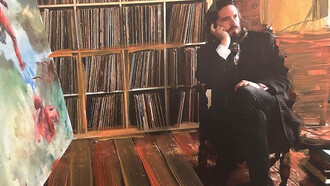
It’s a curious thing, but as I sit in my Surrey painting studio watching the afternoon light perform its slow glow smudge across this half-finished, undistinguished canvas, I am struck by how aggressively our modern world seeks to cure us of any capacity for mystery. We live under the tyranny of the explainable. Between the rigid, binary logic of our technology and the loud, transactional theatre of politics and commerce, we have become a species obsessed with optimisation. We want everything faster, smoother, and devoid of friction.
Yet, as the English zoologist and surreal painter Desmond Morris pointed out in his 2013 book The Artistic Ape, when you strip away the bureaucratic plumbing of politics and the relentless shopping spree of commerce, humanity has historically been left with only three genuine, evolutionary obsessions: art, science, and religion. He suggested it is these three behaviours alone that separate us from all other species.
He defined art as ‘making the extraordinary out of the ordinary – to entertain the brain’, science as ‘making the simple out of the complicated – to understand our existence’, and religion as ‘making the believable out of the unbelievable – to reduce the fear of dying’.
In examining the place of religion in the human condition, we might at first glance consider Morris’s definition a bit dry, perhaps even slightly clinical. It suggests a comfort blanket woven from cosmic bedtime stories to keep the existential monsters at bay. But if we look closer, there is a far more beautiful, alchemical truth at play. Religion, in its most fundamental, transformative sense – from the Latin religare, meaning ‘to bind together' – is the human psyche’s wholly admirable attempt to bridge the gap between our delicate, mortal meat suits and the infinite, terrifyingly immortal mystery of the cosmos. And historically, the methodology we have regularly employed to build that bridge has been art.
Before we had written scriptures, theology degrees, or cathedral gift shops, we had the oral tradition of storytelling and the visual idol. Consider our early ancestors, huddled in the damp draft of a cave or standing beneath the colossal, indifferent canopy of a prehistoric forest. The world was a chaotic, unpredictable theatre of thunder and lightning, predators, and sudden, inexplicable death. To survive (let alone prosper), humans needed to find order in the madness. We needed to make the unbelievable idea of an easier life believable.
And so, we told stories and we carved. We engraved spirals and rings into stone. We took a piece of mammoth ivory or a lump of river mud and fashioned the Venus of Willendorf1 (c. 30,000 yrs) and the Lion-Man of Hohlenstein-Stadel2 (c. 40,000 yrs). These were not mere decorative items to match one’s cave soft furnishings; these representative effigies were vessels of the sacred. By capturing, even personifying, the terrifying, invisible forces of nature – fertility, wildness, death – and refining their essence into a physical, touchable object, humanity tamed the chaos. The disorder was turned into a ‘thing’ around which thought could gravitate and organise. The idol became a focus point for our collective hope and petitions, a tangible receptacle holding our spiritually led aspirations for survival in the face of physical adversity. In effect, extraneous desirable ‘stuff’ was born.
All art that is not mere storytelling or mere portraiture is symbolic and has the purpose of those symbolic talismans which mediaeval magicians made with complex colours and forms and bade their patients ponder over daily and guard with holy secrecy, for it entangles, in complex colours and forms, a part of the Divine Essence.
(William Butler Yeats)
There’s a strong argument to suggest that art did more than merely serve the fledgling course of religion; art potentially birthed it. The pagan artefact became a powerful and effective lightning rod mediating the unpredictable currents of the unexplainable and divine into the earth of daily reality.
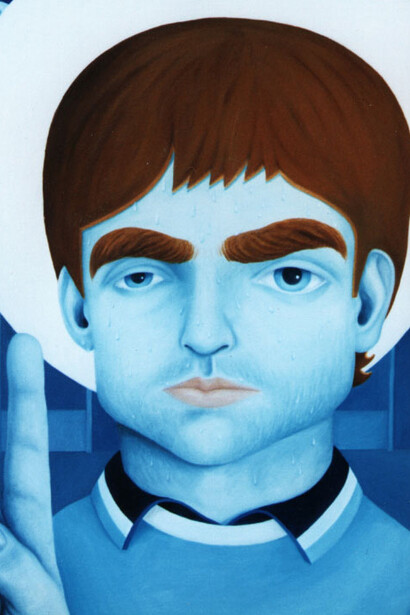
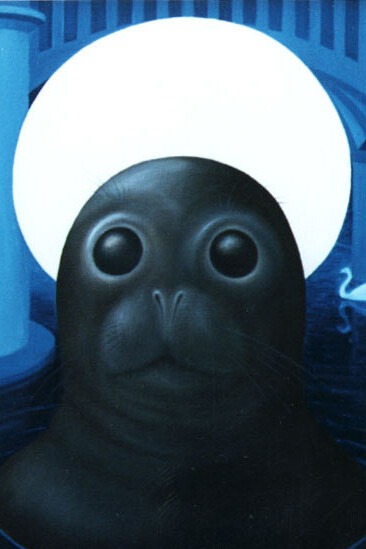
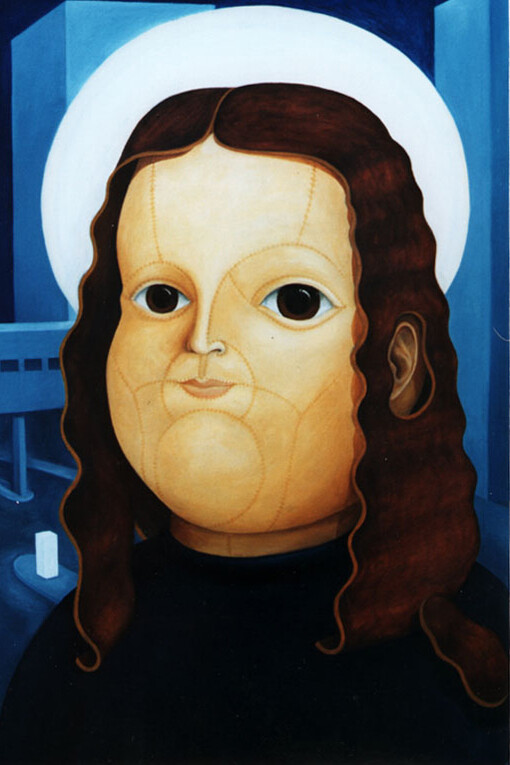
This sacred, integrated impulse didn't vanish with the arrival of modern civilisation, even if we have swapped our limestone caverns for neo-Gothic cathedrals and white-walled public galleries. In 1996, I found myself playing with the provenance of this ancient relationship when creating work for The Twelve Saints of Manchester, a solo show held at the Manchester City Art Gallery.
At the time, I was working as the artist-in-residence at Chetham’s School of Music, a stone’s throw from the mediaeval heart of a city built on the relentless, gritty engines of the Industrial Revolution. Manchester is now a thriving hub of cosmopolitan modernity, all crystal towers and canal bars, but in places it still honours its grand architectural past, damp cobblestones and politically never reneges on its fiercely proud, working-class roots. It is a city that has known the heights of economic triumph and the deep, grey valleys of industrial decline.
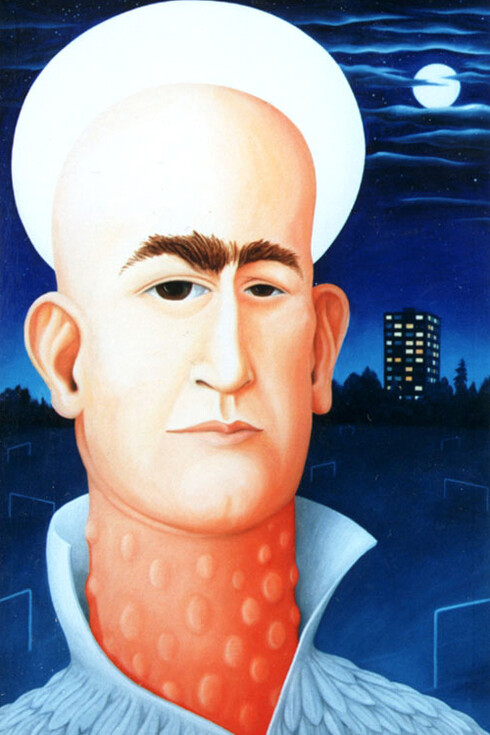
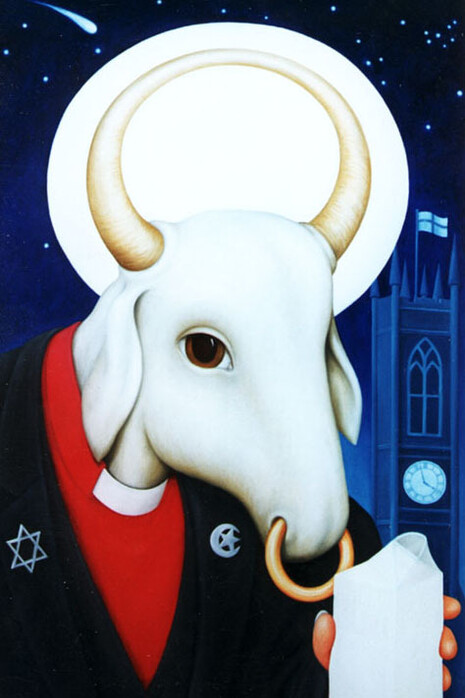
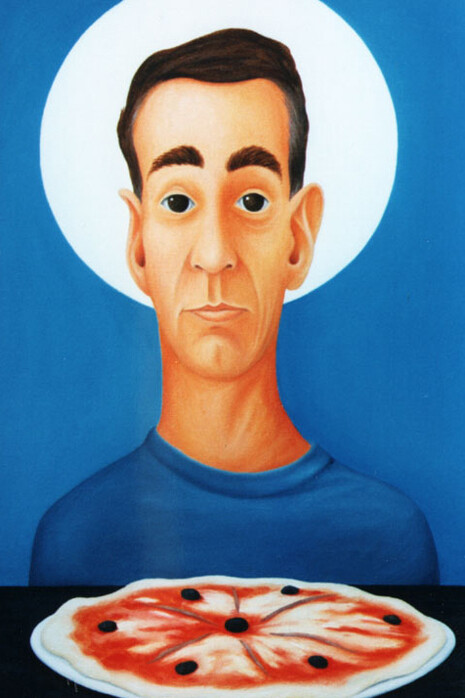
For the exhibition, I painted the portraits of 12 entities – Manchester's ‘Saints’. They were not historical, canonised figures of orthodox Christianity, nor were they immaculate, gilded icons designed to foster emulation or obedience. Several of them bore an uncanny resemblance in name and appearance to characters performing on the contemporary Manchester scene. There was Noel – Patron Saint of Oracy; Dolly – Patron Saint of Fashion; and Eric – Patron Saint of Self-Defence with hints of Messrs Gallagher, Parton and Cantona, respectively. Others resembled people I had encountered personally in my time in the city. These depictions, complete with attendant halos, were purposely polemical, verging on heretical, in one case showing the imposing figure of an anthropomorphised holy cow (Nandy – Patron Saint of Religion) wearing an informal archbishop collar with both an Islamic crescent and a Star of David badge on opposing suit lapels. There were a couple of official complaints, but commendably the gallery remained supportive of the non-denominational validity of the work.
The notion was that this special breed of being were making their own, often unseen and innocuous, contributions to the quality of life in Manchester. The exhibition blurb suggested that the paintings “provide the opportunity for the viewer to experience some of their wonderfully magical, healing powers.” Under the watchful, unconditionally loving gaze of the Saints, viewers were invited to honour the champions in their midst, those Mancunians unerringly and selflessly determined to bring joy and peace to life in the city. The images were, in essence, of modern pagan idols, a pantheon of benevolence, and seemed very in keeping with the huge cultural shifts happening in the city at the time. Images of the works can be seen on my website.
A key intent in the work was to evoke that same ancient, animist feeling: the sense that an inanimate object, through the slow, concentrated focus of the artist's hand, could become charged with a spiritual presence. Standing in the gallery, surrounded by those dignified silent sentinels, visitors weren't being asked to subscribe to a specific dogma or fear an impending hellfire. They were being invited to pause, to step out of the frantic white noise of the city outside, and to feel the weight of their own awareness. It was a further invitation to recognise that our desire for sanctity – our need to feel part of an indivisible, perfect whole – is still very much alive, even in the midst of a rain-slicked northern metropolis.
Today, we live in a world that feels increasingly fragmented, scarred by war, ideological division, and the dehumanising screens of the digital age. We are constantly encouraged to view ourselves as separate entities, trapped in our own tiny, polarised bubbles, screaming at ‘the other’ across an apparently yawning, culturally devised but ultimately non-existent chasm.
But if we return to the shared lineage of art and religion, we find a powerful, healing antidote to our modern malaise. Both art and the true spiritual impulse require us to surrender the illusion of separation. When you stand in front of a painting that moves you to tears, or when you sit in silence beneath the branches of an ancient wood, the engrained boundaries of your ego temporarily dissolve. You are no longer a consumer, a voter, or a data point to be targeted by an algorithm. You are simply a witness to the profound, shared mystery of being alive.
If this cherished understanding – that there is ultimately no separation – holds true, then whatever we do to the ‘other’ is an act directed straight at the Self. To harm is to harm Self; to love is to love Self.
Humanity’s ongoing spiritual challenge is not about escaping this world or securing a golden ticket to a sterile, cloud-based afterlife. It is about actively cultivating a deep, empathetic reverence for the living planet and the diverse, beautifully flawed human family that inhabits it.
Your daily life is your temple and your religion. Whenever you enter into it, take with you your all.
(Kahlil Gibran)
By bringing the sacred back into our creative endeavours, we defy the cold, reductionist materialism that seeks to turn our lives into a series of monetised transactions. When we paint and sculpt, when we create spaces for shared reflection, we are building modern-day altars to our common humanity. We are offering a quiet, persistent prayer for peace and prosperity – not the prosperity of endless economic growth, which is currently driving our biosphere toward a cliff, but a prosperity of the spirit, rooted in community, fellowship, and love.
So, let us look to our past, to the cave walls and the cathedral arches, not to mimic their forms, but to remember the eternal creative values that inspired them. Let us continue to make our mark, to instil all that’s good, true and beautiful into our output in thought, word and deed, that we may manifest benefit to all. For in the end, it is through these small, defiant, and deeply humane acts of reverent creation that we will remember how to heal ourselves and our planet.
In this life we cannot do great things. We can only do small things with great love.
(Mother Teresa)
Notes
1 Venus of Willendorf.
2 The Lion Man: an Ice Age masterpiece.