English
 Español
 Français
 Deutsch
 Italiano
 Português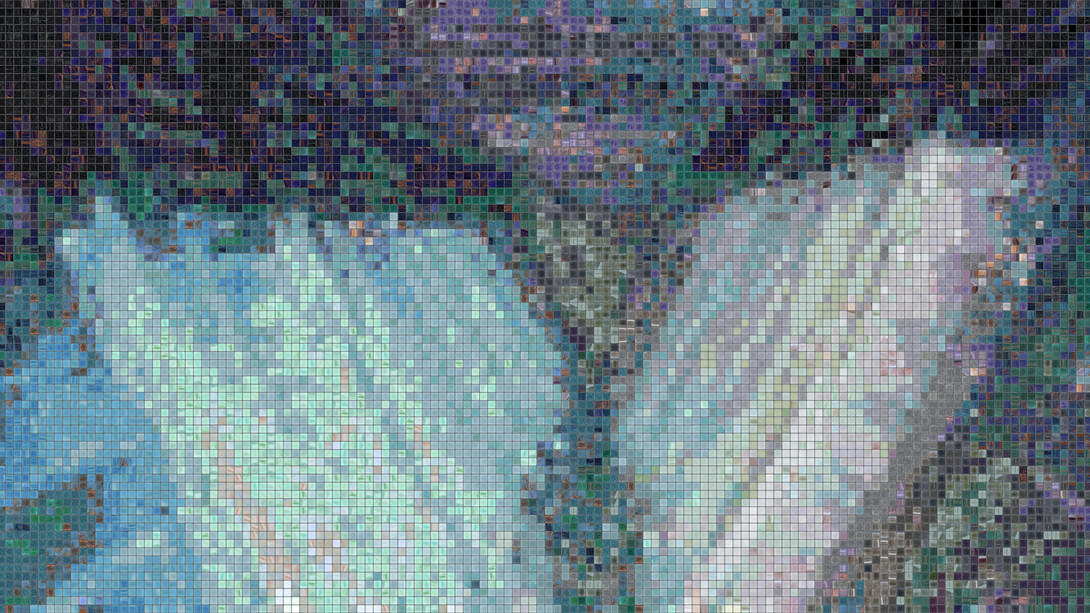
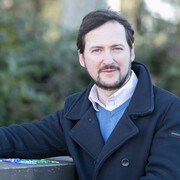
There are artistic projects that are not born solely from an idea but from a personal journey made of memories, passions, and visions. Eternal echoes is one of them. With this collection of mosaics, Simone Ferrero brings his two worlds—the artist and the mathematician—into dialogue, transforming matter into timeless stories. The tiles become fragments of memory, vibrations that resonate between nature and mythology, between the intimate and the collective. In this conversation, Simone tells us how mosaic, for him, is more than a visual language: it is a threshold to inner worlds, an invitation to recognize in ancient myths and their resonances a reflection of our own human experience.
Meer: Simone, how did the Eternal echoes project come about, and what does it mean to you as an artist?
Eternal echoes is an artistic and inner journey I have cultivated for years. It is not simply a collection but an experience that grows from two sides: that of the artist, fascinated by forms, colors, and the mystery of ancient stories; and that of the mathematician, who taught me to see the world as a network of connections and relationships, where nothing exists in isolation.
Since childhood, I remember the wonder I felt before nature: the waves crashing on the shore, the leaves moved by the wind, the stars illuminating the night. Every detail spoke to me of a hidden order, a secret harmony linking chaos and beauty. Over time, this fascination intertwined with mythology, revealing a universal language that has accompanied us since ancient times—stories of gods, heroes, and transformations that speak of us, our fears, and our deepest desires.
I came to understand that these stories are not just memories of the past but waves of meaning that continue to resonate in the present, crossing cultures and generations. This is where Eternal echoes was born: a project that transforms these vibrations into images, into compositions of tiles that, like small fragments of emotion and memory, come together to form a greater design.
M: How would you define mosaic in your artistic and human journey?
One of the aspects I love most about mosaic is its ability to become a dimensional portal, a threshold inviting us to move beyond the surface of the work and come into contact with invisible worlds and inner possibilities. Each mosaic is like a passage that allows us to cross the boundaries of time and space and embark on an imaginary journey.
I see mosaic as a universal language made of fragments that unite to create a harmonious whole. Each piece is like a fragment of memory, a recollection, an emotion. It is a unique element that, interwoven with others, generates new connections and stories. When we observe a mosaic, we can be drawn to its colors, shapes, and vibrations—and in that moment, the threshold opens: a passage leading us beyond the visible, toward what resonates within us.
M: You often speak about “resonance.” What does this concept mean to you, and how do you translate it into your art?
The heart of this work is the concept of resonance. I like to imagine it as a wave spreading through space and time, a vibration that begins at one point and reaches thousands of others, transforming and enriching itself along the way. It is an echo that never stops, capable of connecting past and present, myth and reality.
In the Greco-Roman myths that inspired this collection, this vibration is always present: in the song of Orpheus, in the tears of Demeter, in the fire of Prometheus. Ancient stories that still speak to us today because they tell our story. In my mosaics, I’ve sought to translate this vibration into images, where the tiles intertwine in compositions that do not illustrate a story but rather evoke it.
M: You’ve mentioned your personal connection with nature and mythology. Could you elaborate?
From a young age, I have felt a deep bond with nature, and as I grew, I found in ancient mythologies a reflection of that same power—a journey intertwined with my own story, my dreams, and my deepest questions.
In my work, I don’t seek to represent myths literally. I don’t want to explain but to evoke. I want viewers to find their own story, their own journey. Art, like myth, does not live through single answers but through questions that accompany and transform us.
M: In your work, there is a strong tension between individuality and collectivity. How would you explain that?
Ancient myths were born as collective narratives: they did not belong to a single author but to the voice of a people. This collective spirit is what I aim to bring into my mosaics. Each piece is unique, but only together with the others does it become part of a more complex vision. Likewise, each of us finds meaning and form within a community.
Each artwork becomes a space of silent encounter, where feelings intertwine and create a shared energy. I like to think that every person who observes my work becomes a traveler, an active participant in this collective experience.
M: The collection is divided into four distinct groups. Can you tell us about them?
Eternal echoes is structured into four sub-collections, each with its own energy and atmosphere:
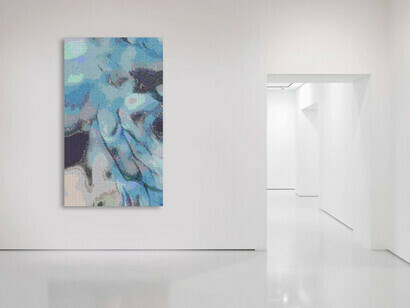
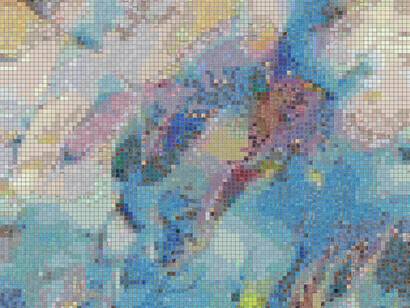
Boundless blue horizons: an invitation to explore the connection between sky and sea. Includes the work Eos’s reverie, a tribute to the goddess of dawn.
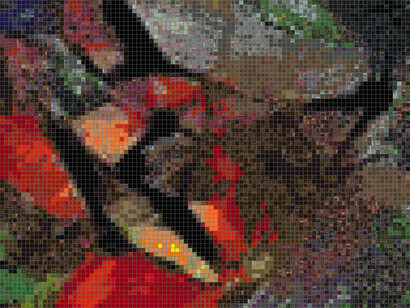
Crimson underworld: leads us into the depths of fire, with The cry of Hephaestus, inspired by the god of the forge.
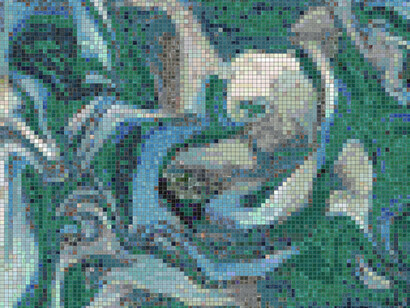
Jade realms: celebrates the fertility of the earth, with Emerald flow, evoking the goddess Eurynome.
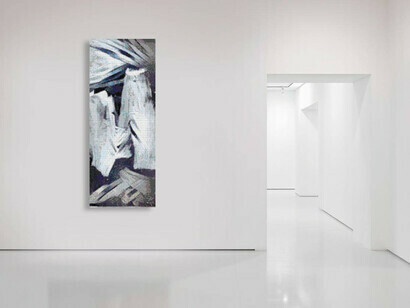
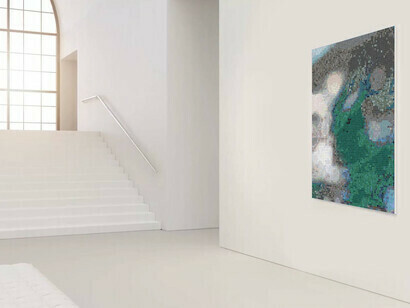
Obsidian peaks: guides us toward the mysterious solidity of the mountains, with Abyssal glow, dedicated to Selene, goddess of the moon.
Each of these works acts as a threshold to emotional worlds and symbols in constant vibration.
M: A key part of your reflection relates to the thought of Edgar Morin. How has he influenced your work?
He is a fundamental source of inspiration for me with his philosophy of complexity. Morin invites us to move beyond a fragmented vision of the world and to see reality as a web of relationships and interconnections. Each tile of a mosaic is a fragment that joins with others to form something greater and, in a sense, more powerful.
For me, mosaic becomes the ideal language to embody this vision: it is an open, ever-evolving structure. Each work becomes a dynamic system that renews itself through the viewer’s gaze.
M: The concept of order and disorder—how is it represented in your artistic approach?
In my mosaics, I seek to embrace the dance between stability and chaos. I don’t compose according to a rigid scheme but allow the tiles to move, intertwine, and repel one another. This movement creates a visual rhythm that reflects the vitality of life itself. Each composition becomes a small cosmos where tensions transform into a temporary equilibrium.
M: Edgar Morin’s thought encourages transdisciplinary knowledge. How does this vision influence your creative process?
I feel deeply connected to Morin’s idea that art is one of the privileged spaces where different forms of knowledge—philosophy, science, emotion—can converge. When I work on a mosaic, I’m not only composing forms but weaving geometry, mythological symbolism, and inner experience. Each tile can simultaneously be a mathematical unit and an emotion, a fragment of nature and an existential question.
M: What message would you like to leave with visitors to Eternal echoes?
Each mosaic in the collection is more than a work of art; it is a threshold opening onto diverse, living worlds made of emotions, stories, memories, and connections. It is a mirror that reflects something of each of us. There is no single key to pass through it—everyone carries their own, and together we can build a collective story made of glances, memories, and new questions.
I hope this artistic journey can accompany those who encounter it, leaving behind a lingering vibration and a memory that inspires us to look at life with eyes that, though ancient, are also renewed.