English
 Español
 Français
 Deutsch
 Italiano
 Português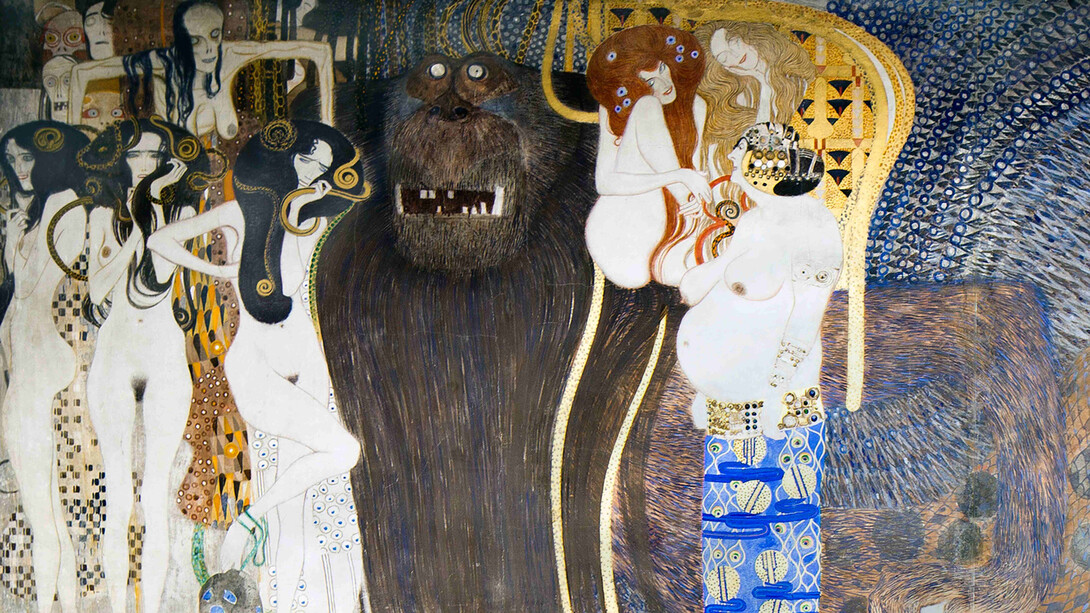
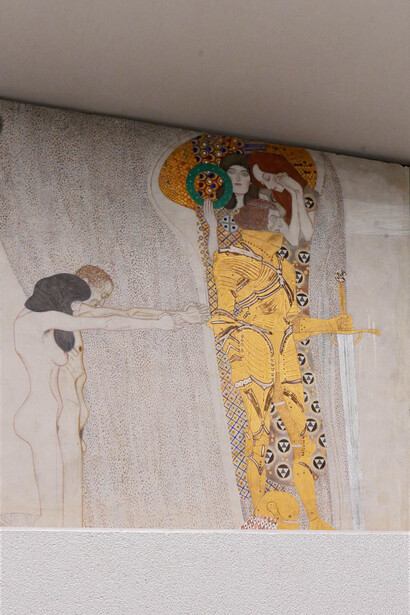
Visiting the Secession Building in Vienna, I came expecting to see a monument to artistic freedom. I left considering something stranger: that art, when pushed beyond its aesthetic function, becomes less an object of beauty and more a space for reckoning. Gustav Klimt’s Beethoven Frieze, which wraps itself across three walls of the lower hall, was originally meant as a temporary backdrop to a sculpture of Beethoven by Max Klinger. Yet over a century later, the frieze remains, not because it answers any great cultural question, but because it poses several that remain unresolved (Duncan, 1994).
We are often told that the frieze is Klimt’s homage to Beethoven’s Ninth Symphony, a visual analogue to the final choral movement, the Ode to Joy. But this description, while broadly accurate, fails to capture what the work actually does. Walking alongside it, I was struck less by its decorative beauty, though it has that, than by its intellectual restlessness. Klimt takes the symphony’s famously triumphant arc and complicates it, refracting it through a visual language that blends myth, anxiety, eroticism, and abstraction (Gale, 1995).
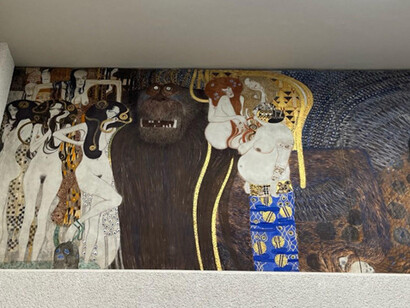
The narrative begins with a stylized procession of figures symbolizing humanity’s “Yearning for Happiness.” These are not heroic forms but elongated, ghostlike silhouettes, more haunted than hopeful. They stretch forward, not toward any clear goal, but toward a knight-figure who appears oddly passive, almost ceremonial in his bearing. Already, Klimt’s reimagining departs from the Enlightenment optimism embedded in Beethoven’s music. Where Beethoven suggested universal brotherhood, Klimt suggests something more ambiguous: that desire is not always noble, and that seeking fulfillment might be an existential condition rather than a solvable problem (Partsch, 2017).
The central section of the frieze, the so-called “Hostile Forces,” disrupts any narrative of linear progress. Here, Klimt introduces a monstrous Typhoeus, flanked by allegories of Madness, Sickness, and Death, as well as figures representing Lust and Wantonness. The figures are not just threatening, they are alluring. Klimt blurs the boundary between danger and desire, creating a psychological space where suffering is not merely endured but inhabited. This may be the most honest portion of the work: it resists the fantasy that human advancement is a smooth trajectory from ignorance to enlightenment. Instead, Klimt seems to suggest that what we fear and what we want are often entangled and that no cultural achievement, musical, artistic, or moral, is immune to this entanglement (Bailer, 2009).
Standing before this section, I was reminded of the broader currents running through Vienna at the turn of the twentieth century. The city was a hub of psychoanalytic thought, with Freud’s theories suggesting that human behavior is shaped as much by repressed desire and irrational drives as by reason. Klimt’s Hostile Forces seems to visually anticipate that insight: the monsters of his frieze are not simply obstacles to be defeated but reflections of the internal conflicts that shape the human condition (Freud, 1900/2010).
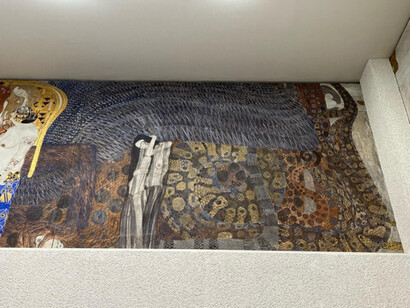
By the time the frieze resolves into its final panel, the so-called apotheosis, the mood is oddly quiet. The knight has overcome the trials and is greeted by the allegorical figures of Art and Love. Unlike Beethoven’s score, which erupts into a nearly irrational joy, Klimt’s conclusion is restrained, even tentative. The figures are still and pale. They touch but do not move. The space they inhabit feels calm but also inert. I was left wondering whether this was redemption or merely resignation, a peace achieved not through victory, but through acceptance.
To see this work in Vienna is to be reminded of its historical context. Klimt painted the frieze at a time when Vienna, though outwardly confident, was deeply fractured. The Austro-Hungarian Empire, while still vast, was increasingly unstable. Social hierarchies were shifting, nationalist movements were gaining momentum, and new scientific and philosophical ideas were undermining the certainties of the previous century. The Secessionists, the artistic movement to which Klimt belonged, were breaking from academic tradition not in search of novelty for its own sake, but out of a conviction that the old forms could no longer capture the complexity of the moment (Gale, 1995).
In that sense, the Beethoven Frieze is a product of rupture. It isn’t merely a tribute to a composer; it is a reinterpretation of what his music could mean in a world that no longer believed in uncomplicated heroism. Beethoven’s Ninth was, in its time, a bold humanist statement, a belief in unity, progress, and the moral uplift of art. Klimt, a century later, offers a more hesitant vision, acknowledging both the necessity of such ideals and the fragility of the human psyche that must bear them.
What I found most compelling was how Klimt uses the structure of Beethoven’s Ninth not to confirm a worldview, but to interrogate it. His mural asks: What does joy look like after despair? Can art redeem suffering, or does it only aestheticize it? Is transcendence possible, or is it just another fantasy we project onto beauty?
These aren’t new questions, but they felt sharpened by the context of my visit. Vienna, with its imperial façades and lingering melancholia, still feels like a city negotiating its past. Walking out of the Secession Building, I could see how the same city that celebrated Beethoven’s heroic vision was also the one that produced Freud’s unsettling insights into human desire and Klimt’s uneasy blend of the sublime and the grotesque.
Perhaps this is the lasting value of the Beethoven Frieze: not that it illustrates universal truth, but that it reflects cultural tension between faith in reason and an emerging awareness of the unconscious, between order and ambiguity, and between beauty and its discontents. It is a work that neither affirms nor dismisses the promise of joy; instead, it places that promise in a context where it must be negotiated, contested, and reimagined.
Klimt’s mural doesn’t offer comfort. It offers complexity. And in that sense, it still belongs to our time, an era equally preoccupied with ideals and their unravelling.
References
Bailer, Brigitte. Gustav Klimt and the Women of Vienna’s Fin-de-Siècle. London: Prestel, 2009.
Duncan, Alastair. Gustav Klimt. London: Thames & Hudson, 1994.
Gale, Steven H., ed. The Vienna Secession: Art, Architecture, Design, and Music. New York: Garland Publishing, 1995.
Partsch, Susanna. Gustav Klimt: Art Nouveau Visionary. Munich: Prestel, 2017.
Freud, Sigmund. The Interpretation of Dreams. Translated by James Strachey. New York: Basic Books, 1900/2010.