English
 Español
 Français
 Deutsch
 Italiano
 Português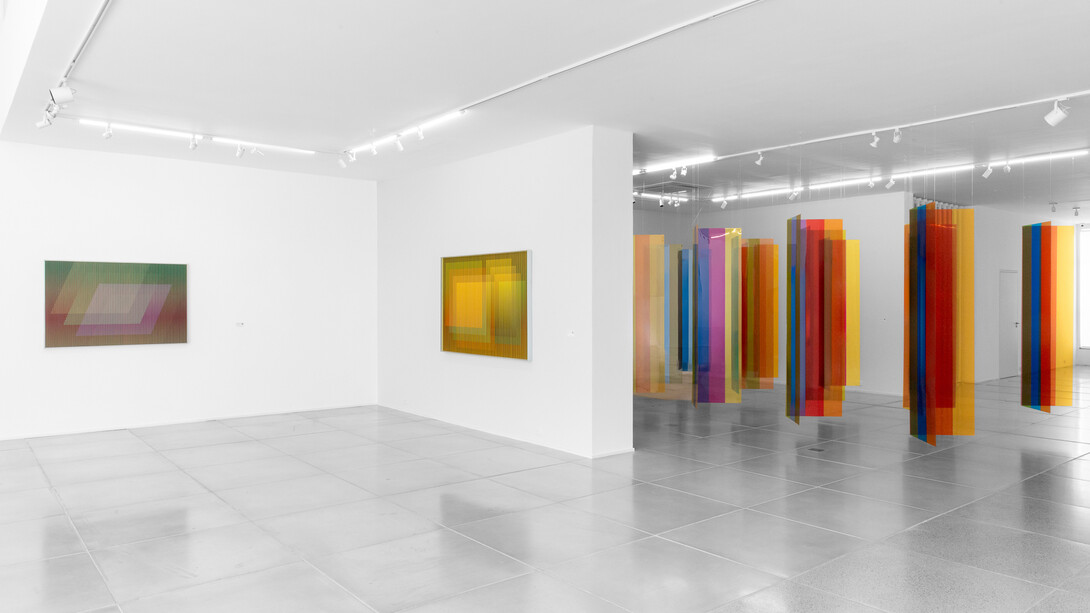
If we ask a city urban citizen: What color is the sky? ... he will answer without hesitation: “It's blue.” ... If we ask the same question to a Pemón indigenous person from the Venezuelan Amazon, he will respond with another question: What time? ... At night? ... During the day?...
In the early 1950s, I felt the need to invent my own discourse, and to do so, I undertook a long and methodical analysis of what had been the art of painting up to that point. I discovered that, over many centuries, the notion of color in art was closely linked to a stereotypical idea. Color was accepted as a mere anecdote of form; because drawing, theme, and “personal style” were more important.
However, the search for information on different physical, chemical, and industrial theories, as well as the reflections of philosophers, artists, and some personal experiences, showed me that color was much more than a simple anecdote of form.
Among these personal experiences, I remember that as a child, while my grandmother served breakfast, the colors of the stained glass window reflected on my body and on the white tablecloth, changing continuously with the intensity of the sun. Many years later, I had another unforgettable experience in the Venezuelan llanos1. Around August, when the sun sets on the horizon, there is an intense saturation effect that changes the color of trees, the earth, objects, and people. Everything is submerged in a monochromatic orange atmosphere that slowly disappears as night falls.
In these episodes, color appeared and disappeared without support; it was not a material applied with a brush onto a canvas. But, beyond that, I observed that the emotion was as intense as that of a painting. At that time, I understood that there was a clue there that encouraged me to seek other solutions and other notions of color in art.
All my work, in its different manifestations, aims to reveal another perception and another delight in the world of color in art. Not as an anecdote of form, but as a fact of transfiguration, a “situation,” an event that evolves from instant to instant during the 12 hours that the sun visits us daily.
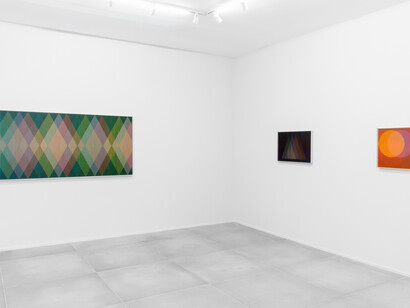
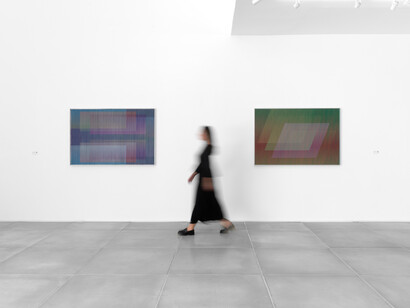
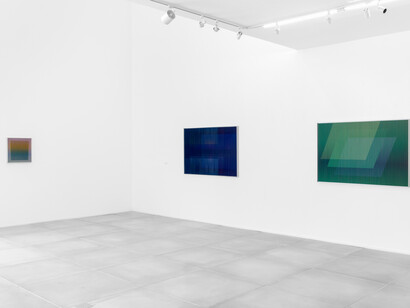
The works on display [...] suggest color forming and dissolving in time and space. They are “supports for chromatic events,” a kind of light trap, where the viewer can discover and stimulate their emotional resonance. In my works, color floats virtually outside the support that contains it. What appears to be a shape is, in reality, a programmed succession of parallel lines that, through accumulation, generate spaces of changing and virtual colors that have not been physically applied.
The proposition of color evolving, constantly appearing and disappearing, produces a dialectic of time and space between the viewer and the work. This dialectic requires a “material support” that highlights the immaterial and gives each work its own character.
The “support,” that is, the actual space, can present a wide variety of solutions, as long as they express and communicate the discourse effectively. All the surfaces I conceive for this purpose create a chromatic spectacle of transfiguration that is independent of the form that contains it. This “form” or “continent” exceeds its simple condition as a shape to give way to the spectacle that is produced and that characterizes and individualizes each of the works.
Through my research, I seek to find non-traditional solutions for the perception of the chromatic world and plastic space. I believe that art is communication, that artists should not only create works for collectors and museums, but should also be present in all areas related to the collective.
I believe that a work of art integrated into the city or habitat should generate unprecedented events in constant flux that prolong “the visual call to a reading in time.”
(Text by Carlos Cruz-Diez)
Notes
1 The Llanos are a vast region in northern South America (Venezuela and Colombia), part of the savanna biome. They are considered a very important ecosystem for both countries due to their suitability for livestock and agriculture.