English
 Español
 Français
 Deutsch
 Italiano
 Português
Human history is a long tapestry woven from intention, instinct, and imagination. Every era leaves behind a fragment of itself: paintings on cave walls, figurines carved in secrecy, flutes made from the bones of vanished animals, and later, gold buried with the dead. As I walk through this journey, piece by piece, I realise that human creativity was never accidental. It was always a reflection of something deeper, a desire to understand ourselves.
After the gold-filled graves of Varna, where hierarchy and identity began to take shape, I expected the next chapter of human civilisation to follow that same trajectory towards power, status, or territorial ambition. Instead, what I found was something entirely different. A civilisation that chose community over conquest, meaning over material, and symbolism over hierarchy.
This was the world of the Cucuteni-Trypillia culture, a Neolithic civilisation that thrived between 5200 and 3500 BCE in present-day Romania, Moldova, and Ukraine. They were Europe’s first creators of mega-settlements, world-class potters, architects of circular societies, and pioneers of ritualistic renewal. Yet, astonishingly, many people have never heard of them.
A civilisation hidden in the soil
The discovery of the Cucuteni Trypillia culture began much like many pivotal archaeological breakthroughs: quietly, accidentally, and in pieces. Pottery shards emerged from ploughed soil, figurines surfaced near riverbanks, and layers of ancient clay appeared beneath modern villages. Slowly, archaeologists realised they were not looking at scattered fragments but at the remains of an entire civilisation, one far more advanced than expected for its time.
What emerged was a portrait of people who lived with intention. They built vast settlements that were structured, organised, and harmonious. They perfected pottery techniques unmatched for thousands of years. They developed spiritual systems with symbols still not fully deciphered. Perhaps most astonishingly, they lived without war.
In a world where human history is often told through battles and conquests, the Cucuteni-Trypillia remind us that civilisation can rise beautifully without violence.
The first proto-cities of Europe
When archaeologists uncovered settlements like Talianki, Maydanetske, Poduri, and Petreni, they were stunned. These were not small Neolithic clusters of huts but proto-cities older than the earliest cities of Mesopotamia. Some housed up to 10,000 to 15,000 people. To put this into perspective, they were larger than ancient Jericho, early Uruk, and settlements of the Indus Valley during the same period.
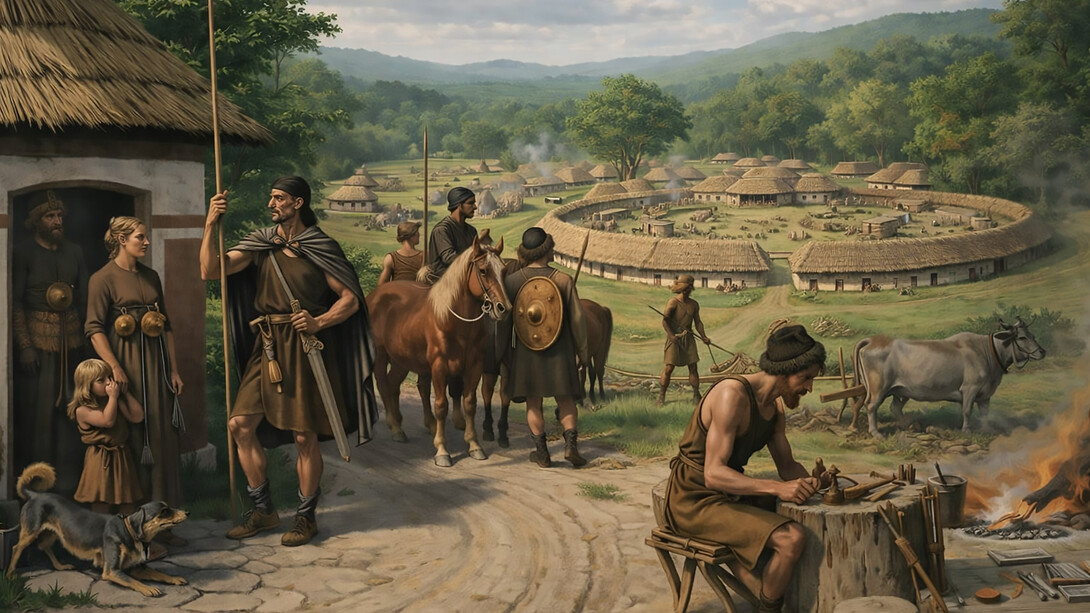
Yet unlike later civilisations that built walled cities with rulers and armies, the Cucuteni-Trypillia people created circular settlements that were symbolic, intentional, and visually striking. Their villages were arranged like mandalas, with houses built in concentric circles, central communal spaces, pathways forming geometric patterns, and storage buildings placed strategically. Each household participated in a collective rhythm.
Their architecture reflected their worldview: life moves in cycles, community is sacred, and order emerges from harmony rather than domination. To think that this level of planning existed 7,000 years ago is both humbling and awe-inspiring.
Art that became a language
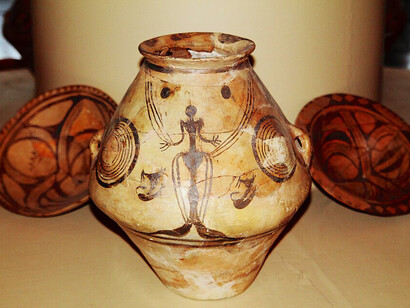
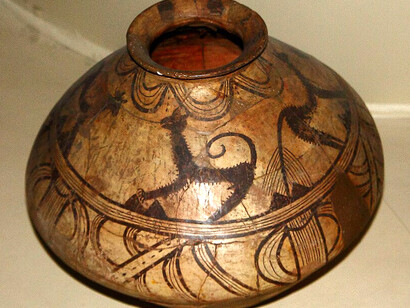
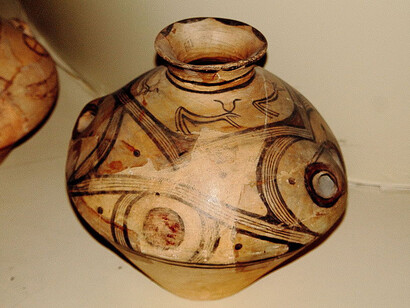
What the Cucuteni-Trypillia left behind was not only architecture but also art that feels alive. Their pottery is some of the most beautiful the ancient world ever created. Long before the invention of the wheel in their region, they shaped vessels by hand – symmetrical, elegant, and painted with extraordinary precision.
Their designs were not random decorations but symbols repeated across generations, connecting households, rituals, and beliefs. Common motifs included spirals symbolising life cycles, meanders representing water and continuity, diamonds possibly linked to fertility or the earth, triangles associated with the feminine principle, and interlocking patterns expressing unity.
The sophistication of their art shows that they were not simply decorating objects but communicating. These patterns formed a visual language shared across hundreds of settlements, suggesting a cultural unity far beyond what we expect from the Neolithic world. When I look at their pottery, I do not see just vessels. I see a meditation, a philosophy, and traces of a worldview where life itself was sacred, cyclical, and rhythmic.
Figurines of the sacred feminine
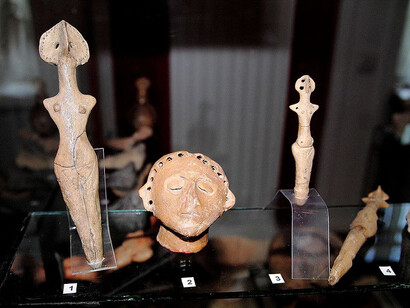
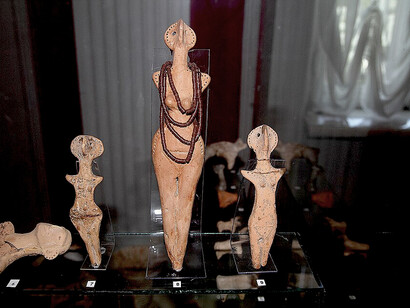
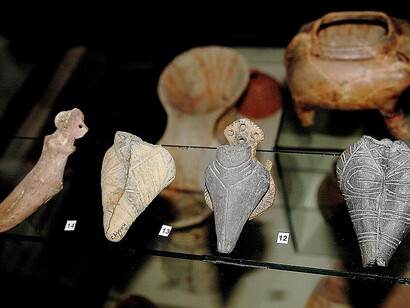
One of the most compelling aspects of Cucuteni Trypillia culture is its deep connection to the feminine. Hundreds of figurines have been found, some pregnant, some seated in ritual poses, some stylised with exaggerated hips or torsos, and others painted in sacred designs.
Unlike the Venus figurines of the Palaeolithic era, which were small and symbolic, these figurines display personality, posture, and ritual intention. They seem to embody not only fertility but also the presence of a maternal force guiding life, agriculture, and community.
Many scholars believe the society may have been matrilineal or at least spiritually centred on women. Unlike Varna, there is no evidence of gender-based inequality. Burials do not show hierarchy, and there are no signs of rulers or elite classes. Instead, society appears balanced and unified. It invites us to question how different human history could have been if we had followed the path of creation rather than domination.
The mystery of the burning houses
One of the greatest enigmas of this culture is the discovery that every few generations, settlements were deliberately burnt. These were not small or accidental fires but full-scale, high-temperature, planned events. Clay floors were found melted into solid ceramic slabs, requiring extremely high heat.
Archaeologists initially believed these settlements were destroyed by invaders or disasters, but evidence showed no signs of warfare, no weapons, no mass graves, and no defensive structures. Instead, the burning appears to have been ritualistic.
Several theories attempt to explain this. One interpretation suggests a ceremony of renewal, where destruction marked a new beginning. Another proposes that burning returned clay to the earth, completing a spiritual cycle. Some suggest a communal rebirth, where entire settlements consciously chose to let go and start again. Others interpret it as symbolic cleansing.
Whatever the reason, it reveals a level of spiritual awareness and collective coordination that challenges our assumptions about Neolithic societies.
A society without war
It is remarkable that a culture of this scale existed for over a thousand years without evidence of warfare. There are no fortifications, no weapons designed for conflict, no mass graves, and no signs of invasion.
This was a civilisation built on unity, ritual, and harmony. It reminds us that human potential is not inherently tied to violence. Civilisation can rise through cooperation, creativity, and shared purpose.
A sudden disappearance
Around 3500 BCE, the Cucuteni Trypillia culture disappeared. There was no clear destruction, no confirmed epidemic, only silence. Possible explanations include climate change, soil exhaustion, migrations, or gradual cultural integration. The truth remains unknown.
They left behind no written language or monumental structures, only their pottery, homes, and symbols. Their disappearance reminds us that even advanced societies are fragile in the face of time and change.
What Cucuteni Trypillia teaches us today
Ancient civilisations speak to us through intention as much as through evidence. This culture teaches that civilisation can grow through community rather than conquest, that beauty can form the foundation of society, and that destruction can be part of renewal. It also reminds us that humanity once chose harmony over hierarchy and that art can carry memory across millennia.
Final reflection
When I study this culture, I feel both awe and sadness. Awe for their creativity, unity, and spirituality, and sadness that such a peaceful civilization could vanish so completely.
Perhaps their greatest lesson lies in what they chose not to build. They created homes instead of palaces, symbols instead of weapons, and communities instead of empires. They lived in a world where art carried wisdom rather than ego and where renewal was embraced rather than feared.
Though their voices have faded, their symbols still speak. In remembering them, we remember what humanity is capable of when we choose creation over destruction, when we build worlds instead of empires.