English
 Español
 Français
 Deutsch
 Italiano
 Português
When we look back at the earliest chapters of human history—Paleolithic caves, ochre paints, stone tools, fragments of bone sculptures—what we often see is survival. Art was guided by spirit, instinct, and nature. Beauty was secondary to necessity, and creativity was woven into the simplicity of life.
But somewhere, thousands of years after cave walls were painted and the first figurines were carved, humanity crossed a threshold. We began building not only tools, but identities. We began wanting not just to live, but to be remembered.
One of the most powerful turning points in this journey lies quietly beneath the soil of modern-day Bulgaria, in a place called the Varna Necropolis—a prehistoric cemetery dated to around 4500–4200 BCE. What was discovered there profoundly reshaped our understanding of early civilization. The site holds the earliest known processed gold in human history, and with it the first clear evidence of social inequality, leadership, trade, symbolism, and the birth of what we now call wealth.
A civilization hidden in the soil
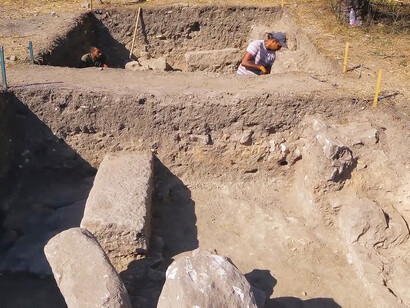
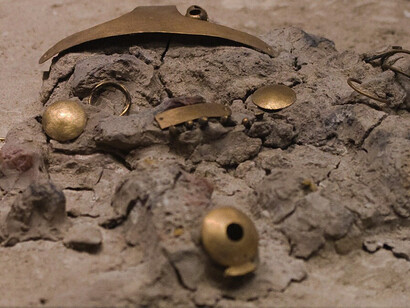
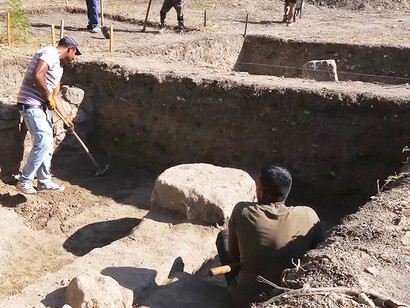
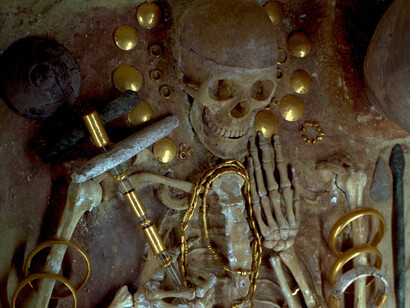
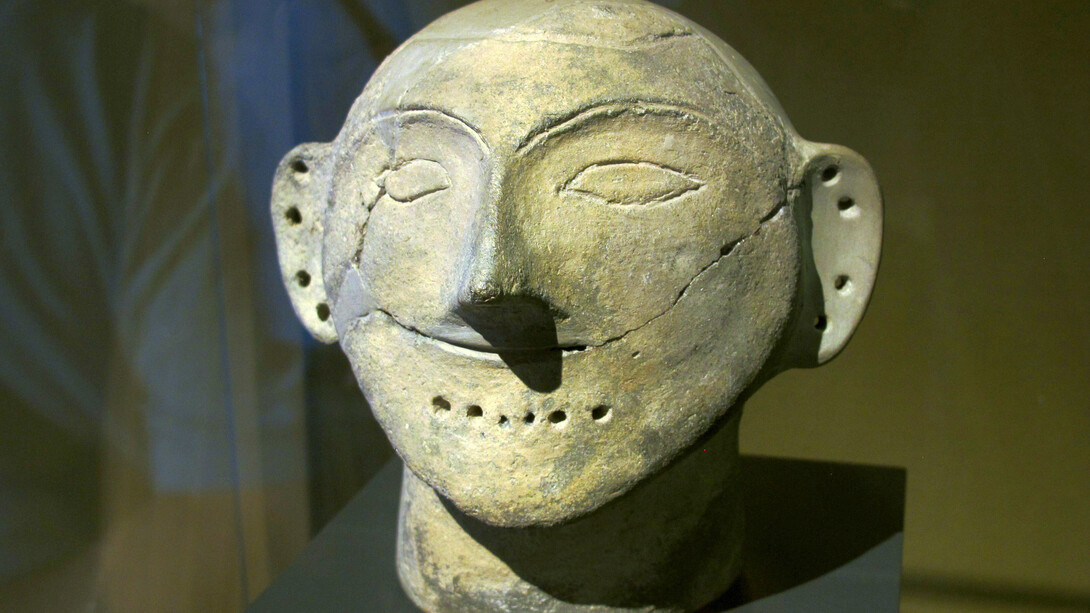
The Varna Necropolis was discovered accidentally in 1972, when a worker digging a trench uncovered bones and unusual artifacts. Archaeologists, unsure at first of the magnitude of the find, began systematic excavations. Over time, they uncovered more than 300 graves containing over 3,000 gold artifacts, along with jewelry, beads, scepters, copper tools, flint weapons, intricate pottery, and symbolic clay masks.
Before Varna, the oldest known gold objects appeared thousands of years later. This discovery rewrote what scholars thought they knew about Europe’s prehistoric cultures. These people did not merely extract gold; they purified it, shaped it, and used it to communicate meaning. Gold was not decoration. It was identity.
The man buried richer than a king
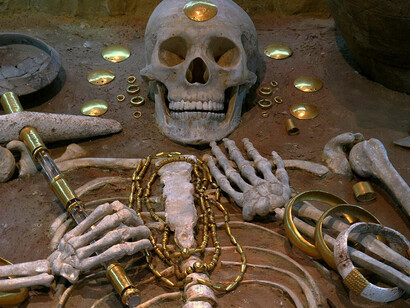
Among the most striking burials was Grave 43, the resting place of a man believed to have held immense power. He was buried with a gold sheath covering his genitals, gold beads woven into his clothing, ornaments around his neck, arms, and head, and heavy copper tools and scepters.
He was not a warrior—his bones showed no signs of violence. Instead, his wealth suggests spiritual authority or leadership rooted in wisdom rather than force. This single grave contained more gold than the entire world would produce in the next thousand years.
This raises an essential question: why did ancient people suddenly value gold? It had no survival function. You could not eat it, hunt with it, or build shelter from it. Its value was symbolic. Humanity had begun assigning meaning beyond necessity. Gold became a marker of prestige, spirituality, memory, and selfhood.
A civilization connected to the world
What is most striking about Varna is that it was not an isolated or primitive settlement. The people buried there were connected—culturally, spiritually, and economically—to distant lands. Mediterranean Spondylus shells, found among the graves, originated hundreds of kilometers away in the Aegean Sea. Copper tools came from mountain regions far beyond Varna. Pottery styles echoed those of other communities.
Varna was not merely a cemetery; it was evidence of an emerging global consciousness. People traveled, traded, and exchanged not only objects but ideas and beliefs. This challenges the notion that early societies were simple or isolated. They were organized, curious, and interconnected long before cities or empires emerged.
Trade gave birth to communication. Communication gave birth to culture. Culture gave birth to identity.
The beginning of inequality
Not every grave at Varna was filled with wealth. Many were modest, containing only pottery or a single copper object. Some were symbolic graves—richly decorated with gold but containing no human remains at all. These may have been ritual offerings or memorials for the absent dead.
Here we see both the birth of identity and the birth of inequality. Some lives were elevated and remembered. Others passed quietly. For the first time, archaeology allows us to observe how humans judged honor, status, and worth.
Before Varna, prehistoric societies appeared largely egalitarian. By 4500 BCE, this had changed. Specialized roles emerged—spiritual leaders, metalsmiths, traders. Trade networks expanded. Rituals and class divisions formed. Humanity had begun building structured society, and with it came power, ownership, and inequality.
When wealth became identity
What makes Varna a spiritual landmark—not just an archaeological one—is what it reveals about human consciousness. Gold here was not currency. It was legacy. It existed to say: I was here. I mattered.
Isn’t that impulse still with us? We build monuments, careers, collections, and reputations, often driven by the desire to leave something behind. Varna is not about gold. It is about ego, self-importance, and the belief that some lives hold more weight than others.
And yet, the richest grave and the simplest grave were both sealed by earth. Both returned to silence. Both were equal in death.
Perhaps this is Varna’s greatest message: humanity created wealth to feel powerful, but in the end, the earth reclaims everything.
What Varna teaches us today
Varna is a mirror—not of who we were, but of who we still are. We still chase symbols of success. We still build hierarchies. We still measure worth through possessions. Yet beneath all this lies something softer: a desire to be remembered, a longing for meaning, a hope that something of us will outlast our bodies.
From cave paintings to gold necklaces, from ochre-covered bones to digital footprints, humans have always tried to say: This was my life. This was my story.
Some scholars believe the scepters found at Varna symbolized spiritual authority, not violence. Others interpret the masks and artifacts as evidence of belief in an afterlife. If so, Varna did not just reveal wealth—it revealed faith.
A whisper from 6,500 years ago
Every time I think of Varna, I imagine the silent cemetery by the sea. Hundreds of lives, buried beneath time. Their names are forgotten, their faces unknown. And yet, they are remembered—in gold, in pottery, in tools worn smooth by human hands.
Perhaps that is why Varna feels so modern. Even today, we are driven by the same impulses: to connect, to exchange, to express ourselves through what we create. From shells carried across seas thousands of years ago to digital messages crossing the world in seconds, humanity has always reached outward.
Varna is not a symbol of wealth. It is a symbol of connection. And in that sense, those buried there succeeded in what we all quietly hope for—to be remembered.