English
 Español
 Français
 Deutsch
 Italiano
 Português
Giving thanks is something truly wonderful. Feel gratitude for receiving, for sharing, and for the opportunity to give. Give thanks for being alive and enjoying good health, for your loved ones, for your family, and even for your neighbors. Give thanks for love or forgiveness, and for the possibility of experiencing them. Give thanks for recognizing and accepting our circumstances, and give thanks for the opportunity to change them. Feel gratitude toward God for all of this; live it and help others to feel it as well. When human beings come to know themselves and to recognize their fellow human beings and God, they feel gratitude. In its essence, gratitude is a privilege.
Nowadays, gratitude is celebrated in many corners of the world. In fact, the universal Catholic Church has practiced constant gratitude in every Mass celebrated throughout history. Although the exact origins of this holiday remain a subject of debate, we know that the celebration known as Thanksgiving has deeply American roots. That is indisputable. There is evidence of at least five historical events that support this claim—all North American.
For such events to be included on that list, they must meet the three fundamental principles that characterize the celebration: an encounter between Europeans and Native Americans with the purpose of giving thanks to God for blessings received, and, in the process, an exchange between the two cultures, primarily through food. The American Thanksgiving is, in essence, a celebration that emerged from a cultural blend.
This last point is important, since its origin has often been confused with the simple act of giving thanks for an abundant harvest before the arrival of winter. Such a gesture has been a common and universal practice; throughout history, almost all societies have thanked their gods for the blessing of a successful harvest. In Germany, Austria, and Switzerland, there are official celebrations of this type, known as Erntedankfest. Similar celebrations commemorating productivity and abundance take place in Japan (Kinro Kansha no Hi), China (the Moon Festival), India, Ghana, Saint Lucia, and elsewhere. The real Thanksgiving is not about that.
The first meeting of mutual thanksgiving to God on the American continent took place on September 8, 1565, in St. Augustine, Florida. That day, Pedro Menéndez de Avilés, a native of Asturias, Spain, founded what would become the oldest continuously inhabited European settlement in the United States. To commemorate the occasion, the Spanish invited the Timucua people to share a meal after celebrating a Mass in which they gave thanks for their successful arrival and establishment on that coast. The Spanish menu included a pork stew with garlic and chickpeas, accompanied by wine and hardtack, while the local inhabitants contributed fish and corn. Michael V. Gannon, professor emeritus of history at the University of Florida, has defended the thesis that this was the true "first" Thanksgiving.
Subsequently, on July 22, 1578, the crew accompanying English explorer Martin Frobisher on his third voyage gave thanks to God for having arrived safely on solid ground on Baffin Island, in Nunavut, Canada, a feat made possible with the help of some Indigenous people. They shared a meal consisting of salted meat, mashed peas, and ship's biscuit. The explorer himself held a similar celebration in 1609, during his fourth and final voyage to the region. Later, in 1606, Samuel de Champlain introduced his own version of the celebration in New France (a region corresponding to present-day Quebec), and since 1957, modern-day Canada has observed this holiday on the second Monday of October.
The fourth celebration took place on April 30, 1598, near El Paso, Texas. The Spaniards, led by the adelantado Don Juan de Oñate and accompanied by Tlaxcaltecan Indigenous people, held a Mass and a thanksgiving ceremony on the banks of the Rio Grande to commemorate their survival following the perilous journey they had just completed. On this occasion, they shared fresh fish from the river, as well as wild geese and ducks. This account is presented by historian Sheldon Hall, founder and president of the El Paso Mission Trail Association.
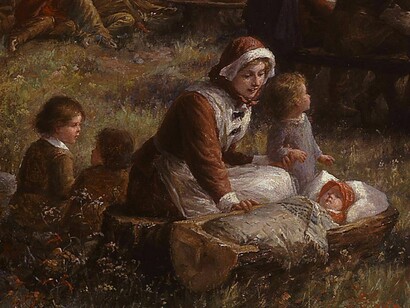
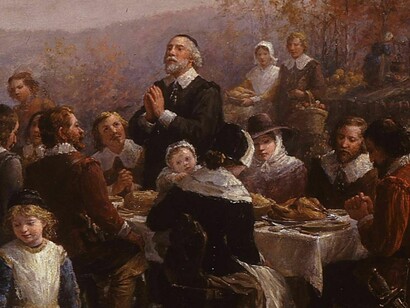
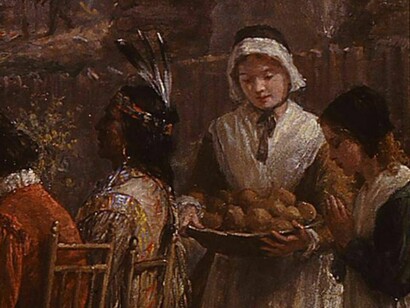
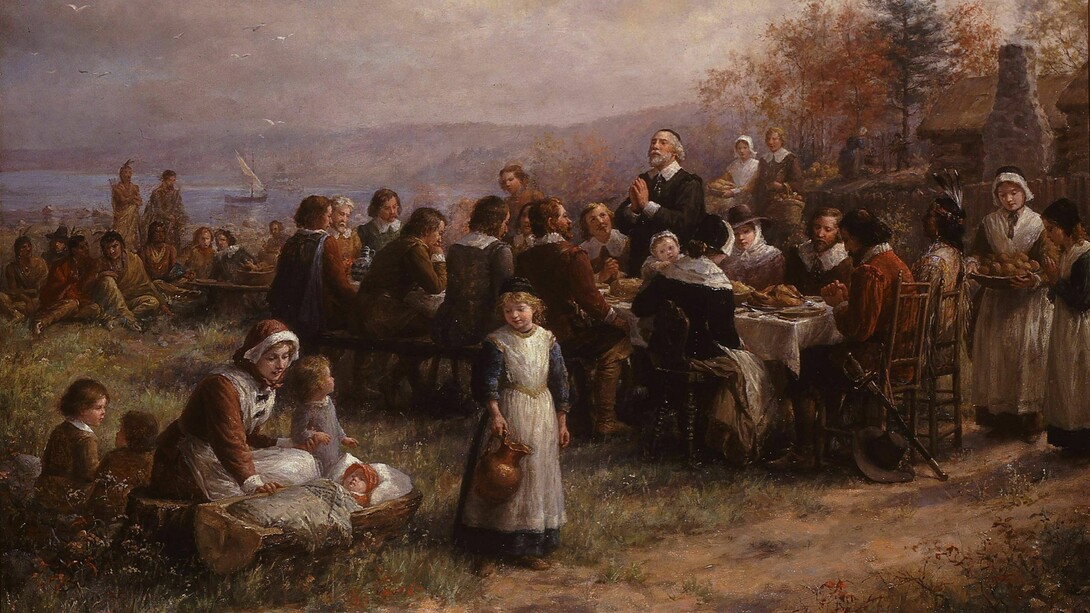
The best-known and most memorable of all these celebrations took place in the autumn of 1621 in Plymouth, Massachusetts, in New England. The Pilgrims celebrated alongside the Wampanoag tribe, who that year had managed to prepare better for the approaching winter, following a year in which many of the colonists who had arrived aboard the Mayflower in 1620 had perished. The feast on this occasion consisted of venison, fish, shellfish, eels, and game birds—all of which were foods obtained from the wild—accompanied by corn.
At the request of Congress, George Washington, a Founding Father and the first president of the United States, proclaimed a day of celebration for Thursday, November 26, 1789. At that time, only New York formally adopted it, as its observance was optional for the states that made up the American Union. However, it was not until 1863, when President Abraham Lincoln established it as a national holiday to be observed on the fourth Thursday of November each year, that it gained widespread and universal popularity.
During the American Civil War, President Lincoln needed a foundational narrative for the Northern states. He wanted one that, following a victory over the Confederates, could serve as a founding myth for a new version of the American Union. The Southern states, at the beginning, viewed the celebration as too "Yankee." However, the narratives surrounding Thanksgiving that emerged in the Southern states, such as those in Texas or Florida, were of no use to him; furthermore, they belonged to a Hispanic culture—ethnically mixed and predominantly Catholic—which, at the time, was perceived as alien to the prevailing American identity, an identity that was largely Anglo-Saxon, Protestant, and composed, for the most part, of a population of European origin. To address this, he revived the founding myth of New England, which, at the very least, incorporated elements of cultural blending and the emergence of a new society.
The visionary behind this celebration had already worked extensively to popularize Thanksgiving dinner, viewing it as a crucial step toward fostering unity between the Northern and Southern states. With the 1827 publication of Northwood: A Tale of New England, the first American novel written by a woman, Sarah Josepha Hale launched a deliberate cultural campaign. This effort ultimately influenced President Abraham Lincoln, in part due to a chapter in the book that describes preparations for the holiday, with a particular focus on the turkey. Later, Hale became the editor of Ladies' Magazine and Godey’s Lady’s Book; through these publications, she continued to disseminate articles, recipes, and other content that shaped the customs and aesthetic of the American Thanksgiving as we know it today.
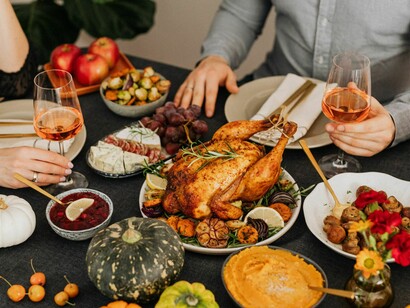
The typical menu we enjoy today has its own internal logic, even though it differs considerably from many of its original versions. In fact, we do not even know for certain whether wild turkey was served at the 1621 feast. This bird, known as guajolote in Mexico and pavo in Spain, is the centerpiece of the modern Thanksgiving meal. It was originally brought to Europe from New Spain by the Spanish, and the British dubbed it "turkey," mistakenly believing it came from Turkey. Those who shaped the foundational Thanksgiving celebration in the United States chose, as the star dish of their feast, a bird of Mexican origin: a species introduced to the rest of the world by Spain and to which the British assigned its English name.
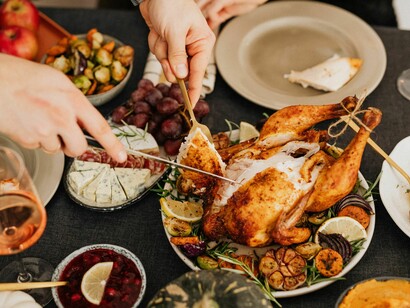
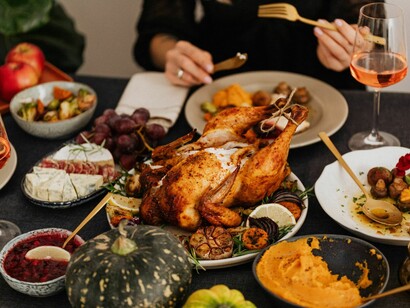
In the United States, the consumption of farm-raised turkey became popular, gradually displacing dishes made with game meat or fish. Since roasted turkey can sometimes turn out a bit dry on the inside, it is often served with its own concentrated juices, prepared as a gravy, or with stuffings made from breadcrumbs, vegetables, raisins, prunes, or nuts, sometimes combined with other meats, such as pork, to enhance the bird's flavor. Another common accompaniment is cranberry sauce, perfect for those who enjoy a touch of sweetness alongside their turkey. Mashed potatoes, sweet potatoes, green beans, and traditional cornbread round out a menu that is quintessentially American.
After the meal, any leftover pumpkins from Halloween, along with a surplus of apples, pears, nuts, and other fruits or dried produce (regardless of whether they were in season), were used in making pies for dessert. Meanwhile, in the context of the "Tea Party" movement, which rejected English tea as a hot beverage, coffee began to gain ground over hot chocolate, a drink with more Hispanic roots. In any case, for those of us fortunate enough to have experienced an authentic Thanksgiving dinner in that country, it remains a delightful and unforgettable family experience.
In the United States, since 1970, many Indigenous communities have gathered to reflect on what is known as Thanksgiving, observing it instead as a "National Day of Mourning," because they believe that what Thanksgiving purports to celebrate was very short-lived. For these groups, the process of conquest, epidemics, colonization, displacement, racism, and genocide—all brought about by the arrival of Europeans in North America—is not something that deserves to be commemorated.
They are largely right. However, the very same people who feature in these five stories—accounts of tolerance, harmonious coexistence among neighbors, and the solidarity that emerges from sharing—are also linked to episodes of marginalization, persecution, and abuse directed at local Indigenous populations. There is, nonetheless, a significant difference, which you will soon notice, in how these individuals were treated by their superiors, or by the nations they represented, in the wake of their actions.
The English explorer Martin Frobisher was involved in incidents that included kidnappings, armed clashes, and the deaths of captured Indigenous people. Samuel de Champlain, after introducing firearms into Indigenous communities, became embroiled in intense conflicts with them that resulted in death and destruction throughout the regions colonized under his authority. Meanwhile, William Bradford, leader of the Mayflower Pilgrims, served as governor of the Plymouth Colony and ordered massacres—documented, for instance, in 1623 and 1636—some of which were carried out by another Mayflower Pilgrim, Captain Myles Standish. None of these men were ever held accountable, as the legal systems of the royal houses they represented, as well as the local governments, did not classify such abuses as crimes. They were never brought to trial, let alone convicted for their injustices.
Furthermore, Don Pedro Menéndez de Avilés employed coercive diplomacy, the taking of hostages, and armed violence against the Indigenous populations of Florida. His most violent military campaign was directed against French Huguenot settlers, whom he viewed as invaders; he was subsequently accused and tried in Spain in connection with administrative and customs-related disputes with the Crown. Similarly, Don Juan de Oñate was accused, tried, and convicted for his excessive cruelty toward the native populations of New Mexico. This serves as further evidence that the Spanish Crown maintained a legal framework intended to protect Native Americans—laws that, in many instances, were effectively enforced.
The current situation of Indigenous peoples is considered by many to be deplorable. Groups advocating for Indigenous rights have seized upon this juncture to stir up sentiment. However, the reality is that, at least within the Hispanic world, and to varying degrees, cultural and ethnic mixing has given rise to the present-day Ibero-American population. In many parts of North America, such as the states of Washington, Oregon, Montana, North and South Dakota, Arizona, and New Mexico, among others, as well as in Canada, a certain degree of ethnic and cultural blending has occurred, though to a significantly lesser extent than what was documented in the Hispanic American viceroyalties. In Ibero-America, we are all, to a greater or lesser degree, mestizos or mulatos—unless, of course, one happens to be a criollo (a person of Spanish or European descent) who has recently arrived.
Since 1934, American football and Thanksgiving Day have been linked in the United States. At the same time, traditional parades, such as the one sponsored by the department store chain Macy’s in New York, along with the now-popular "Black Friday" (which originated in Philadelphia), effectively mark the beginning of what remains the most important holiday of the year in commercial terms: Christmas.
The American version of Thanksgiving is officially celebrated in Liberia, Puerto Rico, Brazil, and Grenada. Unofficially, similar celebrations take place in Mexico, the Philippines, and the Netherlands; the latter case is unique, as it commemorates the period between 1609 and 1620, when the Puritan Pilgrims of the Mayflower found refuge in Leiden before eventually emigrating to what would later become New England, in the United States.
In Costa Rica, we are officially celebrating our own version of Thanksgiving for the fifth consecutive year. Inspired by the holiday as observed in the United States, this celebration was approved by Congress on March 15, 2022. We hope that these celebrations, both in Costa Rica and elsewhere throughout the Ibero-American world, will serve to highlight the profound mestizo cultural essence of this act of giving thanks—an expression rooted in the distinctively Hispanic spirit of mutual respect, solidarity, and equality before God, values that the Hispanic world, with its universal vocation, has always exemplified.