English
 Español
 Français
 Deutsch
 Italiano
 Português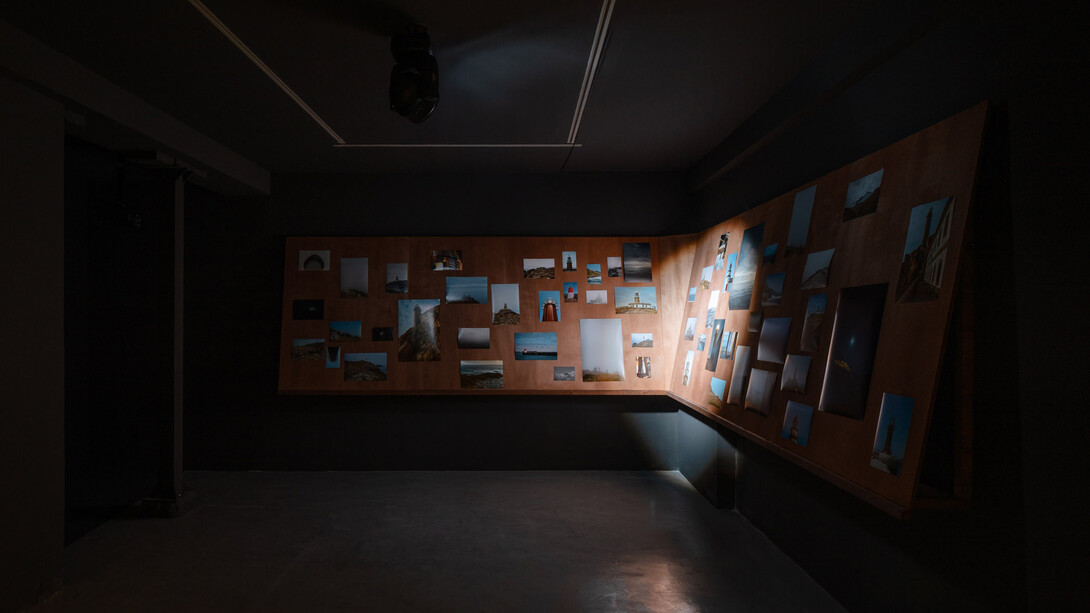
Gonzalo Lebrija and Jorge Méndez Blake went to the Costa da Morte and brought back something they did not know they were looking for: lighthouses. Or rather: one imaginary lighthouse, made up of little bits of all the lighthouses—like a synthesis of all of them into one. They could have gone to Cornwall or Brittany or Cork, even to Tierra del Fuego or Nova Scotia, without bringing back the lantern of Lariño, or the sirens of Finisterre, or the light of Silleiro, and instead bringing back other lanterns, other sirens, and other light beams, and the result would have been much the same. Is what we feel when we look out onto the sea from any of the lighthouses mentioned really different from what we feel at any other lighthouse? Thinking that the answer is “yes” would turn us into mere stamp collectors. It is not the case.
Before continuing, a couple of notions to guide us: the Spanish word “faro”, like its equivalent in other Romance languages, derives from the Greek name of the Egyptian island where the lighthouse of Alexandria once stood. In English and other Germanic languages this isn’t the case, but the lack of pedigree is compensated by the inclusion in the corresponding vocabulary of something essential to any lighthouse: light. The light of the larger lighthouses is usually white, although some are red or even green. Each lighthouse has its own flashing pattern. The Finisterre one emits a flash every 5 seconds with a rhythm of L 0.3 Oc 4.7; the one at Cabo Vilán does so every 15 seconds with a rhythm of L 0.5 Oc 3.5 L 0.5 Oc 10.5; the one at Touriñán gives three flashes every 15 seconds with a rhythm of L 0.2 Oc 2.2 L 0.2 Oc 6.1 L 0.2 Oc 6.1; the one at Punta Insua (which has white and red lights) flashes three times every 9 seconds with a rhythm of L 0.5 Oc 1 L 0.5 Oc 1 L 0.5 Oc 5.5; and the one at Corrubedo (which also has white and red lights) flashes five times every 20 seconds with a rhythm of L 0.4 Oc 6 L 0.4 Oc 2 L 0.4 Oc 6. There are also other types of lighthouses—offshore, port, island—but the lighthouse we all have in mind is the coastal one. Many of them, along with the light, had a foghorn for misty days, which sounded like the sad roar of a chained mythological sea monster. Regarding the Finisterre one, which I’m not sure is still active (the line between past and present is especially blurry in anything lighthouse-related), it is known as La vaca de Finisterre.
Except for the members of an isolated Amazonian tribe or similar cases, it is impossible to visit a lighthouse without a preconceived idea—or a romanticized or stereotyped one—of the sensations it will evoke. The sad thing is that, no matter how we try to frame it, we leave with these ideas firmly in place. On one side, its photogenic nature, its solitude, its daring defiance while facing an environment that overwhelms it; on the other, a horizon that is imposing—whether calm or turbulent—to those who gaze at it. With very few exceptions, before even realizing it, we will be thinking about our small, fragile existence; about mortality, and about the vastness of the universe in which we are contained. As José Carlos Llop says in Si una mañana de verano, un viajero: “Every Finis Terrae places us in front of ourselves, pours out our own void.” The more isolated the location, the more dangerous the sea, and the more abrupt the coastline, the more deeply we feel questioned. George Borrow, although he sold Bibles and was not inclined to fall into exalted states of sensibility, wrote the following in The Bible in Spain, regarding his passage through Finisterre, contemplating a landscape identical to the one he pictured as the end of the world as a child: “Oh image of our grave, and of those fearful paths which lead thereto! The wilds and deserts which I have traversed are like the rugged and melancholy ways of our existence. Cheered by hope, we struggle with every obstacle—the mountain, the morass, and the thorny brake—that we may reach what?—the tomb, and its awful verge”.
Among the books about lighthouses that I have read—there seems to be a genre of its own—one of my favorites is “Cuaderno de faros” by Jazmina Barrera. It’s a modest essay, a youthful approach, but it is full of discoveries. This one, for example: “If the lighthouse is a solid tower of light, its opposite would be the well: an inverted tower of liquid darkness”. The comparison is more than eloquent. Both are products of human ingenuity; one guides navigators, the other gives water to drink. There is, however, one difference: the lighthouse, so long as it remains lit, never betrays the purpose for which it was built, whereas the well can send us free-falling into a darkness deeper than that found at sea.
However, the lighthouse is far from harmless. The lighthouse is vertical; at sea, although caressed by waves, we perceive it as horizontal. The lighthouse is the work of humans; the sea was here before us, and will be here after us. The sea is liquid, changing, in motion, while the lighthouse is solid and static. The lighthouse’s daring challenge tears away the veils and places us in front of primordial existence. The ambivalence of water: so necessary, yet also a source of danger. Light and darkness: intimate, friendly even, impossible to disassociate, yet clearly distinct; dawn, the Homeric “rosy-fingered dawn,” and the sunset in which Julio Verne and Éric Rohmer have led us to believe we might glimpse the green ray; the hope of those who find a light in the prison of night, and the unease of those forced to navigate in blindness. The often imperceptible distance between life and death.
Almost everyone who knows the ocean has been in, or near, a lighthouse. The fascination about lighthouses is similar to the fascination about cemeteries. There is lighthouse tourism just as there is cemetery tourism. I wonder which is more popular. Maybe both derive from the same army of eccentric individuals. If that were the case—I doubt so—the most popular places would be those that combine both functions. I know a few, but none on the Costa da Morte. Maybe it’s because here the cemeteries are like lighthouses already, overlooking the oceanic abyss.
Just like the lighthouse, the cemetery is a frontier territory. Whether or not we believe in God, it resembles a threshold between our earthly existence and the extramundane, between mortality and eternity, between the corruption of the body and its eventual forgetting. The lighthouse, in its own way, stands between two worlds that do not always coexist peacefully. From the land it gazes toward the sea, ensuring that the passage from one to the other is as gentle as possible.
There is something about lighthouses that I have not yet mentioned: since we are not sea people, used to entrusting our survival to them, in general, when we think of lighthouses, we think of them in daylight—when they are not performing the function for which they were conceived. Souvenirs and bad paintings often depict lighthouses in full daylight. Who has been at a lighthouse at night? The collector of sunsets usually leaves the place as soon as the sun is gone.
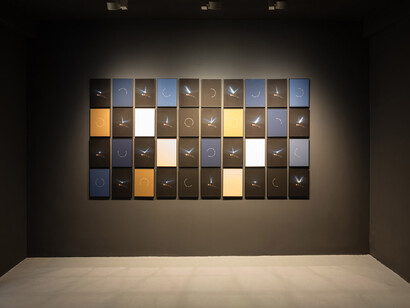
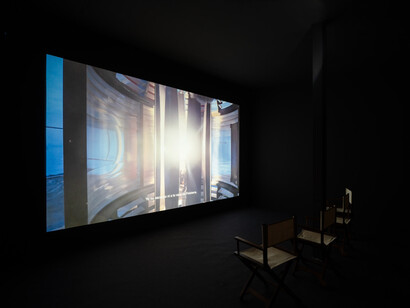
Jorge Méndez Blake and Gonzalo Lebrija have traveled to the Costa da Morte at night precisely for that reason: daytime infatuation gone, mysteries reveal themselves in their full indecipherability. The candle that once gave light before it was snuffed out, the incandescent silhouette of a boat crossing the horizon, the luminous crown of a tower in the middle of the Atlantic, the imagined conversations between sailors and lighthouse keepers… without their cold presence, without their Beckett-like solitude, without their words—or our own—to point out what transcends us, Finisterre would not even have a name. As stated in one of the dialogues of the exhibition: lighthouses, fractions of hope, flickering over the horizon. “The fog surrounds us,” says one sailor in the same dialogue. “And our light traps us in it,” answers another.
(Fracciones de esperanza palpitan, by Marcos Giralt Torrente)

![Various artists, El lado caliente [The warm side], exhibition view. Courtesy of Travesía Cuatro](/attachments/9e461736d4173e61813478d40c123fe4286f2231/store/fill/330/330/c723f24f391b905508810f019aa9f3359fe01b06910c916d52200a570a76/Various-artists-El-lado-caliente-The-warm-side-exhibition-view-Courtesy-of-Travesia-Cuatro.jpg)