English
 Español
 Français
 Deutsch
 Italiano
 Português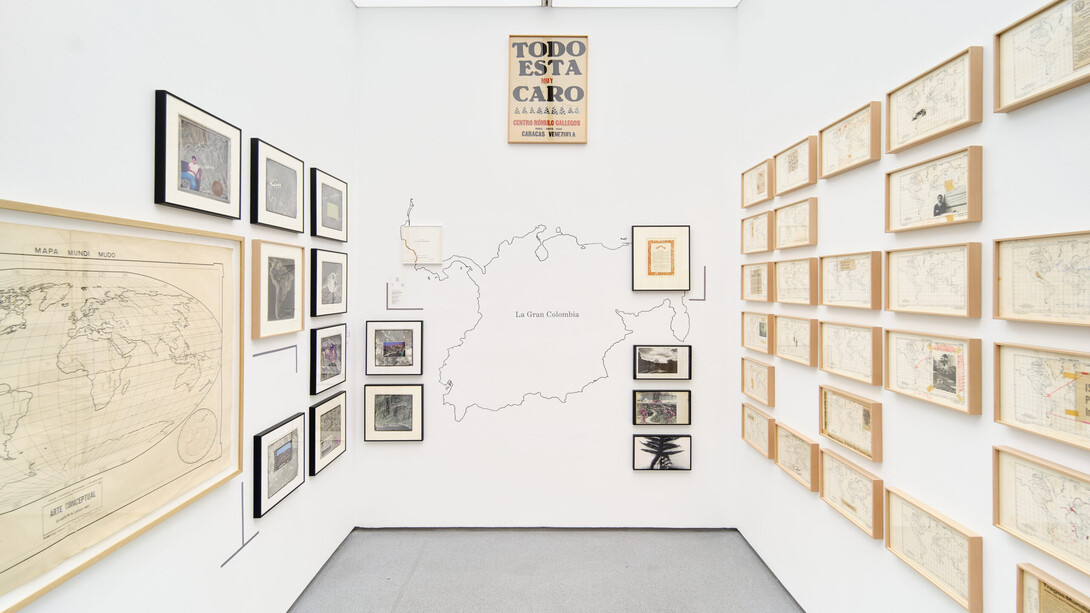
Conceptualism in Latin America emerged in the mid-1960s with its own specific characteristics, led by a group of pioneering artists who boldly challenged the prevailing avant-garde canons dictated by interwar Europe. Among the most significant figures were Claudio Perna in Venezuela and Antonio Caro in Colombia, who proposed a conception of territory informed by social, national and ecological perspectives that foreshadowed an art of the Global South.
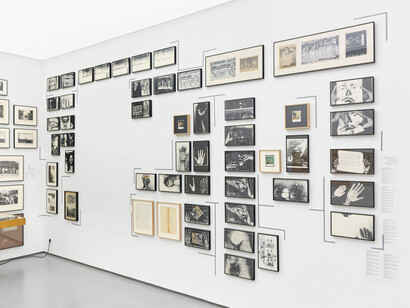
Claudio Perna Fermín (Italy, 1938 – Holguín, Cuba, 1997) was born to an Italian father and an Afro-Venezuelan mother. He moved to Venezuela in his late-teens, taking with him only a camera and the certainty that he would find his identity in this Land of Grace. He acquired citizenship when he turned eighteen Antonio Caro (Bogotá, Colombia, 1950-2021) grew up marked by a visual impairment that ran counter to his artistic vocation, and by a stutter that obstructed fluent expression, thus explaining his preference for non-conventional languages. Although Caro was twelve years younger than Claudio, they coincided in their concerns for a new kind of art in terms of motivations and methods. They rejected scholastic artistic education and, despite enrolling in formal art studies, they soon abandoned them on discovering that they fell short of their goals, choosing instead to explore experiential learning and creative ferment. Between 1964 and 1967, Perna was influenced by the artist Alejandro Otero and found in photography a vehicle to carry out his first conceptual experiments: Directed Photos and Photos as Concept.
In his book Didáctica de la liberación: arte conceptualista latinoamericano, the Uruguayan artist and critic Luis Camnitzer claimed these works were the beginning of conceptualism in Latin American; he also called Antonio Caro a “communication guerrilla.” Perna dropped out of university and travelled to the USA to study English. There he visited museums, mentored by the Cuban lawyer and art critic José Gómez Sicre.
At the same time, Caro travelled to several Latin American countries and worked in an advertising company, where he learned graphic and propaganda techniques.Influenced by the work of the Colombian artist Bernardo Salcedo (1939), Caro became his disciple and transitioned to artistic creation. Thanks to Salcedo, he came to realize that art was more than painting. Perna returned to the Universidad Central de Venezuela, where he graduated as a geographer. He went on to teach there, integrating geography into art as a unified whole, equating Art=Life=Science. Antonio Caro first made his name on the Colombian art scene in 1970, at the 21st National Salon, when he exhibited a bust of President Lleras Restrepo made of salt inside a glass container, which the public had to dissolve with water. Instead, the liquid spilled onto the floor, causing confusion among the public. The press covered the incident, labelling the artist as an enfant terrible. Claudio Perna, in turn, applied to take part in an official salon in 1966, submitting two minimalist Arte Povera works. When they were rejected, he decided never to submit work to salons again, convinced that critics were unable to understand new art.
Three years after presenting Sal, Caro was also rejected by the National Salon. In response, he invited the press to document his performance Defienda su talento (Defend your talent), which consisted in slapping the critic who had rejected his work. Caro and Perna embraced popular screen printing, producing T-shirts following Perna’s ideas of Art to Wear and Domestic Art, creating works from found materials. They borrowed methods from advertising. Claudio enlisted cinema billboard painters to produce his Instruction Paintings. Caro reproduced his ideas on billboards and posters with kraft paper, deploying witty, homographic slogans such as Todo está muy Caro, a sarcastic play on his own surname. Perna likewise transformed his first and last name into conceptual tools, creating works such as Vida E’Perna, Claudillismos, and his story La lámpara de Claudino. He used these strategies to forge a conceptual identity, producing a Pernian lexicon with over 300 registered concepts.
(Text by Luis Emeterio González)