English
 Español
 Français
 Deutsch
 Italiano
 Português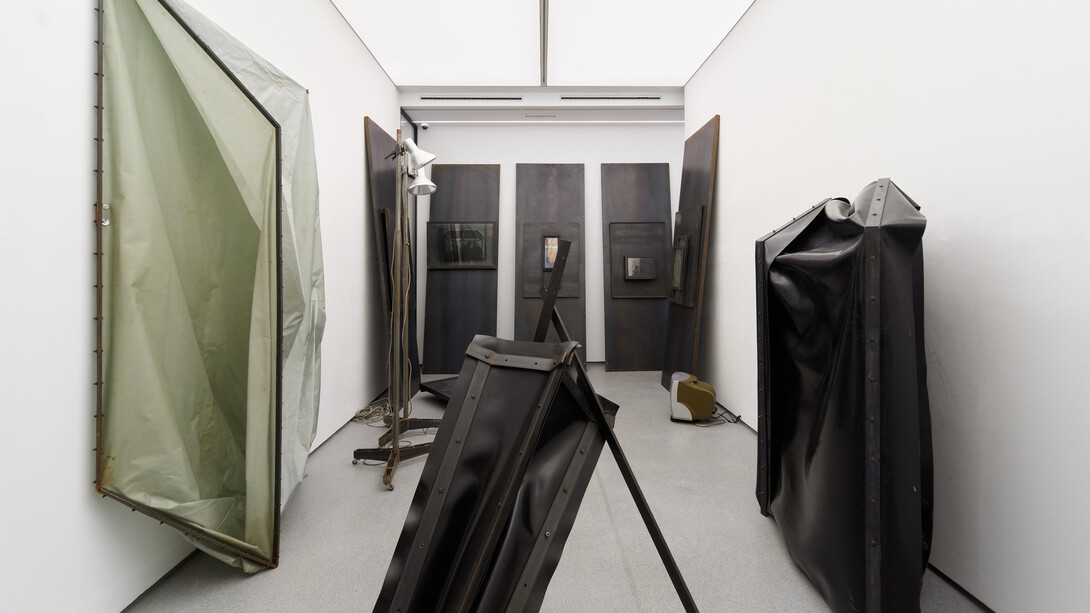
When he died in 1995, Gilles Deleuze left behind “Immanence: A Life” a final writing that once again placed the question of the power of life at the centre of his thinking. This essay was intended to be a chapter in a larger, unfinished project called Ensembles and multiplicities. As we shall see later on, this notion runs throughout the intellectual and artistic trajectory of Ángeles Marco (Valencia, 1947–2008). Contemporary historiography has assigned Marco to what it calls New Spanish Sculpture, which is essentially a period that began in the 1980s and reached its zenith in the 1990s, which ushered in a new vision of sculpture that, as several historians have argued, became a new artistic horizon. The main contribution of this generation of sculptors was to introduce an innovative relationship between form and concept, each one through their own individual approach. Marco’s practice cannot be separated from post-minimalist and post-conceptual positions which would, in turn, inspire later generations.
Throughout the course of her life’s work, Ángeles Marco turned to philosophical thought for many of her projects, co-opting its conceptual complexities and developments. In fact, one might say that her own thought process unfolded in parallel with the words of Derrida, Deleuze or De Man, as well as Heidegger and Sartre, and also of her good friend and doctoral advisor, the renowned professor and aesthetician Román de la Calle. Nonetheless, her reflection took material form through the act of sculpting with her hands. It is generally accepted that in her series Suplemento (Supplement, 1990–1992), Marco enlarged upon some of the ideas Jacques Derrida had posited in his Of grammatology; and that she explored the performativity of the self and the construction of language in her series Presente / Instante (Present / Instant, 1991–1992). That being said, here, however, I would like to underscore her conceptual affinity with Deleuze’s Difference and repetition, which is absolutely key for a proper grasp of Marco’s practice. But first let us return to the essay by Deleuze I mentioned at the opening of this text, in which immanence is not contingent on an object or a subject, but on life itself. “We will say of pure immanence that it is a life, and nothing else. It is not immanence to life, but the immanent that is in nothing is itself a life. A life is the immanence of immanence, absolute immanence: it is complete power, complete bliss” (Deleuze, 2001, 27). In Ángeles Marco’s work, that life, pure energy, is in her diamond-like assemblages, material couplings, sensitive weldings and configurations poised between the real and the illusory, or between fiction and the fullness of the void. Grounded in new materialisms, this reading was behind a profound interest in how her projects revolve around the virtuality and the potential of material. In this sense, we can observe, from her earliest works to those completed towards the end of her life, an uninterrupted vital circuit that suffuses her whole production with a mobile energy. And while Marco defended the activation of her works through the viewer’s experience, this too is part of the same energy, life, that in a single instant ‘vibratorily’ connects artwork, viewer and sculptor in an agential assemblage (Jane Bennett, 2010). In this sense, El péndulo de oro (The golded pendulum, 2006), Marco’s final work, gravitates within that orbit of Deleuzian immanence.
The other Deleuzian concept that springs to mind in relation to Marco is that of ‘ensembles and multiplicities’. This would dovetail with the overarching structure of her career, built around her series, which, while subject to a certain regime of unfinishedness, were always open to dialogue with their creator’s experimentation. There is a thread running through them, and not just in the way she named them—some of which share or repeat concepts—but also in terms of the transversality that undergirds her entire production. There is in fact one thing that unites her series and that is a mise en scène that awakens the activating potential of the works, which is precisely where their virtuality resides. And so, matter unhitches itself from reification and becomes possibility. After all, “a life contains only virtualities. It is made up of virtualities, events, singularities. What we call virtual is not something that lacks reality but something that is engaged in a process of actualization following the plane that gives it its particular realization” (Deleuze, 2001, 31).
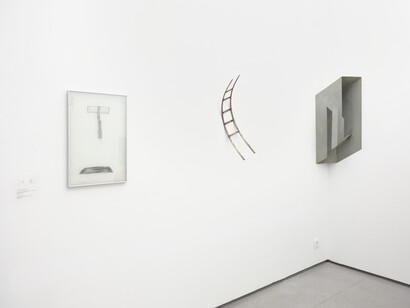
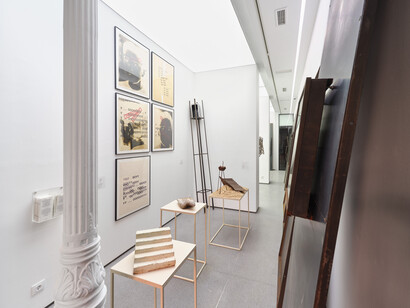
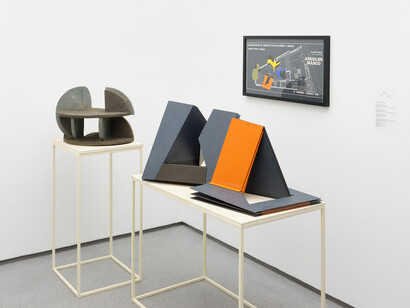
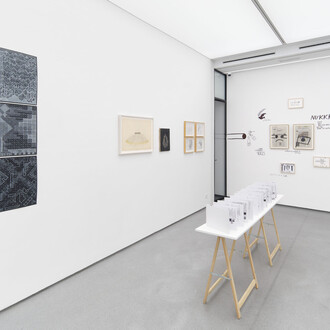
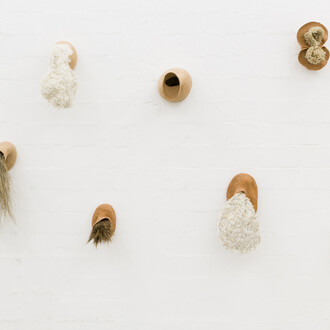
The exhibition at 1 Mira Madrid takes us on a visual walkthrough of Ángeles Marco’s most significant series, unfolding more or less in chronological order. Made in marble, stone and plaster, the works from her series Obra inicial (Initial work, 1970–1973) are early pieces before taking on the greater experimental and conceptual heft and maturity of her later production. Yet one can already discern some of the formal interests and concerns that would remain constant till the end of her life. From there we move on to her Modular series, which she began in 1974, grounded in a paradigm of explicitly organized geometric forms. There is a certain sense of unity cutting across the pieces despite their articulated differences. The fold hinted at in her iron plates would be fully developed in later series revolving around the idea of unfolding. In Espacios ambiguos (Imagen y ficción) (Ambiguous spaces [Image and fiction]), a series dating from 1980 to 1986 and the focus of her doctoral dissertation, Marco explored the expansion of her work towards space. This amounted to her first engagement in installation in the malleable terrain between image and fiction. In other words, compositions that overstepped the boundaries of the imagined in order to intertwine with the real, making use of monochrome metal sheet reliefs. In Entre lo real y lo ilusorio (Between the real and the illusory, 1986–1987), one can note a progressive tendency toward staging, later evolving into ambitious scenographies of the precarious. In this regard, her use of iron sheets saw metal move to the centre of her personal language, fleshed out with boxes, tables, folders, grease, gravel asphalt, cardboard and photocopied images: signalling concerns to be developed further. In these sculptural ensembles, Marco confronts the second and third dimensions of space, creating a deliberate undecidedness between where one ended and the other began. And so, we can see how the artist operates on the latent fiction on a scenographic plane called ‘reality’.
However, it is in the El tránsito (Transit) and Salto al vacio (Leap into the void) series (1987–1989) that a number of iterative elements crystallized into a distinctive vocabulary: trajectories, transitional spaces, wells, levers, bridges, elevators, tripods, stairs and ramps, weights, plumb lines and pendulums, harnesses, slides, folds, tunnels and portals. Besides metal she started to add rubber, tar and nylon sheeting with the materials enhancing the architectural and engineering-like quality of her installations, capturing the differing behaviours of matter. For instance, her study of harnesses, used to suspend rubber or metal bodies that, while seemingly empty, are full of potential. The harness balances and measures the weight of a body that refuses to give in to gravity. Meanwhile, her wells seem to swallow us into an abyss; her slides, on the other hand, emphasize the impossibility of ascent. The same fate befalls her truncated elevators, bridges and trampolines that deliberately launch into the void. Underlying these series are metaphors that transcend the imagination of existence: one is transition, as a phenomenon of process and action, and the other is failure, inasmuch as certain figures negate the functionality of the object. Both anticipate an energetic heaviness of constant effort. There two series can be understood as co-dependent spatial narratives, unfolding as imagined stage settings where everything leads towards the instability of vertigo. The objects induce physical or emotional movement, imbuing the cold appearance of the materials with sensation.
In the case of the aforementioned Presente / Instante series, we are presented with an exercise in self-awareness. Comprising an installation, a filmed performance, prints and photographs, the complete series focuses on the artist’s personal identity. Here Ángeles Marco performs the self, constructing it through her lived reality as an artist, dressed in her overalls and boots, in the present tense: “I am. present. present indicative of the verb to be.” All there is beneath the mask of “the artist” is the artist. The final work in the exhibition belongs to the Suplemento al vacio (Supplement to the void, 1996–1998) series: a group of works that embraces the full range of gestures present across all her series and takes a stance in the notion of “recycling” in which the artist assembles and disassembles like a kind of poetic staging. A series of series that sustains Marco’s enduring obsession with the ever-present danger of glimpsing the face of the abyss.