English
 Español
 Français
 Deutsch
 Italiano
 Português
In an industry often driven by speed and constant reinvention, the most compelling designers are those who create from something deeper than trends. Galib Gassanoff belongs to this rare group. His work feels personal, almost intimate, because every piece he creates carries fragments of memory, culture, and identity. What appears on the runway is not simply fashion—it is a translation of heritage into contemporary art.
Gassanoff’s journey into fashion began far from the traditional capitals of the industry. He was born in Georgia, in a village near Tbilisi called Karajalar, a place with a strong Azerbaijani community. Growing up there meant living at the intersection of two cultures. He was raised in Georgia but within an Azerbaijani family, surrounded by traditions, visual languages, and histories that quietly shaped his imagination long before he understood what fashion design was.
In that environment, becoming a designer was not an obvious dream. In fact, it was barely imaginable. In many small villages, professional paths are shaped by what people around you know and practice. Careers in agriculture, trade, or local business are familiar; fashion design, especially at an international level, is something distant and abstract. For a young person growing up there, the idea of designing clothes for global runways did not exist as a realistic option. It was not even something people talked about.
Yet creativity often begins long before it finds a name. For Gassanoff, inspiration came from the textures and traditions surrounding him. Everyday life contained objects that carried artistic meaning—particularly textiles. Among them, Azerbaijani carpets stood out as powerful visual and cultural symbols.
For centuries, carpets in the Caucasus have been more than decorative items. They are deeply connected to identity, family history, and storytelling. Every pattern and color can carry meaning: symbols of protection, prosperity, nature, or lineage. Growing up in a community where these traditions were part of daily life meant that weaving, pattern, and texture naturally entered his visual memory.
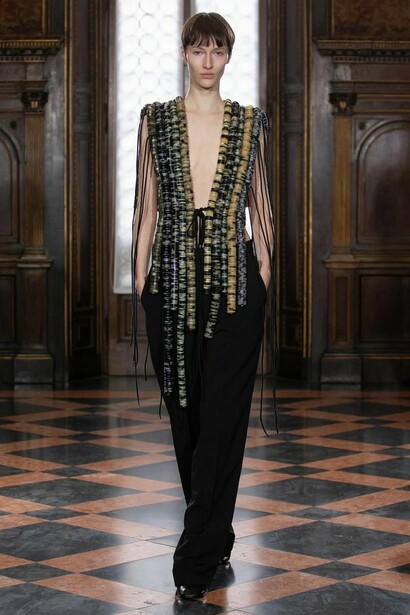
Later, when he began working in fashion, these memories reappeared in a new form. Instead of simply reproducing carpet patterns on clothing, Gassanoff reinterprets the idea of weaving itself. The logic of interlacing threads becomes a conceptual framework for his garments. Fabrics are manipulated, layered, and constructed in ways that echo traditional loom work. Sometimes he experiments with unexpected materials, transforming them into woven surfaces that resemble textiles while pushing the boundaries of fashion construction.
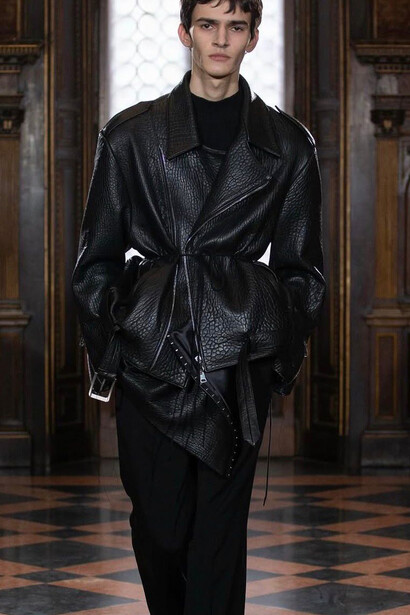
This deep connection to craft reflects his Azerbaijani heritage, but it is only part of his creative identity. Equally important is the Georgian environment in which he grew up. Georgia has a long history of distinctive clothing traditions characterized by strong silhouettes and dramatic structure. Historical garments from the region often feature defined shoulders, elongated lines, and architectural forms that emphasize presence and strength.
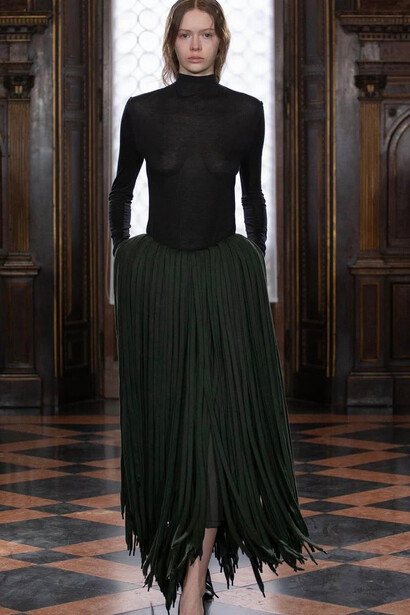
These influences appear subtly in Gassanoff’s work. While the textiles often echo Azerbaijani craft traditions, the silhouettes sometimes carry a sculptural quality reminiscent of historical Caucasian attire. The garments feel structured and intentional, balancing softness and strength in a way that reflects the broader cultural landscape of the region.
Because of this, Gassanoff’s work cannot be reduced to a single national identity. It exists between cultures. Born in Georgia to an Azerbaijani family, he grew up navigating both worlds simultaneously. Rather than choosing one cultural narrative over the other, he allows them to coexist in his designs.
This bicultural perspective gives his work a rare authenticity. Many designers search globally for inspiration, traveling across continents to discover new aesthetics. Gassanoff’s inspiration, however, comes from within his own history. His heritage is not a reference point but the foundation of his creative language.
When his collections appear on the runway, they feel like visual conversations between past and present. Traditional textile ideas merge with experimental construction techniques. Cultural memory transforms into contemporary form. What emerges is something that feels simultaneously ancient and futuristic.
Another essential element of Gassanoff’s work is his respect for craftsmanship. In a time when much of fashion production has become industrial and rapid, he emphasizes processes that require patience and skill. Weaving, handwork, and textile experimentation remain central to his approach.
Through these techniques, he not only creates striking garments but also preserves knowledge embedded in traditional crafts. Many of these skills are passed down through generations, particularly among women in local communities. By incorporating them into contemporary fashion, he brings these traditions onto an international stage.
There is also something symbolic about the role of weaving in his work. Weaving connects individual threads into a larger pattern. In many ways, identity functions the same way. Personal history is composed of different cultural threads—family, geography, language, and memory—that intertwine to form who we are.
In Gassanoff’s case, this metaphor becomes visible in the garments themselves. Azerbaijan and Georgia, tradition and modernity, village life and global fashion all intersect within the same piece of clothing. The result is not a simple fusion but a layered narrative that reflects the complexity of his background.
The path from a small Georgian village to the international fashion world was not straightforward. Pursuing such a dream required imagining possibilities that were not visible in his immediate environment. For someone growing up far from fashion capitals, the distance between reality and ambition can feel enormous.
But this distance can also produce a unique perspective. Designers who emerge from outside the traditional fashion system often approach creativity with fewer limitations. Without being shaped entirely by industry expectations, they are free to experiment and reinterpret what fashion can be.
Gassanoff’s work reflects this freedom. His garments often blur the line between clothing and sculpture. Textiles become structures; silhouettes become architectural forms. Each piece feels deliberate, almost like an object designed to communicate an idea rather than simply to follow seasonal trends.
This approach has drawn increasing attention from the global fashion community. Critics and audiences alike are intrigued by the originality of his designs and by the cultural depth behind them. His collections demonstrate that fashion can function as a form of storytelling—one capable of carrying histories across generations and borders.
At the same time, his success represents something larger than personal achievement. It highlights the growing importance of diverse cultural voices within fashion. For many years, the industry’s narrative was dominated by a limited number of geographic and cultural perspectives. Designers like Gassanoff are helping expand that narrative.
By bringing elements of the Caucasus into contemporary fashion discourse, he introduces audiences to traditions that might otherwise remain unseen on global runways. The textures, techniques, and stories embedded in his garments offer glimpses into a cultural world rarely represented in high fashion.
Yet despite international recognition, the essence of his work remains connected to where his journey began. The village where he grew up may have been far removed from fashion capitals, but it contained the seeds of everything that would later define his creative voice.
The carpets, the textiles, the cultural traditions, and the sense of living between two identities all became part of the artistic language he would eventually develop. What once seemed like a distant dream gradually transformed into a reality shaped by determination, imagination, and a deep respect for heritage.
Today, when Galib Gassanoff’s designs appear on runways and in fashion conversations around the world, they carry more than aesthetic value. They carry the story of a designer who turned cultural memory into contemporary art.
His journey reminds us that the most powerful creativity often emerges from places where the idea of becoming a designer once seemed impossible. It grows quietly, shaped by local traditions and personal histories, until one day it finds its voice.
For Gassanoff, that voice is woven from many threads: Azerbaijan and Georgia, past and future, craft and experimentation. Together, they form a unique vision—one that proves fashion can be more than clothing. It can be a living expression of identity.