English
 Español
 Français
 Deutsch
 Italiano
 Português
Youth rebellion on display: visual codes of Americana and subculture in contemporary French retail. In the heart of Paris, where the streets breathe old-world charm and avant-garde experimentation in equal measure, a seemingly modest fashion window display stages a compelling aesthetic drama. Behind the glass are two mannequins—one clad in a vivid red mini dress layered with a denim jacket emblazoned with patches, and the other dressed in a high-waisted, all-white ensemble anchored by a graphic tee with flame motifs.
Beside them, a wooden stool cradles a single sculptural handbag, and grounding it all are pairs of black platform sneakers. At first glance, the scene feels playful, casual—perhaps even nostalgic. But upon closer inspection, this visual tableau opens a rich conversation about Americana in European fashion, the recycling of youth subcultures, and the construction of identity through curated rebellion.
The mannequin as mirror: body without identity
In today’s fashion culture, mannequins serve more than utilitarian purposes—they become avatars of brand ethos, carriers of stylistic attitudes. Notably, the faceless, expressionless mannequins in this window allow the clothes to assert themselves with heightened agency. Devoid of gender-specific traits, the figures embrace an androgynous posture that invites a broader demographic identification, encouraging viewers to project their own narratives onto the outfits.
This neutrality is particularly potent in youth-focused visual merchandising. Without the distraction of facial expression, the garments and their subcultural references take center stage. They function as cultural signifiers rather than just fashion commodities. In this sense, the mannequins become vessels not for realism, but for aspiration—living symbols of a particular lifestyle ethos: youthful, rebellious, Americanized, yet paradoxically at home in the romantic rigidity of Paris.
American pop nostalgia: flames, denim, and the red dress
The display thrives on the visual language of American pop nostalgia. The flame motif on the graphic T-shirt is a direct reference to hot rod culture, a symbol of mid-century American speed, masculinity, and recklessness. Paired with wide-legged white pants and a clean white belt, the look combines garage-punk toughness with ironic polish, echoing both 90s skater aesthetics and 2000s pop-punk fashion—a blend that feels at once ironic and lovingly referential.
Meanwhile, the denim jacket with oversized patches channels a distinctly American rebel iconography—part varsity jacket, part mechanic uniform, part riot grrrl. The decision to layer it over a flirtatious red mini dress strikes a calculated balance between gender play and cultural reappropriation. The dress is coded as traditionally feminine, its bright hue evoking passion, danger, and boldness. But the jacket disrupts that softness with an aggressive, utilitarian edge—an outfit made for performance, whether on a stage, a date, or the sidewalk runway.
Together, the outfits position themselves not just as fashion but as visual storytelling devices. They evoke the aesthetic of a road trip movie set in the American Southwest, the garage band scene of early 2000s MTV, and the digitally filtered world of modern TikTok subcultures, where past styles are endlessly recycled, mashed up, and given new life.
Constructed rebellion: the semiotics of subculture in retail
There is a paradox at the heart of this display: it performs rebellion from within a system that commercializes it. Subculture, by definition, thrives on deviation—on pushing against norms, breaking dress codes, and signaling group allegiance through style. Yet here, the very visual language of rebellion has been flattened, curated, and polished to fit within the polished veneer of luxury retail.
The flame graphics, for instance, once signified nonconformity and danger, especially in rockabilly or skater subcultures. Now, they sit calmly in the safety of a Parisian boutique window, stripped of context but not of visual potency. Similarly, the oversized sneakers—reminiscent of goth and rave footwear—no longer speak of underground scenes but of Instagrammable streetwear trends. They are rebellion as an aesthetic, not ideology.
This process is not new. Since the 1970s, fashion has cannibalized subcultures for their style potential—from punk and grunge to hip-hop and emo. But what makes this display particularly compelling is its self-awareness. The pairing of classic Americana with French minimalism, of loud graphics with monochrome sophistication, suggests a knowing wink at the viewer. It says, “We know this is a costume of rebellion. But so are all clothes.”
The stool and the bag: sculptural stillness in a scene of motion
To the far right of the display, a wooden stool supports a single bag—structured, black, with hard angles and an intentionally sculptural shape. This still life, removed from the mannequins’ implied bodies-in-motion, serves as a moment of contemplative pause. Its presence invokes the artisanal and the collectible. It is less about wearability and more about desirability.
The contrast between this serene object and the youthful energy of the outfits reinforces the tension between fashion as expression and fashion as commodity. While the clothes suggest a life lived out loud, the bag sits like an object in a museum—untouched, pure, aspirational. This juxtaposition mirrors the dual identity of contemporary fashion brands that must cater both to lifestyle and to luxury.
Paris vs. America: localizing global trends
To place this display in Paris is to overlay another layer of meaning. France, with its fashion legacy rooted in haute couture, refinement, and elegance, has long held an ambivalent relationship with American culture. While deeply influenced by American media and streetwear, French brands often filter those references through a lens of intellectualism or ironic detachment.
In this window, American visual codes are not merely adopted—they are translated. The loudness of the flames is balanced by the cleanliness of the silhouette. The denim jacket’s brashness is softened by the structured dress beneath. Even the platform sneakers are given a minimalist edge, their chunky soles grounded in black simplicity. This act of localization reflects how global trends mutate in specific cultural contexts.
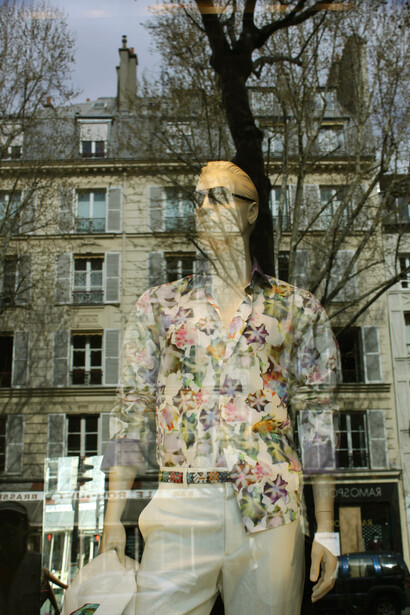
Moreover, the backdrop of Haussmannian architecture reflected in the window glass anchors the scene in a firmly Parisian identity. The old stone buildings and wrought-iron balconies act as ghosts of tradition, silently observing this youthful, globalized fashion moment. The city becomes not just a stage but a character in the narrative.
Genderplay and fashion fluidity
The styling choices in this display also engage with fashion’s ongoing conversation around gender. The red mini dress, traditionally coded as hyper-feminine, is toughened by the jacket, while the white ensemble on the second mannequin reads as gender-neutral. These choices gesture toward the fluidity of identity that marks Gen Z and late-Millennial fashion sensibilities. Clothing is not about declaring “male” or “female,” but about mixing codes to express individual mood, politics, or even irony.
This genderplay is reinforced by the use of faceless mannequins, which serve as blank slates for projection. Viewers are invited not to replicate the outfit exactly, but to remix it—to imagine how it might express their own intersectional identity. This interactivity is subtle but powerful. It marks a departure from prescriptive fashion toward a more interpretive, dialogic model.
The function of reflection: blurring inside and out
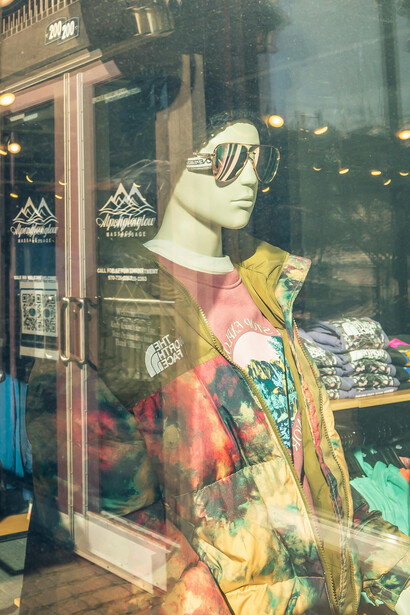
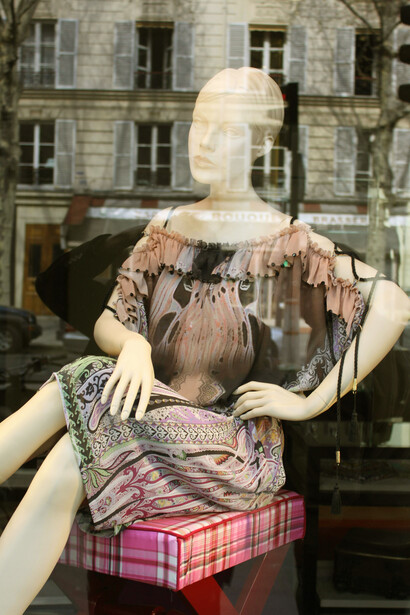
A final, unintentional but potent element of the display is the reflection captured in the window. The image of the street, the city, and passersby becomes layered onto the clothes themselves. This visual layering blurs the line between the curated scene inside and the lived environment outside. It creates a moment of fluid interaction between consumer, brand, and world.
The reflections suggest that fashion is not sealed off from the urban fabric but exists in constant interplay with it. It invites viewers to see themselves within the display, to place their own bodies into the scene, and to fantasize about a life where these clothes aren’t behind glass but in motion—on scooters, down boulevards, and in cafés and concerts.
This is perhaps the ultimate goal of the display: to sell not just garments, but a version of self. One that is bold, rebellious, and aware. One that borrows from the past but speaks to the now. One who walks the cobblestones of Paris with the attitude of a '90s American teen movie character. Constructed? Yes. But no less potent for it.
Retail as a performance of cultural memory: this fashion window offers more than a glimpse into seasonal trends. It stages a full visual essay on cultural borrowing, subcultural performance, and the aesthetics of youth rebellion. In doing so, it reaffirms the role of fashion retail as a site of meaning-making, not merely a transaction.
Here, in this small corner of Paris, Americana burns anew in synthetic flames. Denim reclaims its edge. And rebellion, polished and prepared, waits patiently behind the glass for its next performance.