English
 Español
 Français
 Deutsch
 Italiano
 Português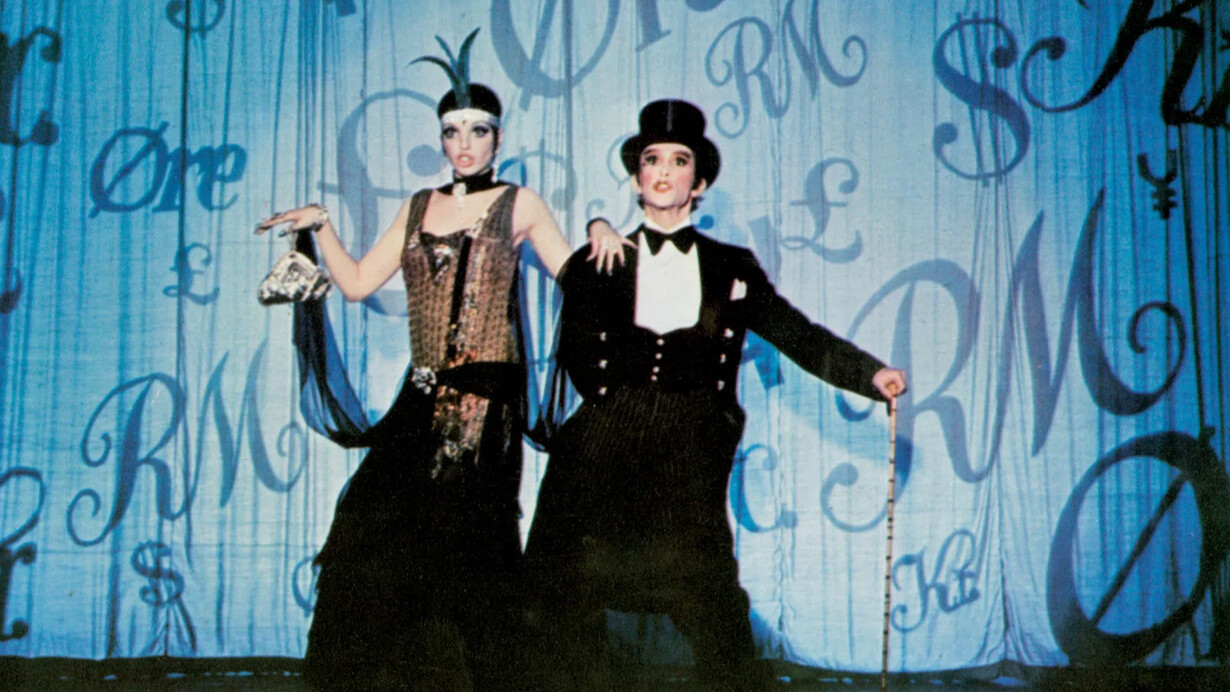
Leave your troubles outside!
That is one of the lines in Cabaret’s opening song, “Wilkommen.”
Cabaret is a musical written in 1966, based on the 1951 play I Am a Camera by John Van Druten. In turn, the play is based on Christopher Isherwood’s 1939 novel, Goodbye to Berlin. Cabaret’s music is by John Kander, with lyrics by Frank Ebb and book by John Masteroff.
All of this to say, Cabaret is a story spanning generations of various media and meanings, with each iteration and production taking on a whole new form and message.
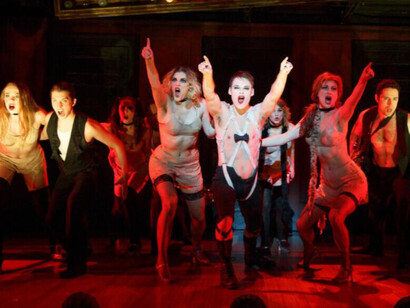
Cabaret takes place in Berlin in 1929-1930, during the beginning of Hitler and the Nazis’ rise to power. However, the musical’s soundtrack is full of jazzy instrumentals, eccentric songs, and entertaining choreography. The complex romance between English performer Sally Bowles and American writer Cliff Bradshaw takes center stage for much of the musical, with subplots between other characters throughout as well.
In reference to the 1993 London Revival of Cabaret, one of the first mentions we get of Nazism in the musical is when Sally picks up a book in Cliff’s room and asks if it is the book he is writing. After realizing it is in German, she reads out the title: Mein Kampf. Cliff had explained that he was trying to get a better understanding of German politics at the time. He later references it again when he discovers his friend, Ernst, was a Nazi, saying, “I’ve read your leader's book,” with disgust written plainly on his face. Cliff becomes more panicked throughout the plot, eventually attempting to force Sally to move back to the U.S. with him to escape the rise of fascism. He is angry, he is scared, and he seems to be the only one noticing what the Nazis are doing.
Sally, throughout the musical, continues pushing politics away from her, speaking of it as if it were some faraway concept that doesn’t concern her. Cliff says to Sally that he should read her the newspaper sometimes, so she can see what is happening outside of her fantasy land. Disdainfully, she replies: “Politics? What does that have to do with us?”
Cliff says back, “If you’re not against it, you’re for it.”
Besides Sally’s willful ignorance on the subject, other characters take a different yet similarly escapist approach. Fräulein Schneider (from whom Cliff is renting a room at the boarding house) had lived through war, inflation, revolution, and other extreme events—in her mind, she can live through more as she has no other choice in the matter. After ending her engagement with Herr Schultz, a German and Jewish man, Cliff tells Fräulein Schneider to resist the pressure and marry the man she loved. She asks Cliff plainly what she should do, and he doesn’t have an answer for her, knowing that his options are much more open than hers.
Herr Schultz, on the other hand, says he knows it will be okay when Schneider tries to warn him. “I know Germans, because I am German.” A true statement, but it is meant to be comforting as well. The insistence on his nationality is to counter the fact that to the Nazis, his Judaism is the primary (and in their mind, the most problematic) identity. He is escaping from his own fear, not exactly blind but not open to what was to come for him, because he trusted his country too much not to turn on him.
Despite all of these instances of these characters seemingly recognizing that something is shifting, they don’t see it for what it is. In Cliff’s final lines, he remarks: “It was the end of the world…and I was dancing with Sally Bowles, and we were both fast asleep.” He acknowledges that throughout his time in Berlin, he was going to parties with Sally, and putting off acting on the increased tension in Germany at the time by leaving or speaking out sooner. At the end of the day, he was complicit in allowing the people around him to ignore it until it could not be ignored anymore. Fräulein Schneider said it herself when she ended her engagement; she could no longer ignore what was happening in Germany. By that point, it was too late.
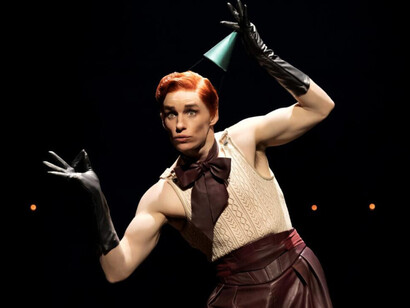
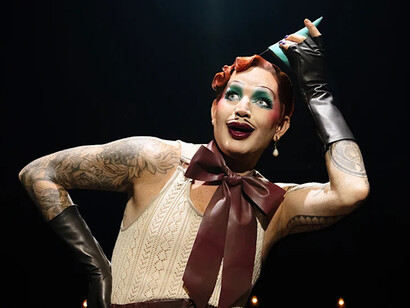
Essentially, the musical is a masterclass in showcasing escapism. However, escapism doesn’t just occur in the musical itself, but also exists outside and around it. A prime example of this is the Ukrainian production of Cabaret, which premiered in 2023 at the Kyiv National Academic Molodyy Theater. After going viral on TikTok for clips of songs like “Wilkommen”, “Two Ladies”, and “Money”, users were instantly enamoured with the charismatic Emcee, the elaborate and detailed costumes, and the beautiful set design. Comments flooded posts about the production, discussing how they would love to travel to Ukraine to watch the show.
The irony of this is the ongoing invasion of Ukraine by Russia, which mirrors the situation presented in Cabaret all too well. Those so obsessed with the Ukrainian production completely ignore the war and further descent into far-right politics around Europe, too taken by the glamour to care. In this case, real life mimicked art vividly. A warzone does not stop art from being made, but art can make people forget about the warzone. In some ways, art is made to offer comfort in tumultuous times, but that does not mean it should push people to be completely ignorant of the context in which it was made and is being performed.
Even today, I hear many people often “burying their heads in the sand” so to speak, using the exact same excuse that Sally Bowles used: “What does that have to do with us?” Some explain they’re just “not political people”, while others push politics to the side and insist that not everything is political.
Cabaret is a perfect response to that, though, in that the very ability to enjoy the glitz and glamour of the musical is a privilege, and politics can easily strip that away.
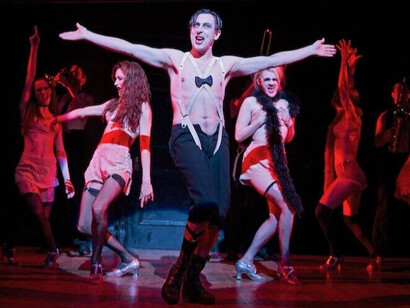
Some important context to Cabaret is that in the 1920s and early 1930s, queer culture thrived in Berlin. The cabaret depicted in the musical represents other gay cabarets in the area, gay theatres, films, etc. That having been eradicated with the rise of Nazism in Germany is essential to understanding Cabaret itself, especially given that in the 1993 revival, Alan Cumming’s Emcee revealed himself to be Jewish, gay, and a political prisoner at the end of the play. He takes off a black trenchcoat with the air of a strip tease, even winking at the audience in some productions, to reveal the striped uniform, upside down pink triangle, red triangle, and the yellow Star of David. In this sense, even the most hedonistic places, where “troubles are left at the door,” are affected by what happens outside of them.
Politics is buried within everything. We are given our rights and privileges through political systems, and those can unfortunately be taken away as well. Through Cabaret, we learn the consequences of ignoring what is happening and the severity of what can happen outside of closed doors. Sally Bowles’ final number in the show is “Cabaret”, and it depicts a spiral into madness because the world is truly ending around her, with fascism stripping all of what she loved from it. The cabaret itself would be gone not long after due to the Nazis, and with it, many people she called friends. Some were Nazis, others were murdered by them, but either way, they were lost to her.
In the 1972 movie rendition of Cabaret, the song “Tomorrow Belongs to Me” is sung by a young boy with a crowd joining in to make it sound more haunting, an omen of what was to come. In the London revival, it is started by Fräulein Kost, a prostitute also living at Fräulein Schneider’s boarding house.
Following an argument between the women—in which Schneider forbade Kost from bringing sailors to her house, and Kost threatened to leave—Kost revealed that Schneider’s fiancé, Herr Schultz, was Jewish to Ernst. Ernst subsequently told Schneider not to marry Schultz, and he almost left the party before Kost began singing the song. It was a haunting reminder of how many people would become Nazis, with all but a few joining in the song. Similar to the film, it became almost a military march, an anthem for German nationalism that calls back to Ernst’s line of “If you were German, you would understand.”
Many supporters of right-wing politicians use that rhetoric, pointing to some policies by their leader and discussing the conditions of their country before that leader to explain themselves. They conveniently ignore outright racism, homophobia, sexism, and even evidence of rape and pedophilia. In their minds, those who weren’t living in their exact vision of what life was like would not understand, and thus could not have a valid opinion. In countries like the U.S. right now, where there is a concerning lack of regard for democratic systems and protocols, many look on with a sense of concern. Historians have spoken out time and time again about the foreboding signs of the rise of authoritarianism, and are met with resistance every single time.
Cabaret may be a musical with campy costumes and some fun songs, but its ability to portray how some react to political turmoil is uncanny. It reminds me of the poem “First They Came” by Pastor Martin Niemöller, which describes a mysterious and frightening “they” who came from various groups. “First they came for the Communists/And I did not speak out/Because I was not a Communist.” The poem goes on describing other groups before ending with “Then they came for me/And there was no one left/To speak out for me.”
If you look away every single time, explaining it away with the legality of human beings, religion, race, or sexuality, there will be no one left to save you. Cabaret leaves you with a sickening feeling that such atrocities were committed when people looked away. Looking away from world conflicts allowed such horrific things to occur that we promised would never happen again. Ignoring wars and blatant hatred disguised as concern or justice allows ignorance to fester, turning focus to such trivial things about celebrities and drama and whatever else pop culture can push out to keep you uneducated.
Cabaret is a reminder of how easy it can be to look away, and how important it is not to. The musical is timeless because while it depicts a certain point in time, the escapism works whenever and wherever you are. On social media, in Ukraine, on the West End, or on Broadway, there is always something happening outside the Kit Kat Club. Cabaret tells you to look.