English
 Español
 Français
 Deutsch
 Italiano
 Português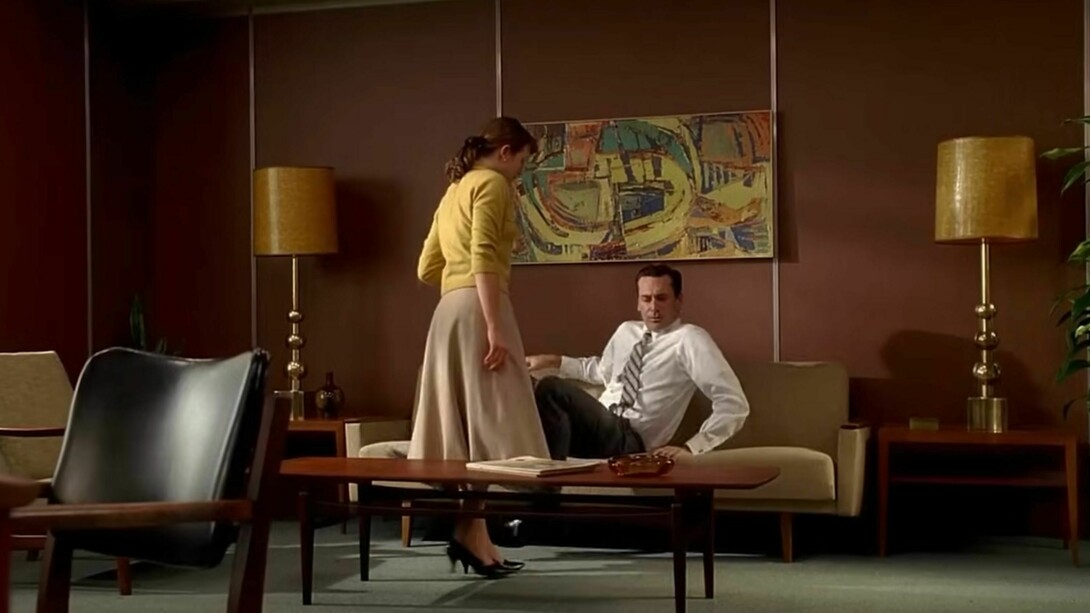
Stephen Bayley of The Telegraph describes Mad Men as not just superb television, but art. Mary McNamara of Los Angeles Times hails Mad Men for “bringing high art to the masses.” High art is sometimes contrasted with low art as appealing predominantly to experts such as art critics, art historians, scholars, and curators, more so than to the masses. Low art includes pop music, blockbuster movies, and advertisements, all of which are deemed to lack texture, subtlety, sophistication, and nuance, and are sometimes denigrated as made for the masses.
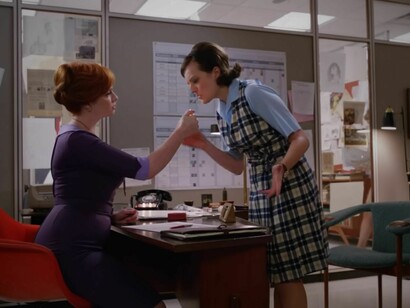
In several scenes of Mad Men, framed advertisements adorn the walls of offices next to abstract expressionist paintings, which points viewers of the show to the fact that creators of the series are conscious of the complex challenges of attempting to make high art in a medium that demands it to be low art and to ultimately sell products and the very idea of consumerism itself.
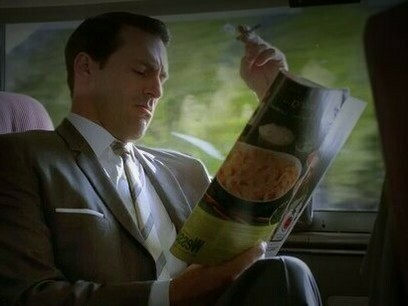
And although Mad Men at times reeks of a melodrama, together with the fact that it is a commercial juggernaut that hocks myriad consumer goods (such as Lucky Strike Cigarettes, Heineken Beer, General Motors, Buick, Jaguar, Ortho Pharmaceuticals, Dow Chemical, Topaz, Ponds, Avon, Nabisco, Life Cereal, and dozens of others) the show is also cloaked in the trappings of high art, such as allegory, symbolism, subliminal messages, and is often beautifully shot and edited.
In some ways, Mad Men is characteristic of high art; it has several subliminal and at times satirical references to other high art, like Mark Rothko’s abstract expressionist paintings and Frank O’Hara’s poetry, and myriad other references that might likely go unnoticed by the so-called “masses.” In season two, for instance, a drunken Freddy Rumsen plays a Mozart tune with the zipper of his pants, which seems to be the show’s creators’ tongue-in-cheek way of expressing – much like the abstract expressionism next to framed print ads on the walls of offices -- a consciousness of Mad Men blurring the line between high and low art, concomitant to blurring the line between art and commoditized product.
The show’s use of doors as a metaphor for the beginning and end of life, and as a metonym for the existential crisis of life as a process of dying, is evidence that the show does indeed have moments of being high art, even though it is ultimately made for the masses. In seasons six and seven, doors become increasingly important as literary devices, conveying new horizons and closed chapters (including music by the band The Doors).
The dance numbers on the show, such as Peter and Trudy Campbell’s rendition of the Charleston, and Joan Harris’ accordion solo in season three; Megan Draper’s Zou Bisou Bisou performance in season five; Ken Cosgrove’s tap dance number, and Roger Sterling’s juggling act in season six; Megan’s dance number with a hipster at her party, and Don and Peggy’s slow dance to Frank Sinatra’s “My Way” in season seven; followed an episode later by Bert Cooper’s “The Best Things in Life Are Free” song and dance, all of which are wedged into the storyline of the show without pushing the plot forward at all, in particular seems to speak to the fact that the creators of the Mad Men have fun with the idea of being high art in a low art medium.
The show’s numerous references to Broadway performances, reference to America Hurrah, and especially the unidentified drag queen in the mâché cake that receives raucous applause from drunken American Veterans of Foreign Wars late in season seven all likewise point to the creators of Mad Men making satire, and arguably high art.
The creators of Mad Men can thus be compared to Andy Warhol and Banksy in that the series makes light of its own commoditization and consumer spectacle. The point is underscored closer to the end of the series as Peggy informs Don that she dreams of “creating something with lasting value.” Don scoffs, “You think you’re going to do that in advertising?” Peggy’s line and Don’s retort seem to speak to the show's creators’ quandary in creating high art for the television masses and ultimately to sell advertising space (commercials) on AMC. The Coca-Cola commercial Don imagines at the very end of the series seems to be Matthew Weiner’s and the other creators’ acknowledgment that Mad Men was as much a name-brand and elaborate commercial as it was art.
In season four, for instance, Sally Draper mentions the Land ‘O Lakes Indian holding a box of herself holding a box of herself. Also in season four, Peggy’s friend Joyce introduces her to artist David Kellogg at a party in downtown Manhattan. Peggy suggests that perhaps Kellogg might be interested in doing some work for the ad agency where she makes a living. “Art and advertising?” Kellogg smugly asks, “Why would anyone do that after Warhol?” Sally’s mentioning of the Land ‘O Lakes box and Kellogg’s snide comment helps to demonstrate that the makers of Mad Men are clearly self-referential towards the duality embedded in Mad Men as a result of trying to be high art for the consuming masses.
The same can be said of the show’s numerous references to soap operas, such as Peyton Place and Dark Shadows, both of which were popular during the 1960s, as well as the fact that Don’s wife, Megan, who seems offended by the commercialization of art, is a soap star in season six.
Mad Men is both high art that critiques consumer capitalism and exposes its fascist features, while at the same time, the show perpetuates the fascism it critiques. Mad Men is indeed art, but also, like a Che Guevara t-shirt or the Red Westerns that were wildly popular in Cold War Eastern Bloc countries, the show ultimately perpetuates consumerism even as it critiques the exploitative nature of capitalism. The fact that Megan can be seen in season six wearing a t-shirt with the five-pointed red star synonymous with the Soviets seems to underscore the point that symbols of revolution, as well as religion, have been subsumed into consumer culture as a means of perpetuating the global economic and political status quo.
Fascists in the decades prior to World War II, like advertisers in postwar America, marketed the notion that they alone represented “new,” “revolutionary,” and “progressive” ideals that appealed not just to the young, but to older literary modernists such as Ezra Pound and T.S. Eliot. “‘This is the way the world ends,’” Paul Kinsey quotes Eliot in season three, “not with a bang, with a whimper.” In season two, Kinsey, who seems to personify the duplicity between revolution and Cold War conformity, plans to flake out on his girlfriend, an African-American woman who is going on a Freedom Ride to Mississippi in order to register voters, so that he can instead go to the “Rocket Fair” in California with Pete Campbell. Kinsey is thus portrayed as a self-absorbed pseudo-liberal masquerading as an enlightened social activist, but is really just a sleazy and self-absorbed libertarian ad man.
Later in the episode, Kinsey pretends to his girlfriend that he has decided to go to Mississippi after all because he is genuinely invested in civil rights for African Americans. But in reality, Kinsey lost his seat on the plane because his superior at the agency, creative director Don, decided to go on the trip. Kinsey’s duplicity seems a metaphor for the creators of Mad Men, who ultimately make what might appear to be a revolutionary critique of consumer capitalism as evidence of postwar American fascism. At the same time, they perpetuate the fascism embedded in consumerism, which they simultaneously critique.
Mad Men, in short, is both subject and object, high and low art, commercial and work of art, liberal and conservative, revolutionary and fascist. Though Mad Men clearly has characteristics of high art, the show ultimately perpetuates the star culture that reifies society into social hierarchies in which celebrities, such as Jon Hamm, January Jones, and Matthew Weiner, are modern royals. The inherent star culture embedded in consumer culture led Frankfurt School critical theorists such as Theodor Adorno and Max Horkheimer to assail popular culture as inherently fascistic.
According to Adorno and Horkheimer, ”the culture industry is a main phenomenon of late capitalism, one which encompasses all products and forms of light entertainment” – from Hollywood films, television shows such as Mad Men, to even elevator music. All popular culture is designed to satisfy the needs of mass capitalist consumers. Adorno specifically notes that the term “culture industry” was chosen over “mass culture” to avoid being understood as something which spontaneously stems from the masses themselves, but from advertisers such as Don Draper and television producers such as Matthew Weiner.
Products of the culture economy appear as artwork but are in fact dependent on industry and economy, meaning they are subjected to the interests of money and power. All products of the culture industry, including high art, are ultimately designed for profit, whether the artist is conscious of it or not. According to Adorno and Horkheimer, this means that every work of art is turned into a consumer product and is shaped by the logic of capitalist rationality. Art is thus no longer autonomous, but is rather a commodified product of the economic relations of production, which is what Benjamin likewise argues in The Work of Art in the Age of Mechanical Reproduction.
The main argument of “Culture Industry: Enlightenment as Mass Deception” is that the commodification of culture is the commodification of human consciousness. Adorno and Horkheimer argue that the culture industry erodes individual critical thinking, thereby preserving the reigning order. The culture industry offers easy entertainment, which distracts the masses from their own exploitation. Adorno and Horkheimer argue that the culture industry has subsumed the very notion of reality as the prism through which people experience life, thus completely shaping and conditioning their experience of life without most being conscious of it, which is also explored in HBO’s dystopian Westworld.
The concept of the culture industry also serves to keep workers busy, as expressed by Adorno and Horkheimer, amusement has become an extension of labor under late capitalism. Popular culture, as such, appears to offer a utopian refuge and distraction for labor, but in truth, it traps the worker in a reality shaped by desire for products and consumerism itself. In other words, rather than being liberatory, the culture industry is the very device that prevents workers from gaining true economic, political, and social equality. The only true freedom the culture industry thus offers, Adorno and Horkheimer assert, is a freedom from critical thinking.
The final argument posed by Adorno and Horkheimer is that people under capitalism suffer the same fate of art under the culture industry as they do in fascist regimes. An inability to think critically as a result of conformity to consumerism turns people into passive, subordinated subjects, unable to fully take critical responsibility for their own actions, which is crucial for a functioning democracy. And so, though the creators of Mad Men expose the specter of fascism embedded in postwar American society, particularly consumerism, they simultaneously break their backs lifting the Moloch of the culture industry higher into the sky.