English
 Español
 Français
 Deutsch
 Italiano
 Português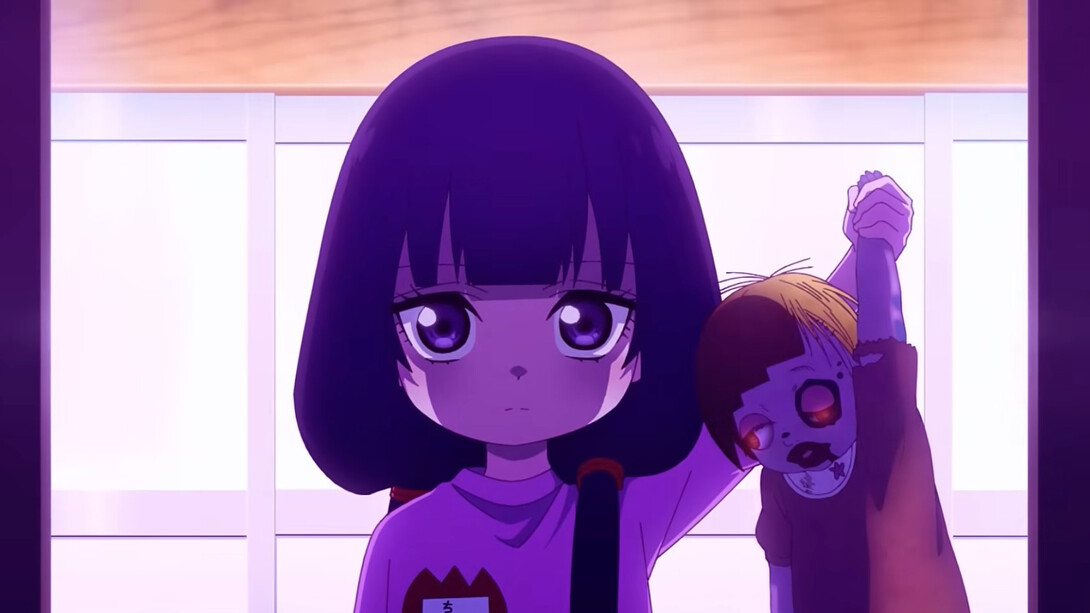
The Winter anime season draws to a close in March, so the various titles that began airing in January are beginning to wrap up. Now that we’re at the end of the season, it’s time for reviews and to look back on what has been a much better introduction to 2026 than I was expecting.
As exciting as this year is for anime, the winter season was big for returning anime titles, and the aspect of the 2026 release window that I’m most excited about is the new titles. One such new title is unfortunately overshadowed by the returns of major titles like Frieren: Beyond Journey’s End, Jujutsu Kaisen, Fire Force, Medallist and others. However, Kaya-chan wa Kowakunai (Kaya-chan Isn’t Scary) is a title I noticed among the heaps of anime coming out this season as something that could potentially be amazing or downright terrible.
I don’t have the best experience of anime horror, mostly because I’m someone who only finds certain things scarier the less likely they are supposed to be in a situation. Blood and gore in a horror movie with real people is far less terrifying to me (still terrifying, though) than the mere suggestion of someone being tortured in a soapie.
Part of my issue with horror anime is also the fact that it is animated, which is ironic given that a lot of people’s aversion to anime stems from struggling to relate to, or find depth in, representations of people rather than actual people – and I find that notion ridiculous. It’s a phenomenon I’d love to read more about, but before I get distracted, I want to offer up my flowers to the resident horror anime of winter 2026, because I think this series is solid and deserves to be discussed more by anime fans.
Uncanny Kaya
The concept of a “creepy child” isn’t new to horror or gothic fiction by any margin, and as an autistic kid, that label can sometimes float your way in some shape or form. The “uncanny valley effect” is a phenomenon that has gained quite a life on the internet as an explanation as to why some dolls (and autistic folk) are seen as “off-putting” or even “disconcerting”. Originally coined by Japanese roboticist Mori Masahiro, the uncanny valley hypothesis posited that there was a “non-linear relationship” between the degree to which robots were like humans and their perceived likeability (Mori, 1970).
In plain English, there’s a point at which a robot being human-like gets unsettling, and that feeling of being unsettled increases the more “human-like” a robot becomes. Nowadays, the term applies to the discomfort experienced when something is approximately human, yet perceivably inhuman. In the age of AI, the uncanny valley effect has also been extended not to human “likeness” as such, but even to the performance of humanity via various forms of content most commonly seen on social media.
According to Freud, the uncanny reaction can be elicited by the appearance of the alien in familiar settings, although he cited a problematic example in the form of a prosthetic limb; the idea that it is the juxtaposition of the familiar with the strange that elicits the uncanny valley feeling is an interesting one (Bretton et al., 2005).
Anyway, the story of Kaya-chan wa Kowakunai follows 6-year-old Kaya, who is seen as a problem child at the preschool she attends because she constantly seems to be at the centre of trouble. As it turns out, though, Kaya is actually the strongest ESPer around and uses her powers to exorcise the apparitions that are constantly popping up around her classmates. Chie-sensei, Kaya’s homeroom teacher, ends up recognising that Kaya is helping rather than hurting her classmates and becomes an important source of support for the young ESPer.
This could easily have become a series of trite, easily resolved ghost-busting exercises, but underlying Kaya-chan wa Kowakunai is an unmistakable "childdom". I’m coining this word (albeit without checking if it hasn’t been coined already; Docs doesn’t have it underlined or anything so it probably exists) to specifically separate it from “childhood”; the developmental period of juvenile humans (I swear I actually talk like this. I am human, not machine [as a machine would say, right?]). I’m talking less about the experience of being a child and more about the concept of a child in the first place. Childdom is explored in the series on various levels through Kaya, the protagonist.
Kaya is a quintessential “creepy kid”, a trope that is prevalent in horror, but the “creepy little girl” is a particularly interesting phenomenon that is prevalent in horror in general but has also been seen throughout anime and manga in some shape or form. However, there is an emerging aesthetic being tied to the trope within anime that I’m noticing. So far, there are few examples of this emerging aesthetic, with Kaya-chan finding herself in truly uncanny company alongside Hōzuki Yayoi, the main little girl in Kondō Kenichi’s Dark Gathering, a supernatural horror manga about a young man who becomes a shut-in after a horrifying supernatural encounter leaves him traumatised and his childhood friend afflicted with a horrible curse.
Yayoi is a young girl who has always been able to perceive ghosts, but her perception develops into clearer sight and unmistakable interactions after a fatal car accident leaves her orphaned. She witnesses her mother being dragged off by a terrifying embryo-shaped ghost and dedicates her life to hunting down the apparition. Purple hair and inhuman eyes are a major part of the emerging “creepy little girl” archetype emerging as a protagonist in anime and manga.
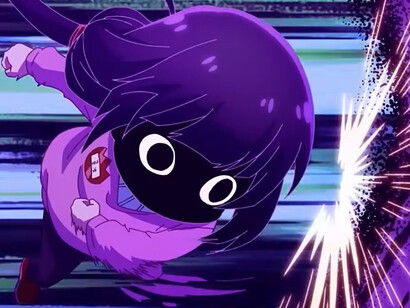
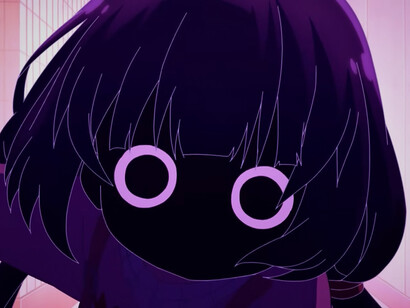
In Kaya-chan’s case, her entire face blackens and her eyes lose all colour and sheen when she performs her exorcisms, often violently swatting, batting, slapping, punching or crushing terrifying apparitions that affect the people around her. Yayoi has purple hair and an almost overdesigned visual aesthetic that contrasts the plainness of the rest of the characters in Dark Gathering. She’s made to appear clearly not of this world, and the fact that she has polycoria – the presentation of multiple pupils in the iris (Yhwach, is that you?) – adds to this strangeness to her character.
To me, the double iris is the physical expression of the “double vision” that Yayoi has as someone who can see the supernatural just as clearly as the natural. This “visual duplicity” is another manifestation of the core reason why this archetype is creepy in the first place, but we need to dig deeper to find this core.
The metaphor that is “The Child”
According to Professor Karen E. Macfarlane of the Department of English at Mount Saint Vincent University, the “Creepy Little Girl” is a subset of the “gothic child” archetype, described as “the figure through which the narrative is unsettled and the Gothic intrudes” (2023:2).
Generally, this archetype is a fleeting existence in the grander context of the narratives in which they appear, being like harbingers of the gothic or horror elements that come to define the story (Macfarlane, 2023: 2). They are peripheral characters that exist as plot devices, introducing the kinds of tonal shifts that enable Gothic narratives to kick into gear. The reason why it’s a prevalent trope in horror lies in the warping of the Western cultural associations attached to both “childdom” and, of course, femininity.
The “little girl” as an archetype is associated with innocence, fragility or vulnerability – elements that are commonly communicated by the lack of a promise of power attached to aspects of the girl child’s being – her small stature, naivety and presentation of a form of femininity that is nostalgic (Macfarlane, 2023:3).
As Macfarlane puts it, “The Child” (with a capital ‘C’) is the “privileged ensign of the future”, a subject that is endlessly constructed and reconstructed to create a “spectacle” of the very concept that is “The Child”, and impose this series of codes attached to childdom. This nostalgia, according to Macfarlane, lies in the fact that we understand children to be blank slates or tabulae rasae; beings without agenda or predilection and no preset beliefs or corruption, as such becoming foreign or alien to the adults around them, who view them as symbolic of a world they once inhabited, one from which they are “permanently banished” (Macfarlane, 2023: 3).
The “Gothic Child” is, on some level, a warping of the “promise of innocence” (as opposed to a promise of “power”) that Western culture has assigned to the Child – a warping of the Child as a cultural symbol. At the core of the Gothic child's characterisation is the tension between the familiar and the strange caused by the “knowing” that they possess because they are the doorway that introduces Gothic elements to the overall narrative. They are a series of contradictions; by all means a child, but with something about them that is unsettling. I’d imagine that precociousness is sometimes offputting to adults because it is the juxtaposition of the expected innocence of a child with an uncanny wisdom or some kind of inexplicable lucidity.
Bringing this back to anime, this is part of the strangeness experienced by the adult characters who were around the twins, Hoshino Aquamarine and Ruby, in Akasaka Aka and Yokoyari Mengo’s Oshi no Ko — given that the twins are reincarnated and retain memories of their past lives, in their childhood years, they are seen as merely precocious, which in some situations has deeply unsettled the older characters, including director Gotanda Taishi, who explicitly used the word “creepy” to describe Aqua’s performance as a child guide in a film.
It was his verbosity that was seen as contributing to this creepiness, which falls in line with the idea of “uncanniness” being borne from the appearance of the strange within contexts that (should be) familiar. Children are small, cute, simple and unaware of the complexities of the world around them; but the Gothic child is wise or knowledgeable to the point of eeriness.
Ways of seeing
Unlike the Child, the girl Child is not a tabula rasa because of the fact that her existence is, as Macfarlane expresses, “overdetermined by the trappings of her gender”. In English art critic John Berger’s 1972 BBC special titled “Ways of Seeing”, he interrogated the subjects of oil paintings, coming to understand the oil painting as integral to the obsession with capital that underpins the values of the ruling class. Long story short, the oil painting emerged in a period where art was particularly interested in realism; therefore, oil paintings became like representations of reality, and the elites who owned them bought paintings either as a record of that which they already owned, or aspired to own.
If the objects depicted in these oil paintings were all trappings of a greater quest for money and power of those in the higher strata of society (Berger, 1972). Berger was interrogating the prevalence of oil paintings that depicted women as their subjects, but rather than present them in a manner that appears to be concerned with highlighting their subjectivities or interiorities in some way, the majority of depictions of women in art were largely nudes. Berger further differentiates the “state of being unclothed” as literal nakedness from nudes as an art form that makes an object of the subject.
How this objectification is achieved, says Berger, is through the relationship created between the viewer of the artwork and the subject – the object – within it. In nudes, the subject is obviously in a state of undress, but such that she is to be seen in that state and her nakedness is emphasised as something to be “enjoyed” by the viewer with little to no expression of the subject’s thoughts or feelings.
The women depicted in nudes tend to be either in a state of vulnerability to which we as viewers must feel privy regardless of the subject’s own feelings on the matter (Berger, 1972). In fact, it is this facsimile of intimacy – the viewing of the naked body while we as viewers remain fully clothed – that creates a contrast: the subject’s nudity is their vulnerability, contrasted by our position (often the perfect vantage point to “see” them), while we stand outside of the scene, able to see them in their nakedness whether such is the subject’s “intention” or not. This asymmetry is further exacerbated by the previously explored conception of the oil painting as the expression or intention of ownership.
We, the viewer, can step into and out of this situation where we’re looking at this naked lady, and sometimes she’s looking back at us, so we are locked in this cascade of perception. There was a specific visual language, and therefore, intention, behind these nudes that separated them from other depictions of subjects “in a state of undress”, and the purpose of this exercise was to illustrate “ideology”, which Berger defined as “meaning in the service of power”, looking at how we construct meaning (Berger, 1972).
Berger contrasts men and women through what he deemed to be how they navigate the world. Men are seen as the promise of power, be it moral, physical, temperamental, economic, social, etc. The locus of a man’s power was external – about what they can do, while women’s power in this paradigm was interior, expressed through the attitude towards the self expressed through what they “allow” (Berger, 1972).
They take up control of factors that are intrinsic and make choices to express a “self” that will be accepted (thus protected) by the promise of the power of masculinity (patriarchy). Essentially, Berger described being born a woman as being allotted and confined to a particular role and forced into having a split consciousness borne from her constant surveillance of herself, existing in the contradictory position of both surveyor and the surveilled (Berger, 1972).
How she appears is of critical importance as a summation of what she has allowed – to gain control over this, she must contain and interiorise this duplicity and is thus turned into an object existing specifically to be perceived by those who are continuously trained to view women as objects (Berger, 1972). This is the kind of world that awaits the little girl as a subject in the world, but given the various elements that are constantly rehearsed as foundational to the child as a subject, such as innocence and naivety, children are generally expected to be protected from harsh realities or be unaware of them. Not the creepy little girl; however, their understanding of some of the darker aspects of society, or of what awaits characters in the narrative, stands at odds with the characteristics their existence has repeatedly been made to signify.
Kaya-chan and cuteness
“Innocence, vulnerability, sweetness, passivity, and a lack of agency; that is what popular culture makes of little girls,” highlights Macfarlane, who breaks down the association of little girls with “cuteness”. The word “cute” describes a particular kind of innocent vulnerability, a “gesture away from violence” and, therefore, away from power. This affixes an elemental powerlessness to little girlhood.
Whiteness is central to both the Creepy Little Girl and the Little Girl archetypes in Gothic media because of the interstitial place in which white femininity exists: between fragility and power, due to their proximity to hegemony (Macfarlane, 2023: 6). There is also a class aspect to the aforementioned archetypes, but exploring that goes beyond the scope of this article (which I swear is going to get into what makes Kaya-chan wa Kowakunai so good in a second, please bear with me). This contradiction becomes central to what makes the little girl we see in Gothic media creepy.
The girl herself is no threat, but whiteness “insists on rights to power and privilege”. At the core of the creepy little girl's creepiness is the fact that she resists stable signification – the information that we get from her drives us to continuously contradictory and confusing conclusions (the alliteration was unintentional) (Macfarlane, 2023: 7).
The little girl is, due to her total lack of agency, seen as the weakest possible subjectivity – she is both a child and a girl, thus seen as signalling weakness and vulnerability from the outset. The Creepy Little Girl is intimately connected to the overworld, the Gothic, dark or horrific underpinnings of the story, a harbinger of the story’s core themes or objectives.
She is unsettling specifically because she doesn’t inhabit any single one of the categories that are associated with her. Unlike the “Evil Child”, who is terrifying because of their shifting between innocence and all the associations with childdom and malice, depravity or evil, the Creepy Little Girl never breaks character – she is always the little girl that she is and the stranger that she is at the same time (Macfarlane, 2023: 12).
Kaya-chan sits squarely in this categorisation, and one of the things I’ve enjoyed the most about Kaya-chan wa Kowakunai is the fact that the narrative and its various scenarios feel like they are specifically about children, given that the protagonist is a six-year-old.
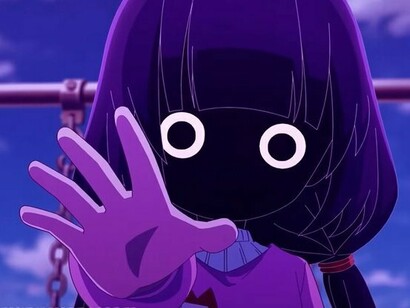
We are introduced to her abilities when a classmate encounters a malicious spirit when playing on the swings and, believing it to be a fellow child pushing him, he initially takes joy in the thrill of going higher and higher before it all begins to devolve into panic over the dangerous heights to which he is being pushed. Kaya intervenes and exorcises the apparition, but her classmate is convinced that she was the one pushing him without regard for safety. This is the trend Kaya faces at school: as she quietly deals with unimaginable horrors, her teachers and peers see her as more of a troublemaker.
Kaya bears all the makings of the little girl as an archetype, from being small, cute, unimposing and, by all means, vulnerable, but she falls into the uncanny valley with her monotonous voice (often a telltale marker of autism, a neurological configuration that makes interpersonal relationships and the uneventful absorption of various kinds of stimuli particularly difficult) and the clearly monstrous power that dwells beneath the surface. Whenever she exorcises apparitions, her face goes completely black, and her eyes, usually full of life and colour, become sharklike. It becomes impossible to tell what she’s feeling in that moment, and this juxtaposition of a… “something” dangerous and the categorically “un-dangerous” little girl makes for a particularly unsettling paradox.
When she isn’t exorcising apparitions, Kaya can be seen enjoying the various aspects of being a child and attending preschool. Her father, a salaryman, picks her up from school later than the other kids, and her mother is a total mystery until the fourth episode of the series. These moments of Kaya as just a little girl, I think, are important to one’s viewing of the series. Anime is notorious for having young protagonists who often contend with decisions far above their expected capabilities as children, and a lot of characters end up seeming much older than they actually are as a result. However, in episode 2, the series takes an even darker turn as we are exposed to Kaya’s home life.
It is completely normal at first glance, but Kaya’s demeanour changes at any mention of her mother, whom she describes as being very sick and unable to get out of bed on most days. When she opens the door to her mother’s bedroom, an apparition of insane proportions is shown to be inside, and we as the audience contend with the fact that this little girl who can see ghosts comes home from a long day of ghost-busting to sleep in the same house as a malignant entity not even she can defeat. This moment took Kaya-chan wa Kowakunai from being just interesting to becoming one of my must-watch anime titles of Winter 2026.
Kaya’s paradox
The wall of text I typed above to explain the concept of creepy little girls in media was important to situate Kaya-chan wa Kowakunai in a greater conversation with the horror media that have come before it as well as to illustrate how well it positions itself as a horror. Anime horror can very often be reliant on gore and shock value (think of the scariest aspects of titles like Another, Corpse Party, Blood-C, and Higurashi), but recently, there have been more titles that are trying to deepen the horror element.
With any story, I think the strength of the story of characters is paramount to making anything memorable, and horror films and media tend to struggle on that front. Kaya-chan wa Kowakunai sets up a simple premise and fleshes it out in a manner that I will admit feels a bit rushed, almost as if the series were made with no hope of there being a second season but is ultimately putting together something uniquely unsettling.
It achieves this uniquely unsettling feeling through its centring of Kaya, a “Creepy Little Girl”, a character archetype that generally would be a fleeting presence in a grander narrative. A denizen not inside the haunted house but beside it. However, other than the fact that she can see and exorcise spirits, Kaya-chan is just a six-year-old. She still needs to be taught how to ride the train, stay away from strangers, and tie her shoes. She doesn’t like babies – much like any first-born child struggles with the concept that there will be a younger child taking up all her parents’ attention. In fact, Kaya-chan wa Kowakunai’s various apparitions all seem to be manifestations of fears and horrors that are related to various elements that come with being a child.
The first malicious entity we see is one that plays rough on the swingset; another inhabits the pages of a picture book about peekaboo, escaping when the game is played, while another little girl finds a cursed doll that causes her to begin harming herself, and a young toddler scribbles black crayon on the mirror because what was reflected scared him. The real kicker is the realisation that Kaya’s mother is by all means normal but pregnant with a baby that is possessed by a truly horrifying entity. Each of these scenarios is faced by children in some way and tends to be grown out of over time, but they’re made ominous through the earlier discussed method of placing the unfamiliar in the context of the familiar.
It is for this consistent contestation of the various “realms” Kaya inhabits – both the Near and Far Shores, seemingly both human and inhuman – that the series title goes from being a quirky one-liner that alludes to the show’s horror to being a brilliant double entendre. In Japanese, the word order is generally Subject → Object → Verb (including auxiliary verbs like “is”), while words can be negated generally through the addition of the suffix -nai, such as “iru” (“[there] is”) and “inai” (“[there] isn’t”). The word “kowai”, meaning “scary,” often mispronounced by learners of the language as “kawaii”, meaning "cute", has a bit of an ambiguity. This ambiguity is due to the fact that “kowai” can mean “scary” or “scared”, and when negated, it becomes “kowakunai” – “not scared/scary”.
As a result, “Kaya-chan wa Kowakunai”, as much as it is officially translated to “Kaya-chan Isn’t Scary”, could also be translated to “Kaya-chan Isn’t Scared”, taking the title from centring those around Kaya to Kaya herself – the same shift her rendition of the creepy little girl archetype exhibits in no longer being a peripheral character but the main one.
I believe that this decision separates Kaya-chan wa Kowakunai from the other similar series I mentioned, Dark Gathering, for how Kaya’s story is what is central to the narrative. I believe this protagonisation of the creepy little girl in Kaya-chan wa Kowakunai makes it a breath of fresh air for horror anime but part of a steady rise in more interesting horror anime stories, as seen with titles like Mieruko-chan, Toilet-Bound Hanako-kun and Dark Gathering.
References
Mori, M., & Macdorman, K.F. (2017). The Uncanny Valley: The Original Essay by Masahiro Mori-IEEE Spectrum.
Brenton, H., Gillies, M.F., Ballin, D., & Chatting, D.J. (2005). The Uncanny Valley: Does it exist?
Macfarlane, K.E. (2023). Creepy Little Girl. Gothic Studies, Volume 25, Issue 1.
Berger, J. (1972). Ways of Seeing.