English
 Español
 Français
 Deutsch
 Italiano
 Português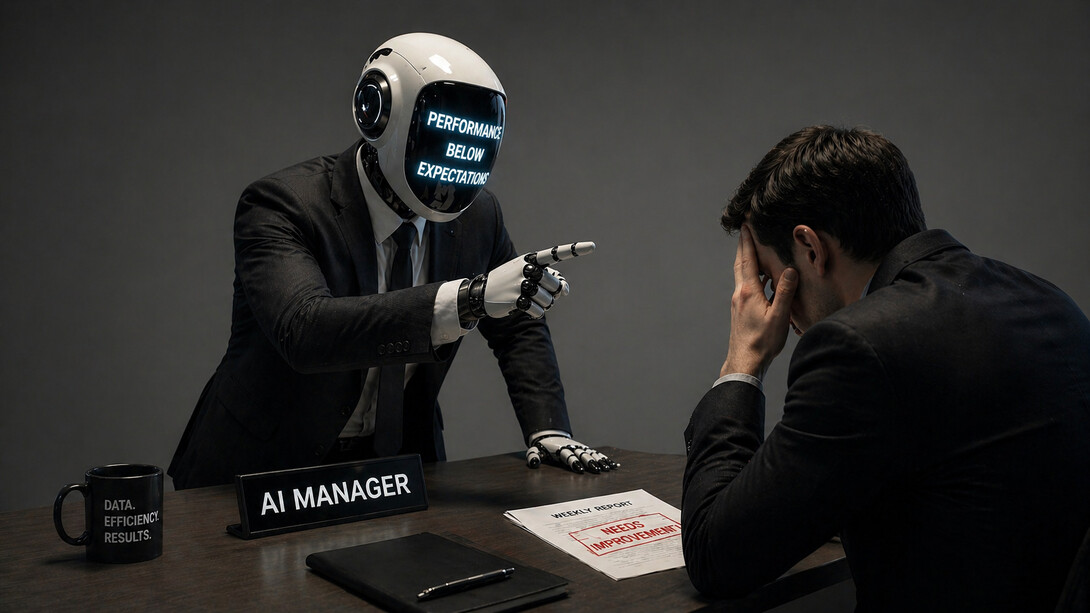
Imagine a workplace where a machine optimises your schedule, an algorithm evaluates your performance, and an automated system is the source of your next project assignment. This is not a scene from a science fiction film—it's already happening today in companies worldwide. Artificial intelligence has quietly moved into management roles, and it has changed everything we thought we knew about leadership and work.
But what does it mean when a code makes important decisions about people? Can human potential be really understood by algorithms? And what happens to the workplace when the "boss" doesn't need coffee, doesn't have a bad day, but also cannot understand what a bad day feels like?
AI's quiet revolution: the end of the middle manager?
Walk through any modern office (or scroll through any digital workspace), and you are going to discover that AI is already hard at work in management positions. This has got nothing to do with robot overlords dressed in suits—it's all about systems that are very sophisticated and that are
Automatically scheduling shifts in order to minimise overtime and to maximize coverage
Analysing patterns in workflows in order to redistribute tasks before the occurrence of bottlenecks
Scanning channels of communication for signs of project risks or team conflicts.
This is not the technology of tomorrow—it is the reality of today. And it's making the traditional role of the middle manager look very different. Before now, middle managers used to spend their days on these administrative tasks, but now they don't.
The hiring algorithm: your new recruiter is code
For many job seekers, the first contact they have with a company today is not with a human being; rather, it is with an algorithm. Within minutes, these systems can scan through thousands of resumes, searching for keywords, experience patterns, and educational backgrounds. Some of these systems can even analyse video interviews, and I'm in the process track:
Voice tone and energy levels
Speech patterns and choice of vocabulary
Facial expressions and micro-expressions.
The promise for companies can be tempting: discover the most qualified candidates in an efficient manner while eliminating human bias. However, the reality tends to be more complicated. For instance, what would happen when the algorithm is trained on data from a company that has historically employed mostly men for technical roles? That system could learn to show preference for male candidates, thereby perpetuating the very bias it was supposed to eliminate.
The quantified employee: your productivity is being scored in real-time
In several places of work, the productivity of staff is now being measured in ways that would have been unimaginable several years ago. These days, AI systems can track the following:
Communication patterns: How quickly you attend to messages and emails
Work habits: Your most productive hours during any day you come to work
Project contribution: Exactly how many sales you close, how much code you write, or how many customer issues you resolve.
Definitely, all of this data can help in streamlining workflows and revealing who the top performers are. However, it equally raises serious questions about privacy and what truly constitutes valuable work. For example, when a staff member responds quickly to emails, does it make them a better employee than the staff member who tends to spend hours in deep focus on a complex problem?
The bias problem: when the algorithmic boss is unfair
The major challenge with AI management is that algorithms learn from historical data. Unfortunately, our history is full of human biases. We continue to witness situations where:
Hiring algorithms disadvantaged women because those systems were trained on industries dominated by men
Performance systems penalized staff who took legitimate medical leave
Promotion algorithms showed preference for staff who socialized with certain groups after work.
But all those scenarios are not as worrisome and as scary as the fact that it can be harder to spot algorithmic bias than human bias. A manager might be able to give explanations for their reasoning and decisions that they take. What about AI systems? The decision-making process of AI systems tends to be a mystery or “black box” that even their creators don't fully understand.
The human resistance: why soft skills are suddenly the hard currency
As AI continues to take over more administrative and analytical tasks, something interesting is taking place: purely human skills are turning out to be more valuable than ever. What are now in high demand are those abilities that algorithms struggle with, such as
Emotional intelligence and empathy
Creative problem-solving
Ethical judgment and nuance
Mentoring and developing talent.
Tomorrow’s most successful employees might not be the ones who can crunch numbers the fastest, after all computers can do that better. The most successful staff of the future would rather be the ones who can build trust, navigate complex human dynamics, and make judgment calls in ambiguous situations.
The hybrid future: redefining leadership in an AI-augmented world
The future of management is not about using machines to replace human beings. It's about the creation of partnerships. The organisations that would be the most effective are the ones that can leverage the strengths of AI while cultivating the strengths of human beings. What this means is that the managers of tomorrow will need to become the following:
Interpreters who can give explanations of recommendations made by algorithms to their teams
Ethicists who can question when the decisions of an AI might be inappropriate or unfair
Coaches who focus on the development of unique human skills that cannot be replicated by machines
Bridge-builders who can maintain team culture and connection in workplaces that are increasingly digital.
The best leaders will be those who know how to use AI to handle administrative burdens. This would free such leaders to focus on what human beings do best: giving inspiration, mentorship, and visualising the bigger picture.
Conclusion: the human touch in the digital age
The rise of AI in management roles is not a story about the replacement of humanity by technology. It is about the redefinition of what makes us unique and valuable. As algorithms continue to take over those tasks that are more measurable, they're showcasing the importance of the very human qualities that cannot be quantified: wisdom, compassion, creativity, and moral courage.
Tomorrow’s most successful workplaces are not going to be the ones with the systems that have the most sophisticated AI. The most successful workplaces are going to be the ones that have the best integration of humanity with technology. Such workplaces would recognize that even though AI can provide optimization for efficiency, it is only human beings who can create meaning, build trust, and navigate human relationships and all of its messy and beautiful complexities.
Sure, the algorithmic boss is here to stay. However, what is more essential than ever is the human heart of leadership.