English
 Español
 Français
 Deutsch
 Italiano
 Português
Eye of newt and toe of frog,
Wool of bat and tongue of dog,
Adder's fork and blind-worm's sting,
Lizard's leg and howlet's wing.(William Shakespeare)
Burnt at the stake, forced to prove her innocence by drowning, the witch was a force for evil – but a force to be feared. Real women suffered physical pain and social ostracising because of society’s anxiety about power, because of her gender and the forbidden strength of women. Between the 15th and as recently as the 20th century, ‘witches’ have been hunted, harassed and murdered in the name of justice or belief. The imagery evolved to reflect society’s fears and feelings towards them.
At turns seductive beauty and ugly hag, hero and scapegoat, creator of healing remedies and poisonous potions, the witch embodies the fear of the unknown. Religion and misogyny played a major role in witch hunting, as did poverty and ignorance. A handbook for witch hunters, Malleus Maleficarum, published in 1484, established that witchcraft was real because the Devil was real; in the book, women are described as lusty, malicious, greedy and feeble-minded – easy prey for the Devil. The handbook is a guide to identifying, prosecuting and punishing witches.
Throughout the Middle Ages, visual representation of witches emphasised their relationship with the demonic. They were ‘the other’, opposing the conventional moral and natural order, a threat to the good order of society. From stealing milk from a neighbour’s cow or stealing a woman’s husband to causing terrible weather, witches could have a destructive effect on the economic and emotional wellbeing of the good folk.
The flying goat
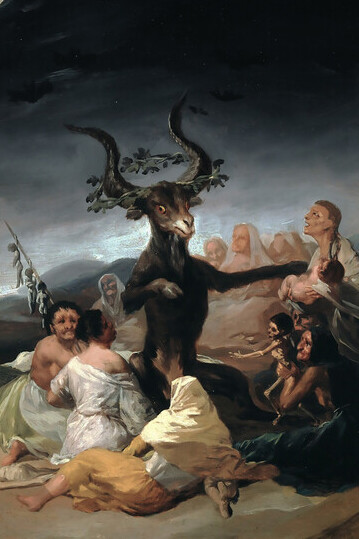
The symbolism of the goat is confusing and contradictory: pastoral innocence and unbridled sexuality, impersonated as satyrs and scapegoats, it features in scenes from mythology to late Christianity. As representatives of pagan deities, goats were associated with the Devil, and this is the reason witches ended up riding them, usually backwards.
In Albrecht Dürer’s engraving, the long hair witch is riding a beautiful strong goat, holding on to one of its horns, while in the other hand she holds on to her stick. Bad weather is approaching from the top left corner of the engraving. It is not clear which direction they are travelling, as the witch’s hair is streaming forwards, while the goat’s hair appears to float backwards. But this is witchcraft; do not expect normality. Dürer signed the work with a reversed D.
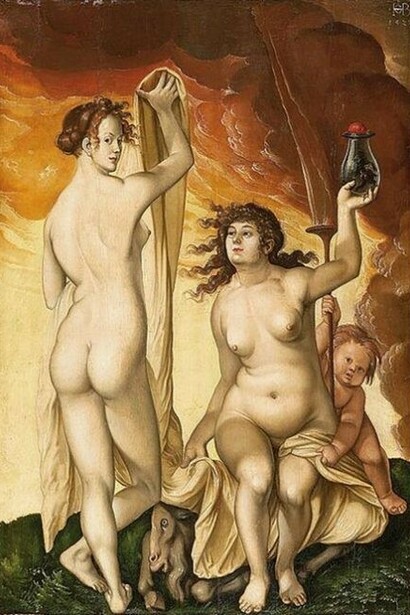
While people believed in witchcraft and magic, witches were portrayed naked, despite their bodies being shown as unattractive or deformed – cavorting with the devil, riding goats or broomsticks, or just standing in a circle, whispering and conspiring.
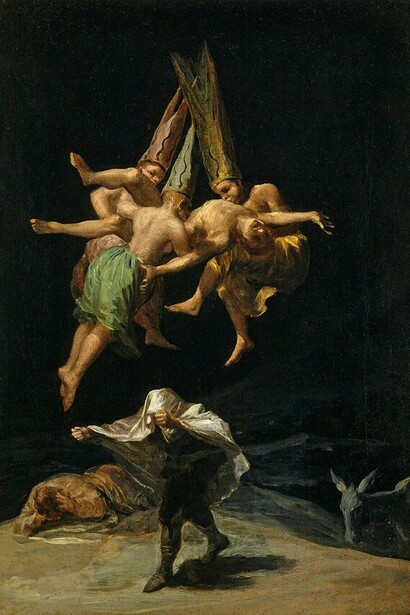
During the Enlightenment, belief in witchcraft declined. From inspiring fear, the witch became a symbol of ignorance and superstitions to be satirised. Francisco Goya used it to mock the fear of the ignorant masses and the callous way this was exploited by the church and the establishment. Theatrical lighting, a sense of the grotesque and real drama create a stunning display in Witches’ Flight. Naked to the waist and wearing double-pointed hats, the witches are holding and torturing, or devouring, their victim. Below on the ground, two peasants try to avoid the sight, one covering his eyes and ears and another fleeing the scene. From the right, a donkey, symbol of ignorance, quietly emerges.
On stage
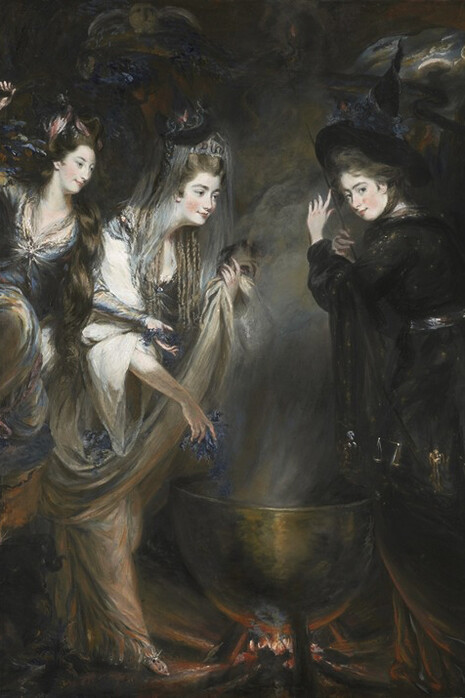
The popularity and later the revival of Shakespeare’s Macbeth gave the witches a new lease of life. Henry Fuseli and William Blake pictured them as a trio, like they appear in the play. Not only were they no longer frightened and repulsed by witches, 18th-century society women commissioned portraits of themselves in a witches-like setting and costume. As the reaction to the rigidity of Classicism, the late 18th century embraced the gothic, the supernatural and the theatrical. Better looking, more elegant and decisively not scary, the three ‘witches’ portrayed by Daniel Gardner are actually three society hostesses, influencers and supporters of the Whig Party. Dressed in their finery, the three friends are gathered around a symbolic cauldron, in which they throw petals and fragrances with delicate movements. There is not a goat in sight.
Women in love
Witches can be mischievous and dangerous if they don’t like you – but apparently even more so if they do. A sorceress in love can cast a spell to attract the object of her affection (or lust), but she could demand his head on a plate or turn her lover into an animal. The concept of a lovestruck witch is paradoxical and as such full of possibilities for an artist. Power and vulnerability, romance and magic, desire – these are emotions to be explored poetically and visually.
Born in Greek mythology and made famous by Homer, Circe is a witch who lives alone on the island of Aeaea. When Ulysses visits her there, she transforms his men into pigs. Circe was renowned for her knowledge of herbs and ability to mix them into powerful potions. She used them mainly against people who offended her, like Picus, the Roman king who rejected her advances and was transformed into a woodpecker. Even more deviously, when the sea-god Glaucus, with whom Circe was in love, chose the nymph Scylla over her, Circe turned her rival into a monster. It is this act of unreasonable jealousy and revenge that inspired poets and painters.
Pre-Raphaelite John William Waterhouse based his Circe Invidiosa on the description in the Metamorphoses by Ovid. He captures the moment Circe is pouring the poisonous mixture into the waters where Scylla usually bathes; the transformation is already taking place. At her feet, the water monster is emerging. The dark tones of green and brown create an atmosphere of fear and menace. It is not clear if Circe experienced guilt or regret. While her magic and potions give her control over other people’s destiny, she appears unable to control her own emotions.
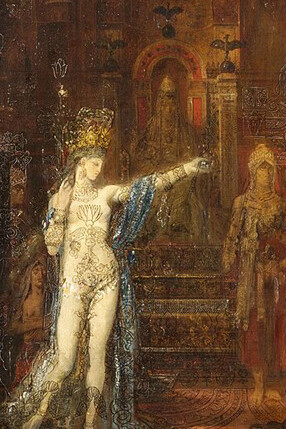
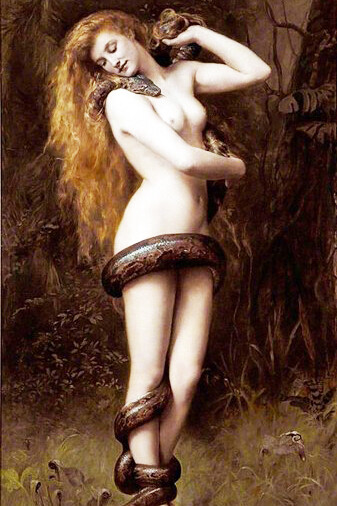
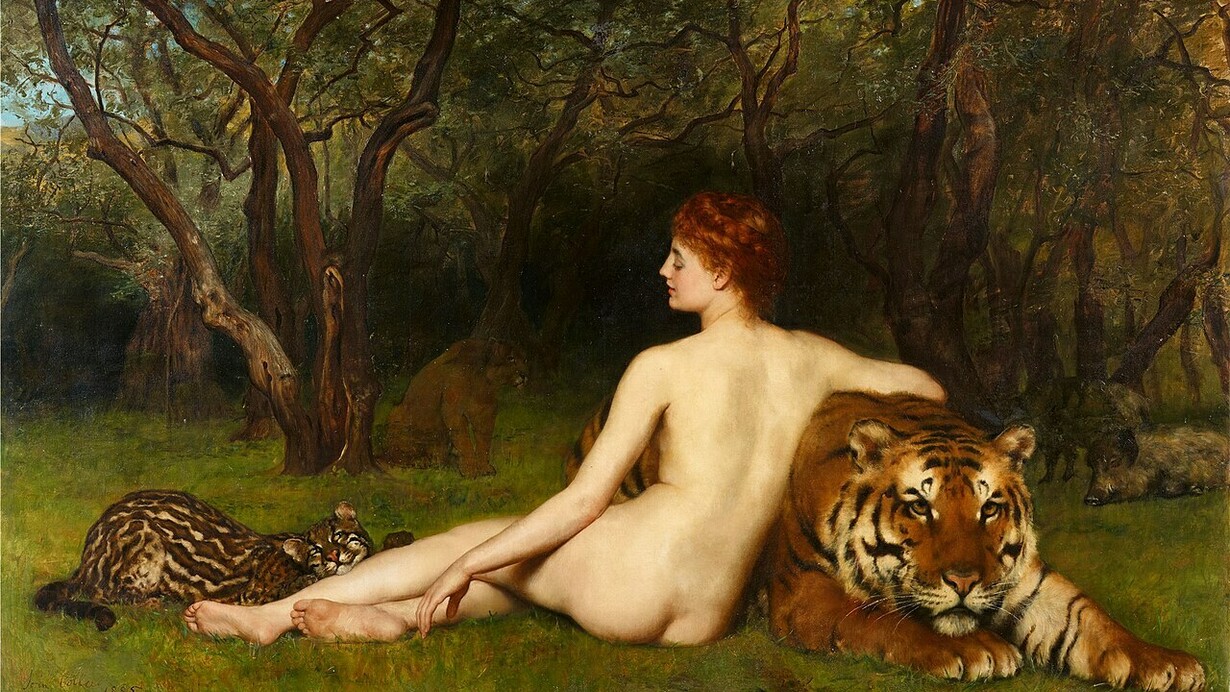
By the end of the 19th century, most people no longer believed in witches and goddesses. But now mortal women were gaining power: political power, economic independence, social equality, and sexual confidence. A new image representing the threat of the strong woman emerges in art: that of the femme fatale. Faced with her physical beauty, her allure and charm, men are bewitched and, again, powerless. The Pre-Raphaelites, Dante Gabriel Rossetti and Edward Burne Jones, portrayed these women with flowing red hair, sensual lips, and a direct gaze; apparently unaware of her beauty, innocence is part of the danger. John Collier emphasised the theme of seduction (Lilith with the serpent), while Gustave Moreau’s Salome adds power and violence. Beware the new generation of witches.