English
 Español
 Français
 Deutsch
 Italiano
 Português
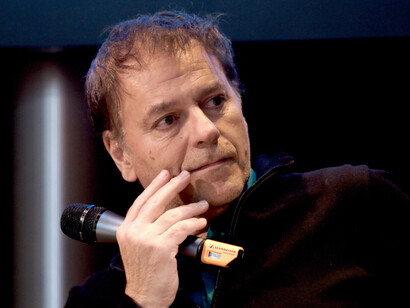
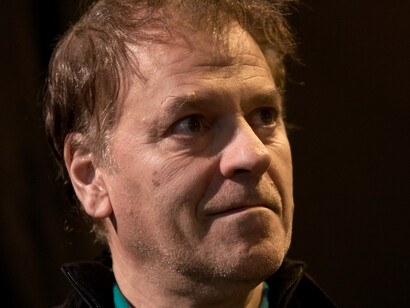
Having been born in Yugoslavia, Enki Bilal, a French bande dessinées (graphic novel) artist and director, is one of the key precursors of the cyberpunk genre. His remarkable body of work has been recognized by the French artistic authorities as well. For example, in 1987, he won “Grand Prix de la ville d’Angoulême” at the Angoulême International Comics Festival (one of the most prestigious comic book festivals in the world) with his book La Femme Piège (the 2nd book of the Nikopol Trilogy)1.
In 2022, he was appointed to the rank Chevalier de la Légion d’Honneur (Knight in the National Order of the Legion of Honor) as a comic book writer and director of 50 years of service.2 Besides being appreciated as an artist, in 2019, he became a jury member at the Cannes Film Festival under the presidency of Alejandro González Iñárritu3. Moreover, he is considered to be the only European graphic artist to have a solo exhibition in the Louvre (Les Phantomes du Louvre).4
In addition to his part in fine arts, Enki also contributed to European science fiction, which has mostly been conquered by Hollywood. He is a prominent artist and a director, both in cyberpunk science fiction and posthuman studies, with his distinctive and visionary works that combine dystopian, surreal, and philosophical themes such as the merging of human and machine, identity, and sociopolitical implications of advanced technology, which are common questions in posthumanism as well as cyberpunk.
The landscape of his works bears dystopian, high-tech, low-life features showcasing political decay, social collapse, and existential concerns. For example, in the Nikopol Trilogy, advanced technology is omnipresent, but humanity coexisting with other living forms suffers from its excesses. However, post/transhumanism and cyberpunk science fiction are not the only subjects to which he made contributions. While creating a dystopian world loaded with cyberpunk elements, he also criticized authoritarian and totalitarian systems, which he witnessed as an artist during his life. Therefore, a critique of communism and political themes is incorporated into his works.
Proving to be a prolific artist, he directed Immortel (Ad Vitam), a graphic novel movie adaptation of one of his most well-known works: The Nikopol Trilogy (La Foire aux immortels (1980), la Femme Piege (1986), Froid Equatuer (1992)). Just like his other works to be marveled at, The Nikopol Trilogy and Immortel accommodate various cyberpunk aesthetics such as the dystopian near-future mise en scene, transhuman characters like a symbiosis of human and a god, or technologically augmented bodies, as well as biotechnological medicines.
Harmonizing the cyberpunk aesthetics with political allegories and existential nihilism, Bilal deals with the essence of Post/Transhuman identity through the collective memory of the breakup of Yugoslavia, especially in his work Hatzfeld Tetralogy.5 As with the other artists, his background takes an important place in the creation process of his works, his perspective, and themes.
Considering the fact that most of his work is about political and social issues, questioning totalitarianism and the corruption coming with the oppression, and how human beings are evolving through these, I believe it is important to understand the socio-political conditions of Yugoslavia during its collapse. Yugoslavia’s historical and cultural context creates another layer of narration in Bilal’s works.
Bilal was born into Tito’s totalitarian Communist Belgrade to a Czech Catholic mother and a Bosnian Muslim father6. Being at the center of a multicultural, multi-religious, and multilingual environment, he had the chance to observe global movements. He gained an insight into contemporary issues from different points of view. He worked on the construction of the identity of an individual and challenged the exhibition of the power dynamics in society.
In his interview with Paul Gravett in July 2014, he explains that what came after the collapse of Yugoslavia was much worse than the Yugoslavian communist regime for the people, and how this inspired him to reflect on the consequences of Soviet Communism.7 Enki admits that although Tito’s leadership was rather harsh as he imprisoned or eliminated his political enemies, Enki doesn’t see Tito as a failure because he kept Yugoslavia, a country hosting multicultural and multi-religious ethnicities, together.
Having witnessed the most magnificent times of Yugoslavia along with its downfall, Enki, in his other work, The Dormant Beast (1998), touches upon the themes of traumas of war and conflict, in particular the Yugoslav and Cold War, as well as power, identity, memory, and humanity. Although he says he doesn’t want The Dormant Beast to be about contemporary Yugoslavia (the 1990s), and that he wanted to create a universal story, he made his main character Nike Hatzfeld 30 years into the future.
However, The Dormant Beast was written during the Yugoslavian War; therefore, it’s expected to carry the politically charged realities of the war and the scars left by totalitarianism. During the 90s, Yugoslavia was having problems with political stability, facing issues of violent conflicts among different religions. The Communist regime in Eastern Europe began to yield its place to Nationalism.
The idea behind the creation of The Dormant Beast, as Enki puts it, is that he imagined extremists from the three main monotheistic religions succeeded in creating this ‘Obscurantis Order’. The protagonist of The Dormant Beast, Nike Hatzfeld, lives in a dystopian future in which societal and political structures have crumbled and the effects of the Balkan Wars are being felt all across the world. Nike's journey is set against a background of broken nations and general instability, which reflects a broader criticism of political violence and human suffering as well as the historical context of Yugoslavia's breakup.
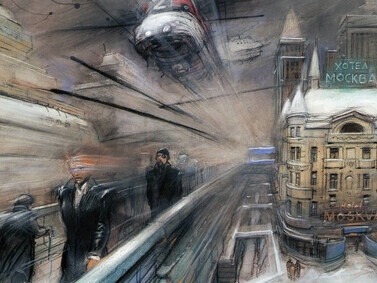
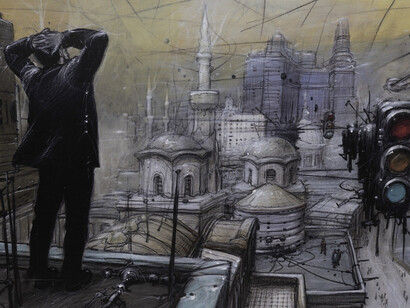
In most of his works, it’s possible to witness his own background, where the personal is always intertwined with political ideologies and socio-political complexities. To convey the ideological conflicts of his era and his then concerns originating from his past, which was characterized by the breakup of Yugoslavia and Cold War anxiety, he used science fiction as a medium to reflect. In The Dormant Beast, one can observe the futuristic, technologically advanced but ragged landscapes with their cold, faded colors and sharp lines, merging speculative fiction and realism.
Just like The Dormant Beast, it’s possible to hear the echoes of the war and political instability in The Nikopol Trilogy, again a blend of personal and political narrative. The dystopian world that he created in Nikopol is similar to the one in The Dormant Beast in that the world in both works is ruled by corrupt powers and oppressive regimes. He created a fictional world where the audience/ reader can witness the transformation of utopias into dystopias based on the false premises of changing regimes.
After taking refuge in France at the age of nine with his mother, the displacement and adjusting to a new culture found its place in his narratives with the characters who are outsiders or displaced figures navigating complex and often hostile worlds.
In another work, The Hunting Party, where he again illustrates a dystopian world that is ruled by a centralized power and citizens are constantly being watched, bears a trace of the bureaucratic and oppressive nature of the communist regime, which is marked by the repression of opposition and a lack of individual liberty. The Hunting Party is more closely related to the Cold War, as it tells the story of a hunting party organized in the Soviet Union.
The invitees are international communist leaders from the Eastern Bloc countries such as Poland, Hungary, Bulgaria, and Czechoslovakia, representing a failure, the end of an era, whose initial promise of equality and justice has been betrayed by corruption, bureaucratic inefficiency, and repression. It describes how the Communist project in Eastern Europe didn’t work. By the time The Hunting Party was written, it was the early 1980s, when the Soviet Union started to fall apart because of economic stagnation and a lack of faith in the government. When it was published, the Eastern Bloc was already in crisis, and the artwork had already promised the eventual collapse of this regime.
Yet, this was not Enki’s only prediction, when he was working on The Dormant Beast in 1997, he foresaw the fall of the towers of the World Trade Center (9/11/2001)8. It must not have been hard for Enki to foresee such political turmoils as he is an artist who acknowledged that today business, finance and thus technology controls everything.
He also noticed that the new generation was building a future for themselves with the help of new technology, and how this new world order paralyzes politics because the power dynamics shifted from the governments to the private companies, and thus, he believes this is the beginning of the end of a world.9 On the one hand, the development of technology and science fiction inspired each other, but on the other hand, these new technological advancements led to skeptical approaches toward the benefits of technology.
Artists like Bilal started to reflect on these insecure beliefs. He pondered upon the consequences of rapid technological advancements in contrast to their politics. Having already been familiar with the science fiction culture, he might have been inspired by the works of Philip K. Dick, whose works are adapted into cinema, such as Do Androids Dream of Electric Sheep, which was later adapted into Ridley Scott’s Blade Runner, Minority Report, and A Scanner Darkly.0 Embarking on the same ship as Dick, Bilal lines himself with the analog lifestyle. He claims that using comic books as a medium to communicate ideas leaves room for the reader’s imagination, as comic books don’t provide everything that we can get from a movie.
Again, in his interview in July 2014, when Paul Gravett asks him about how Enki’s films influence his comics, Enki responds that he is not in favor of making comics like films. Instead of producing comics in the format of movies, he made them more literary by adding more text narration and changing the page layout. According to Enki, “Cinema, by definition, shows the maximum, while literature demands that the reader imagine everything. Comics are a mixture of both, but if you put more emphasis on written text, you increase the reader's role to make their additional images in their head.”11
Opting for such an analog, old-school medium like comics in a digital era, Enki claims that to keep up with the digital revolution, one has to sacrifice one's life to its franticness, or else, s/he might feel lost and excluded. Bilal reflects his own dark visions of human fragility in the face of unbridled authority and corruption in his futuristic brush strokes in his comics.
In the creation of a work of art, the work is sometimes the author, and the characters carry a bit of the author. Although Alcide Nikopol is a fictional character, one can point out the similarities between the creation (Nikopol) and the creator from many aspects. For example, Bilal’s sense of displacement and the lack of belongingness due to his departure from Yugoslavia for France mirrors Nikopol, who wakes up from 30 years of cryogenic sleep in an era he feels he fell behind, alienated, an outsider.
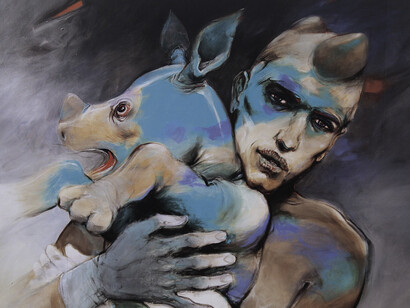
Moreover, just like Yugoslavia, the world Nikopol wakes up to is also one politically corrupted and under authoritarian control. It is not unexpected to claim similarities between the two as Enki dives deeply into personal topics in his works, and hence, his works are genuine and intimate, as his characters are not black and white; they have grey zones, flaws, and ambiguous morality. Melting all these into a single pot to cook his own unique style, he developed a complex structure of narrative with a dystopian taste by using a mixed media approach: watercolor combined with colored pencils or chalks to give a gritty feel, which contributes to the depth of the texture as well as the mood of the stories. This resulted in a mixture of realist and surrealist atmospheres.
In light of his background, Enki Bilal can be considered to be one of the significant graphic novel artists with his unique artistic style and distinctive perspective on the socio-political history of his home country, Yugoslavia. He is also a groundbreaking director with his contributions to cross-medial studies. His multifaceted storylines tackle the sociopolitical effects of advanced technology, hybrid identities, and dystopian futures. He is an inspiring science fiction genre writer who is still resonating with sci-fi appraisers.
As a pivotal European graphic novel artist and director, he helped shape what is considered to be post/transhuman within the limits of its genre by filtering his multicultural background at the same time, blending it with futuristically allegorized ancient drama. Enki Bilal's works transcend genre and philosophy, making him indispensable to both cyberpunk science fiction and post/transhumanist studies due to his ability to blend surreal visuals with profound philosophical issues about what it means to be human in a world where technology and artificial intelligence are taking over.
References
1 Dutrey, Jacques (July 1987). "Enki Bilal Wins Top Prize at Angoulême". The Comics Journal (116). Fantagraphics Books: 130.
2 Décret Du 29 Décembre 2022 Portant Promotion et Nomination Dans l’ordre National de La Légion d’honneur. Décret Du 29 Décembre 2022 Portant Promotion et Nomination Dans l’ordre National de La Légion d’honneur - Légifrance.
3 Le Jury du 72e Festival de Cannes. Festival de Cannes, 29 avril 2019.
4 Sampanikou, Evi D. “Chapter One Postmodernism, Posthumanism, and Transhumanism in Science Fiction: Graphic Novels. Enki Bilal and The Hatzfeld Tetralogy.” Audiovisual Posthumanism, Cambridge Scholars Publishing, 2017, pp. 192.
5 Sampanikou, Evi D. “Chapter One Postmodernism, Posthumanism, and Transhumanism in Science Fiction: Graphic Novels. Enki Bilal and The Hatzfeld Tetralogy.” Audiovisual Posthumanism, Cambridge Scholars Publishing, 2017, pp. 192.
6 Interview: Enki Bilal | Paul Gravett, 6 Oct. 2013.
7 Gravett, Paul. “Enki Bilal.” ArtReview RSS, 21 July 2014.
8 Ibid.
9 Ibid.
10 Ibid.
11 Ibid.