English
 Español
 Français
 Deutsch
 Italiano
 Português
The first time I saw a photograph of a Jeulmun pot, I didn’t see just a container; instead, I saw a handprint. Not the literal kind pressed onto ancient cave walls, but an imprint of thought. Of someone…long ago…deciding not just to make something functional, but beautiful. Decorative. Symbolic.
That moment, for me, was deeply moving.
Because it wasn’t just about pottery, it was about presence.
As an artist who paints what I call Soulscapes, I often trace the emotional and spiritual fingerprints left behind by human experiences. And when I look at early artifacts like Jeulmun pottery, I find myself standing in awe of how those ancient hands were already echoing something profoundly human: the need to express, to design, and to mark time.
A quiet revolution in clay
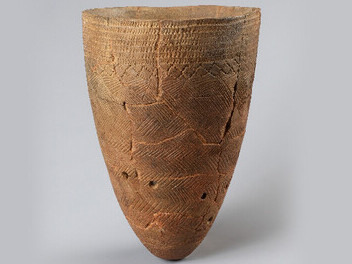
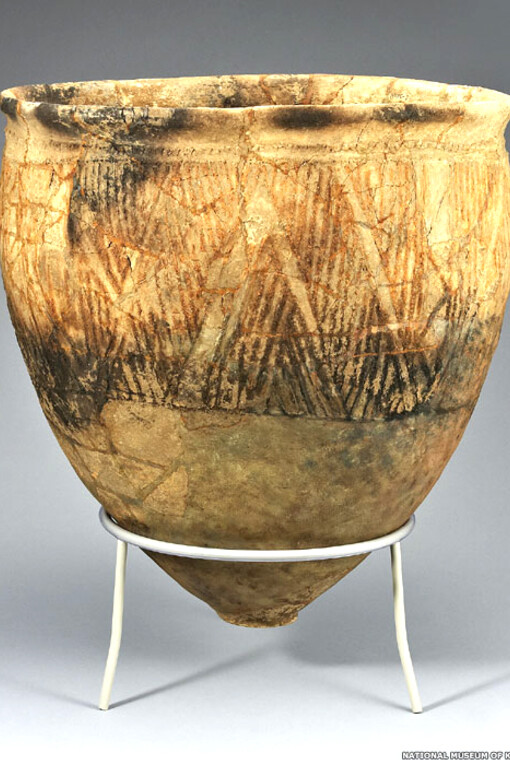
Jeulmun pottery, emerging in what is now the Korean Peninsula around 8000 BCE, is among the oldest known pottery traditions in East Asia.
But this wasn’t just about shaping clay to carry water or store grains. It was about form—meeting spirit.
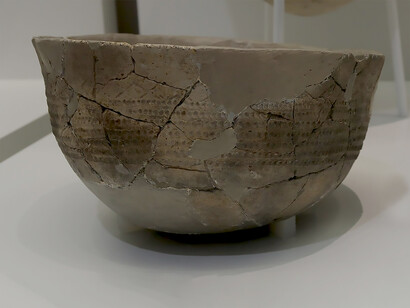
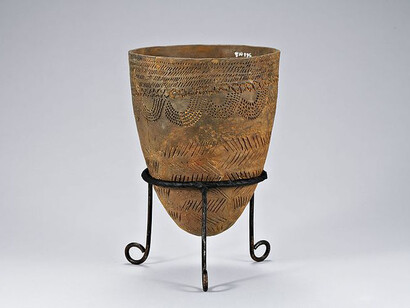
The very word "Jeulmun" refers to the comb-patterned incisions that decorate many of these vessels—linear, geometric, and deliberate. They weren't random scratches. They were chosen marks.
We often associate the Neolithic period with raw survival…hunting, fishing, and foraging.
Yet, even amid such primal needs, early humans were making art. And not just on cave walls. They were folding it into daily life, into practical objects, and into the rhythms of existence.
In the Jeulmun culture, you can feel this shift. From mere survival to the shaping of identity.
A story etched in patterns
The earliest Jeulmun pottery tends to have simple, linear patterns, cross-hatching, parallel lines, and zigzags. As time went on, the designs became more complex, even ornate.
What changed? Perhaps it was more than just aesthetics. Perhaps it was about memory. Legacy. Community.
We have no written records from this era, but we have these patterns, etched into clay like whispers from another world. Some vessels resemble fishnets; others mimic waves.
Were they symbols? Calendars? Stories? As an artist, I often feel that symbols choose us as much as we choose them. They rise from the subconscious. And it’s entirely possible that the Jeulmun people were imprinting their connection to nature, to seasons, and to the unseen realms through these patterns. Not as decoration. But as devotion.
The feminine principle in clay
There is something deeply feminine about the act of shaping clay. The earth cradled in hand, softened with water, spun and formed and baked by fire. Creation itself…made manifest.
Many scholars argue that early pottery-making was likely a task taken on by women.
In the Jeulmun culture, where nomadic lifestyles began giving way to semi-sedentary settlements, pottery might have marked a pivotal moment in the rise of community, kinship, and ritual.
I find this connection stirring. Because in my own life, art has always been my heart. A quiet space where something intangible takes shape. Where pain becomes paint. Where silence becomes color.
Could it be that Jeulmun pots were not just tools but altars? Could the very act of creating them have been a sacred practice?
Ancestral threads and global echoes
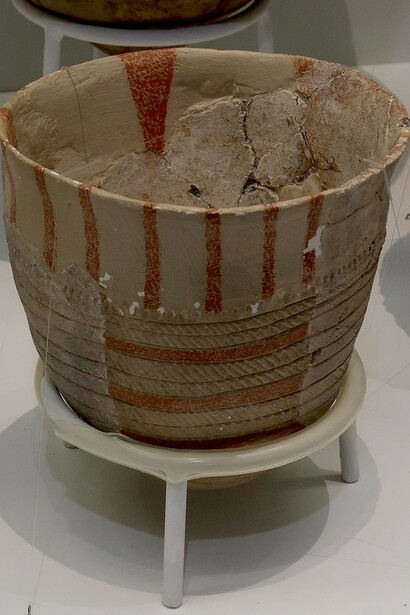
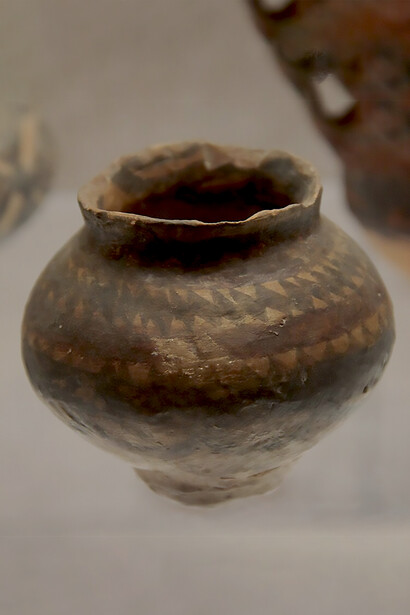
What fascinates me most is how similar these ancient Korean pots are to other early pottery found across the world. From Jomon in Japan to Cardium in the Mediterranean, we see similar techniques, comb patterns, round-bottomed vessels, and burnt clay textures.
These were cultures that had no way of communicating with each other.
No trade routes.
No shared language.
And yet, their hands moved in unison across time and space.
This is what I explore in my Journey of Art series: the mystery of collective human consciousness.
How art becomes a bridge. How, in separate corners of the earth, people began expressing the same instinct to shape, adorn, and preserve.
To me, this speaks of something far deeper than invention. It speaks of intuition. Of the human soul reaching out, again and again, to carve meaning into matter.
A mirror to our own becoming
When we look at Jeulmun pottery, we are not just looking at the past.
We are looking at our own becoming.
These ancient vessels hold more than water or grain.
They hold time.
They hold transformation.
In every carved line, we see a person who paused to make something not just useful, but beautiful.
Who looked at the earth and said, “Let me make something of this.” And in doing so, became more human.
That, to me, is the essence of art. Not what it looks like, but what it leaves behind.
Conclusion: a vessel still speaking
Thousands of years later, the Jeulmun pots are still speaking.
They speak to the part of us that longs to leave a mark. That reaches for rhythm, for pattern, for meaning.
They remind us that before there were cities and scripts and machines, there was clay and hand and soul.
That we have always been artists, even when we had no word for art.
As I continue my own journey as a painter and storyteller, I carry these echoes with me. I see them in the grooves of the canvas, in the dance of pigment, and in the silence between brushstrokes.
And in that quiet place, I meet the Jeulmun potter, still kneeling at the edge of time, pressing her thumb into soft earth, shaping not just a vessel… but a memory.