English
 Español
 Français
 Deutsch
 Italiano
 Português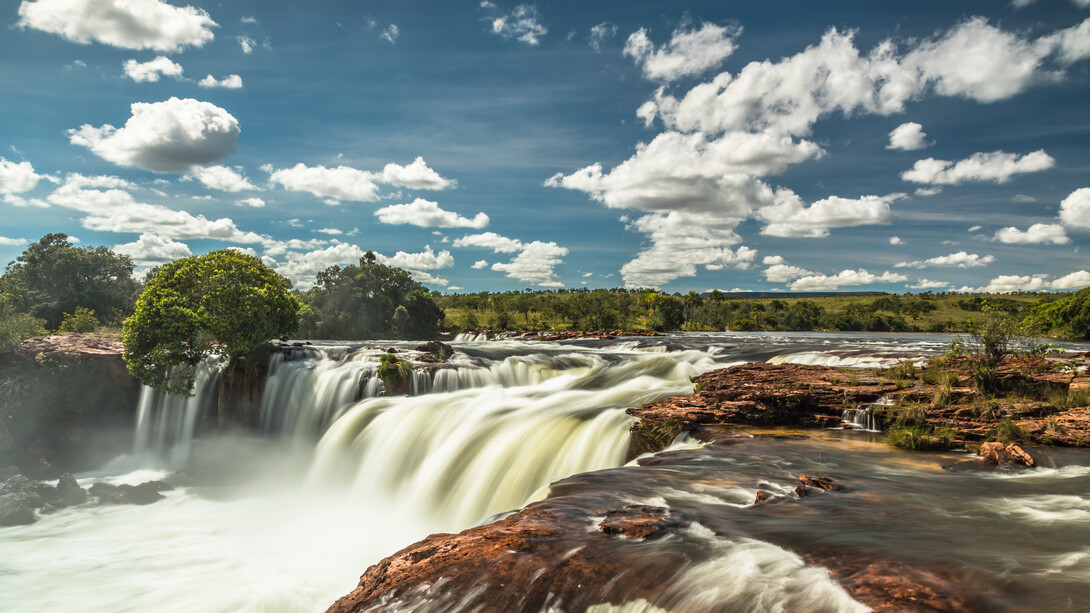
Jalapão is a fantastic tourist destination located in Brazil's newest state, Tocantins. It's the perfect place for those who love nature, culture, diversity, extreme sports, and breathtaking landscapes. Considered an ecotourism and adventure tourism destination, the place is located in a forested region that transitions between the Cerrado and the Caatinga biomes. It is also considered by many to be the Brazilian savanna, due to the region's physical and climatic characteristics, which also feature many waterfalls, fervedouros, crystal-clear rivers, and dunes.
Jalapão State Park is considered an environmental conservation unit, located 180 km from the capital, Palmas, in the eastern region of Tocantins. The park also encompasses four municipalities within its territory: Mateiros, Novo Acordo, Ponte Alta do Tocantins, and São Félix do Tocantins. Important cities in the state that still reflect the ancient customs and knowledge of the region, making them very culturally rich.
Covering a total area of 34,000 km² and with an average temperature of 30°C, this state park stands out from other natural parks worldwide. The uniqueness of the place lies not only in what can be seen but also in the history and biodiversity. Jalapão's biome is the Cerrado, one of the most biodiverse in the world. However, it is also located in an ecological transition zone between the Caatinga and the Amazon. There, one finds a great diversity of medicinal plants, springs, and freshwater aquifers, as well as a range of species adapted to the extreme climate.
The park is also a traditional territory of the indigenous people of the Macro-Jê linguistic family, such as the Xerente, Xavante, and Javae. Native people who, even today, still resist and keep their culture, religion, and history alive. The area is home to quilombola communities as well, territories formed by the descendants of Black people who escaped Brazilian slavery in the 18th century. The most prominent quilombos are the communities of Mumbuca, Prata, and Carrapato. Jalapão is special because it brings together traditional peoples and high ecological diversity in one place, all within a territory that has been little colonized and industrialized.
Main attractions
Waterfalls and beaches
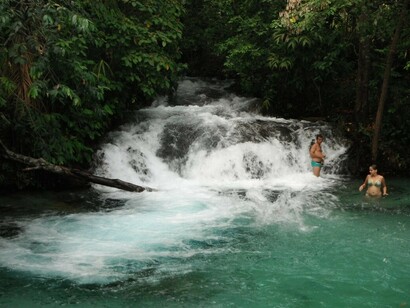
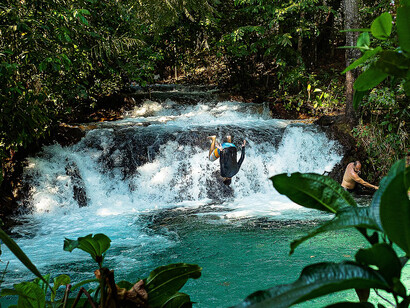
Jalapão has many waterfalls of different styles and crystal-clear waters, perfect for relaxing and enjoying with family. Freshwater beaches are also great options for cooling off in the region's hot climate. The most recommended waterfalls are:
Cachoeira da Velha: A postcard-perfect image of Jalapão, the Cachoeira da Velha waterfall is the largest in terms of water volume. Shaped like a horseshoe, this waterfall is only for viewing and contemplation; it is impossible to enter due to the force of the water.
Cachoeira do Formiga: It is one of the most beautiful waterfalls and a popular attraction in Jalapão, with crystal-clear blue waters.
Cachoeira das Araras: It's a 10-meter-high waterfall with crystal-clear, green water. It's great for swimming, but caution is advised due to deep spots and large rocks at the bottom.
Prainha do Rio Novo: The beach features a sandbar, clear waters, rocks, and surrounding vegetation. Nearby, the community offers a restaurant, restrooms, and a relaxation area.
Lagoa do Japonês: It doesn't belong to the Jalapão State Park area, but rather to the Serras Gerais, another fantastic destination in Tocantins. However, the beauty of the Lagoa do Japonês attracts many tourists, leading travel agencies to include this stop in their itineraries.
Fervedouros
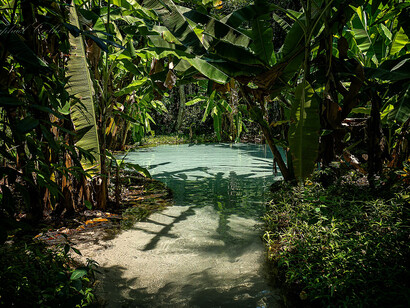
The fervedouros, as they are known in Portuguese, are natural freshwater springs where underground pressure keeps visitors floating, the most sought-after attraction in Jalapão. The edges are usually shallow and the center very deep, with some reaching up to 70 m in depth. Although it sounds frightening, the pressure from below prevents the body from sinking. The sensation is as if the body were inside quicksand. Among the most visited are:
Fervedouro do Ceiça: One of the most beautiful in the region, it has a circular area of 6 to 8 meters in diameter and features transparent water in shades of blue and green.
Fervedouro Bela Vista: It's the largest fervedouro in Jalapão so far. Also featuring crystal-clear waters and white sand at the bottom, Bela Vista is also the most structured. It has a restaurant, inn, and camping area.
Fervedouro Buritizinho: It is the smallest fervedouro in Jalapão, with a capacity of only 6 people. It has a strong blue hue and plenty of vegetation around it.
Fervedouro dos Buritis: This popular fervedouro gets its name from the buriti palm trees surrounding it, a fruit characteristic of the Cerrado biome. Viewed from above, the fervedouro dos buritits has the shape of a heart.
Dunes
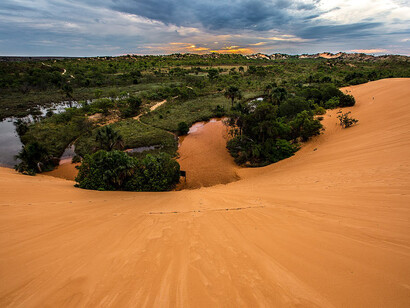
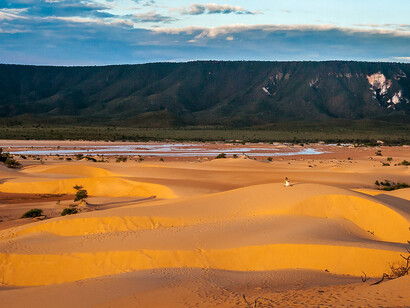
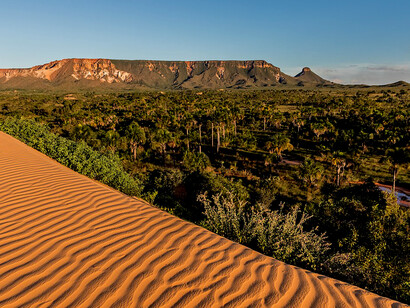
The golden dunes are another unmissable tourist attraction and perhaps the main postcard image of Jalapão. The sandbanks are formed by the erosion of sandstone rocks present in the region, which are carried by the wind and deposited there. The dunes also have a small stream alongside them and some buriti palm trees, complementing the breathtaking landscape. Often visited in the late afternoon, when visitors can sit and watch one of the most beautiful sunsets in the world.
Serra do Espirito Santo
Although Jalapão is surrounded by plateaus and rocky cliffs, the Serra do Espírito Santo is the symbolic image of the state park. A famous destination overlooking the Jalapão dunes, the place is quite popular with those who enjoy hiking to the top (about 3 km of steep trails). The itinerary usually includes a hike that starts at dawn and ends at the top of the mountain as the sun is about to rise. The scenery is spectacular. Honorable mention also goes to Serra da Catedral, another famous spot where tourists often stop their cars to take photos at the foot of the mountain.
Quilombola communities
As said above, quilombola communities represent cultural resistance, resilience, and the history of a people extremely connected to the cerrado biome. Located within the Jalapão State Park, these communities are rich in ancestral traditions and knowledge, an important reason why they must be preserved. The community has its own social organization, with houses, families, restaurants to receive tourists, bathrooms, rest areas, and shops made of adobe and wattle and daub, where they sell their handcrafted products. The most famous communities are
Comunidade Mumbuca: It is the best-known quilombola community of all, very famous for its handcrafted production of bags, hats, and jewelry. The raw material used in the making is usually the Capim Dourado, a type of everlasting flower native to the Cerrado that resembles golden grass. Responsible tourism in the area generates income for residents and strengthens the local culture.
Comunidade do Rio Novo: Well known for selling handcrafted goods, but also for artisanal fishing. The Prainha do Rio Novo near the community attracts tourists who visit the area to have lunch, relax, and explore.
Sports tourism
Jalapão is also very popular with those who love adventure and want to try extreme sports. The activities can be done at different points in the park and are always accompanied by a guide with appropriate protective equipment. Among the best-known and most practiced sports are tubing, trekking, hiking, rappelling, stand-up paddleboarding, zip lining, and rafting.
Travel style
Jalapão is not a destination for just anyone. To fully enjoy the trip, visitors need to have an adventurous spirit and like being in contact with nature. The trails and roads can only be traversed with a 4x4 vehicle, as most tourist spots are isolated deep in the forest. Even with support from the agency and guides, the brutal nature of Jalapão is challenging.
For people seeking a way to disconnect from the outside world and enjoy a relaxing trip, Jalapão offers great options too. It's not all about adventure, extreme sports, and adrenaline all the time. The destination also offers customized itineraries for those seeking only comfort, from relaxing guesthouses and homemade food to visits to communities and less challenging activities.
Although it is permitted for people to go to Jalapão on their own, provided they have the appropriate vehicle, the most common and sought-after way is through tourism agencies. There are many companies currently working with this destination, each offering its own packages and prices. It's possible to book small packages as well as large ones, with trips ranging from 3 to 7 days, or more if desired.
Many packages include transportation from the hotel/airport to the destination, accommodation, and meals. The typical people most attracted to this destination are adventurous travelers, couples, small groups, families, and people who enjoy ecotourism. It is possible to customize the trip in terms of length of stay, tourist attractions, preferred accommodations, and extra activities.
Best time to visit
Jalapão is open every day of the year, allowing visitors to choose when they wish to go. However, the travel experience can vary depending on the season. Unlike other countries and even several parts of Brazil, Jalapão is located in the Brazilian Cerrado, and the seasons there are different. There are only two seasons in the year, the dry season and the rainy season.
The dry season, considered by many to be the best time to visit Jalapão, runs from May to September. The roads are in better condition, the water in the fervedouros and waterfalls is clearer, and there's less risk of getting stuck. However, it's the busiest season, so be prepared for long lines and higher prices.
The rainy season extends from October to April, and it is the period with the lowest volume of visitors. This is due to the heavy rains that fall in the region during this period, the muddy roads that are often difficult to navigate, and the greater logistical risk in relation to some attractions that are affected by rain and wind. At this time of year, prices are better, and you can avoid huge queues, but plans and tours may change or be cancelled depending on the weather.
How to get there
Anyone wishing to go to Jalapão must necessarily depart from Palmas, the capital of the state of Tocantins. So if you are coming from another part of Brazil, or even from other countries—Jalapão receives many foreigners every year, with English-speaking guides—you will need to land first at Palmas airport. The main connecting flights from Brazil to Palmas depart from Brasília, Goiânia, and São Paulo. The capital boasts a great selection of restaurants, hotels, bars, squares, and parks. Perfect for exploring for a few days before heading to Jalapão.
If you choose to travel through a travel agency, the contracted company will pick up tourists at their doorstep with a 4x4 car, wherever they are in Palmas. The paved route goes all the way to the city of Ponte Alta do Tocantins, and after that, it's only dirt or sand roads. Beyond this city, it is also common to pass through other towns located within the Jalapão region, such as Mateiros and São Félix do Tocantins. Stops are made for bathroom breaks, refueling, and rest, as the journey is long. From Palmas to Jalapão, it's about 300 km, with an average travel time of 5 to 7 hours.
Tips
In addition to the tips already mentioned above, such as the best time of year to visit Jalapão and hiring a tour agency with a guide for a better, safer experience, there are other essential points. Due to the region's warm climate, it's super important to remember to pack essential items in your suitcase. Do not forget:
Lightweight summer clothes.
Swimsuit and personal towel.
Flip-flops, sunglasses, and a cap.
Hiking or trail running shoes.
Sunscreen and insect repellent.
Cash only (some places, especially in communities, do not accept cards).
Water bottle.
Personal care medications.
It's important to emphasize that it's necessary to respect local communities and pay attention to what the guides recommend. Jalapão is a unique and wonderful destination located right in the center of Brazil; it's definitely worth a visit. I've been there 3 times, and I always find myself wanting to return. This place offers history, culture, nature, and inner peace and will completely change your perspective on humanity and nature. So, what are you waiting for? Let Jalapão surprise you.