English
 Español
 Français
 Deutsch
 Italiano
 Português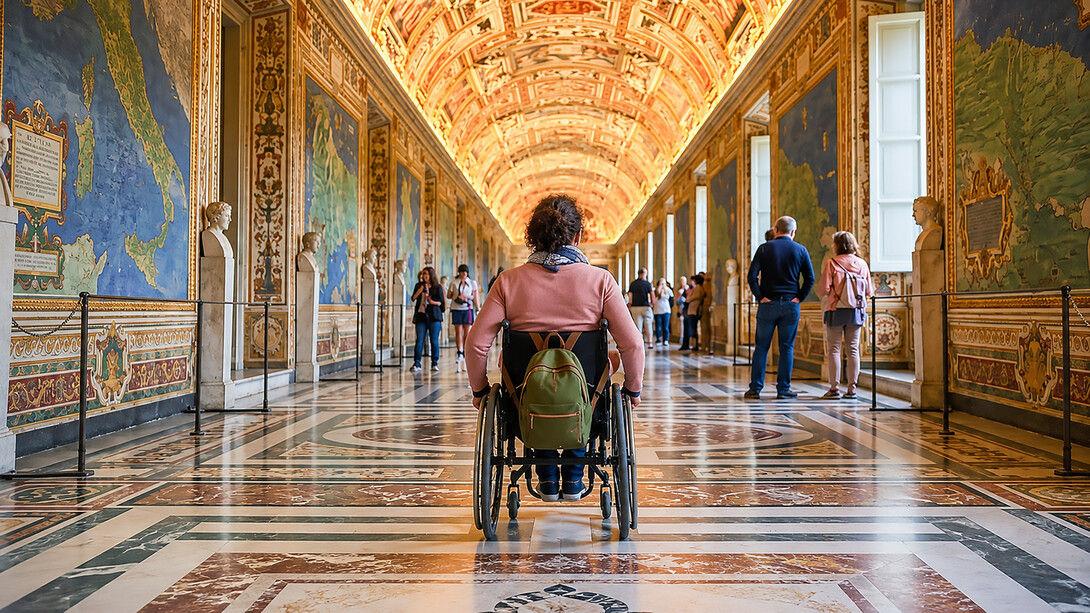
The Vatican Museums and the Sistine Chapel welcome all visitors with mobility issues and are committed to making their programmes and services accessible to everyone. Personal wheelchairs, both manual and electric, are allowed in the museums and the Sistine Chapel.
Complimentary manually operated wheelchairs (not electric) are readily available, free of charge, after you first enter at the Vatican Museum's cloakroom—no reservation required. You will be asked to provide a valid personal ID, which will be kept as a deposit during your visit.
Don’t be embarrassed if you desire a wheelchair! It allows you to move faster, have a seat when you need it, and avoid stairs or long walks that might otherwise end your visit earlier than expected due to exhaustion. Please consider that it is a long walk to the Sistine Chapel (up to 2 km), and there are stairs to enter. Also, please note that there are limited areas where a person can sit down, since the Vatican Museums are not laid out like a standard modern museum.
I reach out to one of my colleagues who often does tours of the Vatican Museums and the Sistine Chapel for her recommendation.
Accredited Tour Guide in the Vatican Museums, Andrea Stoler
First, please consider doing the Vatican Museums and St Peter’s Basilica on separate days, as both are crowded and it can be exhausting all on the same day. If not possible, then give sufficient time between both places (minimum one hour – best at least two) to rest, get refreshed and relax. The basilica has priority entry for wheelchairs.
As for the Vatican Museums, free entry is available for wheelchair users with a certified disability card or statement, as well as for their carer. If not, wheelchair users must either have a pre-bought ticket or obtain one inside. This should be investigated prior to purchasing tickets for your museum visit.
I would suggest an early morning visit, just as the Vatican museums open. The galleries are not yet crowded, and you can be one of the first to arrive at the Sistine Chapel. Afterwards, you can return along the long hallway leading from the Sistine Chapel and then continue on to the Raphael Rooms and other areas of the museum at your own pace.
When first entering the Vatican Museums, normally only the person in the wheelchair and her/his carer will be allowed to skip the line and enter quickly.
Other family members must enter according to their time slot and entrance point on their tickets, with no exception. However, there is a nice space inside to wait, just after the security point for your group; bathrooms and machines to buy bottled water for 1 euro are available.
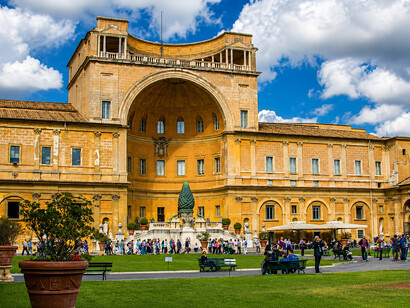
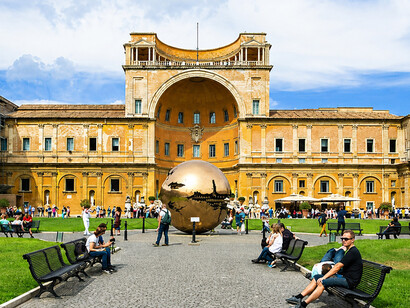
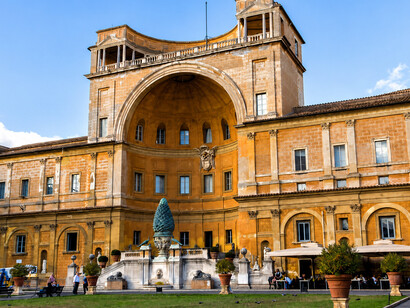
However, the routes for wheelchair users and caretakers are different, and the family are normally together until the Pinecone courtyard. Then the group must return backwards to the four-gate entrance and ask permission to proceed down the corridor. Sometimes the whole family group is not allowed – only the wheelchair user and caretaker. It is best to decide on a place to meet inside the Sistine Chapel before you separate. A suggestion is to meet in the back of the chapel, which is where the wheelchair access is located and easy to meet up. If this occurs, the wheelchair user and their carer will proceed along the long corridor to the very end, where the guard staff will assist them with access to the Sistine Chapel. The rest of the group will continue along the standard route, including the stairs, to reach the Sistine Chapel.
Once you are in the Sistine Chapel, you can meet up with your group. If you want to move to the front, the guards are very helpful in this task, helping make way for the wheelchair. When you are done with your visit, your whole group can leave together out of the Sistine Chapel on the left to go to the museum exit and take the elevator to exit or return the wheelchair. Visitors with wheelchairs are obliged to return the same in which they arrived.
Again, there is no direct access from the Sistine Chapel to Saint Peter’s Basilica for visitors with wheelchairs.
Is there a difference in visiting the Vatican during high season and low season?
Summer months, Christmas and Easter are considered high season, and the museums will be extremely crowded. Keep in mind that there is limited air-conditioning until you get to the gallery of tapestries where new air conditioning units have been installed and then until you get to the Sistine Chapel; therefore, it will become a physically challenging experience for everyone and a long-time consuming experience.
Saint Peter’s Basilica
What are your suggestions for visiting Saint Peter’s Basilica with a wheelchair?
What you will need to do is return to the museum entrance, take the elevator down, and then follow the outer wall around to St Peter’s Square, about a 15-minute walk. From there, you will pass through security again before entering the Basilica. This is the point where, if doing all this on the same day, I recommend a break for a while from the crowds and excitement.
How do wheelchair visitors enter?
Once you do that, then proceed to Saint Peter’s Square. You go to the large colonnades on the right, where you will find a disabled sign for wheelchair access. Follow the arrow and proceed inside the colonnade to the police guards, who will immediately assist the person in the wheelchair, carer and family to go through security. After that, either go up a ramp or use the elevator located on the right side to ascend to get into the basilica. Please do not hesitate to ask staff for assistance, as it is they who will take you up one level to the front of the basilica. The elevators are located in the same area as the access point for the dome, the restrooms, and other visitor facilities.
Mobility issues?
Also, for those with mobility issues, there is a possibility to acquire a manual wheelchair in this area if available, similar to the Vatican Museums.