English
 Español
 Français
 Deutsch
 Italiano
 Português
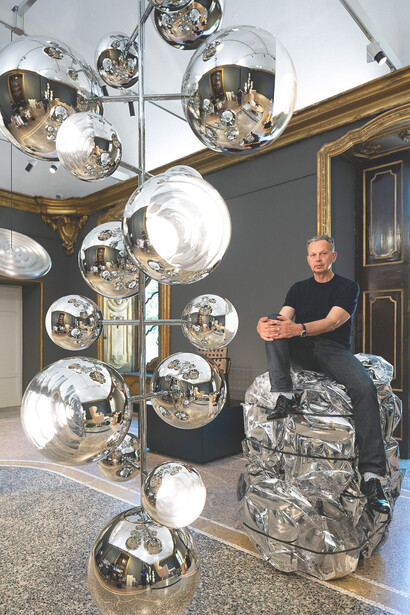
Tom Dixon, known in the mid-1980s as ‘the talented untrained designer,’ took a leading role in the creative salvage movement, where transformation and juxtaposition were key to revolution and new beginnings.
During the initiation of his career, Dixon established the style of improvisatory bricolage, often incorporating industrial rejects and vintage metal scrap.
I do think that the punk movement definitely did liberate a whole generation of people from feeling that they had to a. conform, or b. even be any good in a formal way to produce’. The most important thing became attitude and uniqueness and not a polished outcome. That was pretty unique to London at the time, and definitely the key was unlocked by a series of non-musicians that became the punk bands. That’s what we did in furniture, we created our own exhibitions, we made it up as we went along and the most important thing was to have a recognizable attitude and manifesto rather than a series of very polished manufacturing or craft skills.
(Tom Dixon)
Dixon’s early career began with a series of welded salvaged furniture. In 1984, he collaborated with dynamic like-minds, Mark Brazier-Jones and Nick Jones Young, showcasing their distinctive and eclectic style through objects that were assembled from scrap materials such as scaffolding clamps, slabs of granite, and fragments of glass. The artists shocked people with the unceasing production of unfamiliar works, influenced by over-consumerism, over-production, and the desire to encourage people to find value in the devalued. This punk approach shaped criticism on such matters to create some of the most informed objects of the time.
Their alliance was known as Creative Salvage; they were founders of a movement that rejected clean and pure form to bring forth complex literature that aimed to produce conversation and thought that surpassed the confines of the ‘then’ design language. Many of their early exhibitions successfully produced attention-seizing displays that facilitated the staging of each artist.
The trio were the epitome of non-conformation; Brazier-Jones, Dixon, and Jones published an anti-consumerist manifesto for their exhibition in 1985. ‘Creative Salvage’ is a rapidly expanding development company. We are convinced that the way ahead does not lie in expensive, anonymous, mass-produced, high-tech products. But in a more decorative and human approach to industrial design, the key to Creative Salvage’s success does not lie in the expensive research and development costs of modern-day products. But in the recycling of scrap to form stylish and functional artifacts for home and office.’
Their works appealed to people who adopted a longing for excitement and surprise in the everyday object. By the late 1980s, Tom Dixon was working for the Italian designer Cappellini, for whom he created the renowned ‘S’ chair. It is an artisanal contemporary object that displays his innovative use of recycled materials, which was effectively transformed into a true industrial masterwork, without dropping the spirit of the original product.
This chair can be found in the permanent collections of the world’s greatest museums, from the Triennale in Milan to the MoMA in New York. A dark varnished metal structure: the first original version is upholstered with marsh straw, and the weaving is done entirely by hand—a thorough process that commands intensive hours of craftsmanship.
Dixon’s successes led to his position as head of design at Habitat, later becoming creative director. In 2002, he also set up his own brand, Tom Dixon, which attained an influential position in design. In his own words, ‘I don’t really act like a designer; I’m interested in entrepreneurship, the communication of ideas, the sculpture of an object, the engineering to bring it to market, and the craft involved in the process. Luckily, design allows me to activate all of these disparate threads in my own brand.’ At large, Dixon believes that designers should be responding to what is going on in the world, not living in the designer bubble. Which is an ethos that has continually occurred, evident in his works from the beginning.
A notable exhibition at Friedman Brena, ‘Accidents Will Happen: Creative Salvage, 1981–1991,’ which was curated by Gareth Williams, commemorates the first international demonstration dedicated to creative salvage furniture, highlighting key works from an often ignored but extremely influential period of British design that exploded out of 1980s London.
It attained a critical moment in the sequence of design history to educate on a thrilling narrative through a treasure of contemporary archival material. It was against the scene of a country under constraint that this group of risk-taking and disordered creatives forged ahead, making furniture and utilizing the simplest of materials and tools.
They were magicians who recovered steel rods to rearticulate into rococo-inspired forms; corroding frames and dumbbells became the mechanical support on chairs, and chandeliers were created from broken glass bottles. They found new purpose for discards, an idea that stripped bare the preconceived stigmas ascribed to reuse.