English
 Español
 Français
 Deutsch
 Italiano
 Português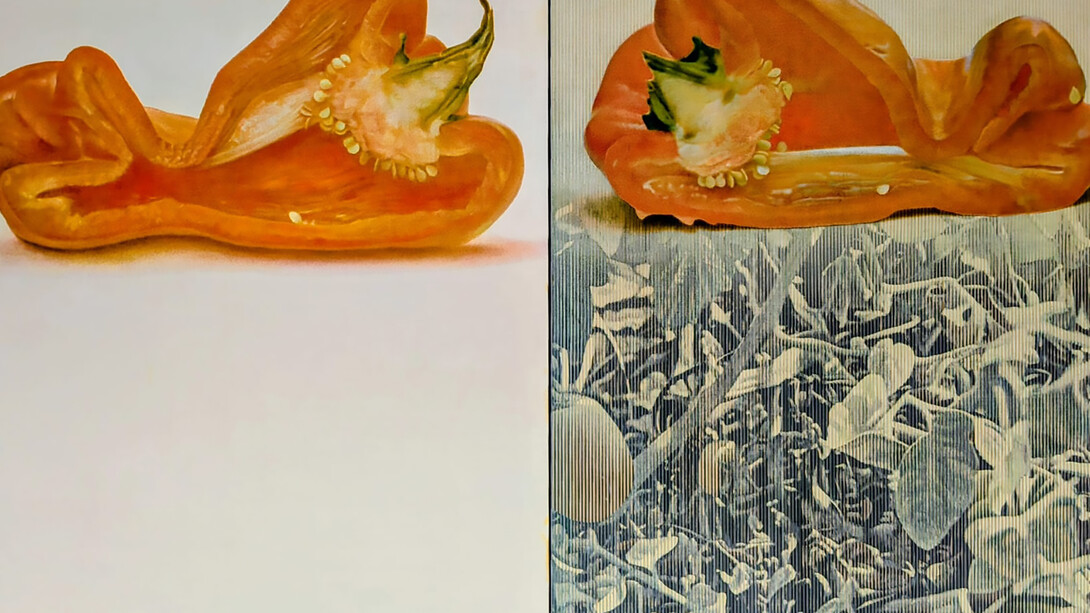
My title refers directly to Umberto Eco’s Travels in Hyperreality, which is less a book about museums than about the modern compulsion to experience reality through its intensifications: replicas more vivid than originals, narratives more legible than history itself, and images that insist on meaning rather than ambiguity.
Walking through the Museo de Arte Contemporáneo de Alicante (MACA), housed in the austere yet luminous Gravina Palace, one senses a related condition. The museum is not a neutral container for Spanish modern and contemporary art; it is a carefully calibrated environment in which objects, ideologies, and materials compete to construct heightened versions of reality—political, perceptual, and corporeal. MACA becomes, in Eco’s sense, a journey through hyperreal states: where representation exceeds depiction, and matter insists on interpretation.
This tension is announced immediately in Rafael Luis Armengol Machí’s Pebrot partit (Split Pepper, 1985). Presented as a monumental diptych, the work stages a confrontation between hyperrealistic illusion and patterned abstraction. The left panel renders a split pepper with forensic precision: flesh taut, seeds luminous, surface textures obsessively detailed. It is a still life that refuses modesty, inflating a humble vegetable into an object of visual excess. Opposite this, the right panel dissolves referential certainty into a monochromatic field of vertical lines, suggestive of ground, vegetation, or perhaps data—an abstracted residue of nature. The pepper, already split, becomes emblematic of the painting’s logic: reality divided between what can be seen too clearly and what can no longer be read. Eco’s hyperreality thrives here, not in fakery, but in over-clarity, where the real is rendered so intensely that it borders on the artificial.
If Armengol Machí amplifies perception, Pamen Pereira’s Lecho de piedra (Stone Bed, 2001) withdraws it. Carved in granite, the sculpture resembles a bed or resting place, yet its material denies comfort, warmth, or human accommodation. The bed—one of the most intimate and bodily of forms—is transformed into a funerary, geological presence. Its stillness resists narrative; its weight resists metaphor. In the context of MACA, the work reads as a counter-hyperreal gesture: not a simulation, but an insistence on matter’s indifference to human projection. And yet, paradoxically, this refusal heightens its symbolic charge. The stone bed becomes more “bed-like” precisely because it cannot function as one, an object whose meaning is intensified by its negation.
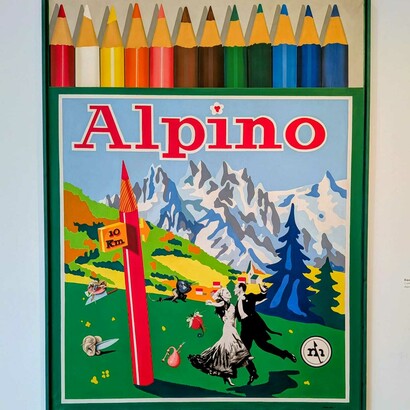
The pop-art irony of Equipo Crónica’s Alpino (1974), by Rafael Solbes and Manolo Valdés, returns the visitor to the terrain of cultural hyperreality. Depicting an oversized box of Alpino coloured pencils—a ubiquitous school object in Spain—the painting operates as both collective memory and ideological critique. The familiar commercial design is rendered monumental, flattened, and stylised, transforming a childhood artefact into a pop icon. Yet unlike American Pop’s often celebratory tone, Alpino carries a distinctly Spanish political inflection. Created during the final years of Francoism, it suggests how mass-produced images educate, discipline, and normalise. The pencil box is not merely nostalgic; it is a device of cultural formation. Here, hyperreality lies in recognition: the viewer knows the image instantly, perhaps too well, and in that instant the work exposes how deeply images script social experience.
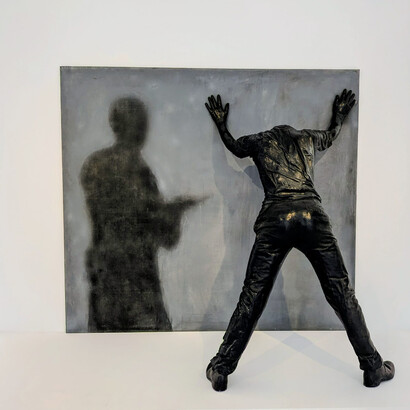
That scripting becomes violent in Rafael Canogar’s El Arresto II (1972). Breaking decisively with the flatness of painting, Canogar thrusts the figure into three dimensions. A human form, hands raised against the wall, is rendered as a sculptural relief, while a painted shadow figure—armed, faceless—looms nearby. The work collapses the distinction between representation and event. It is not an image of repression so much as a reenactment of it. The viewer is implicated spatially, forced into proximity with the arrested body. Eco wrote of museums that seek to make history “more real than real”; Canogar achieves this through physical intrusion. The hyperreal here is ethical rather than optical: the artwork refuses distance, demanding recognition of dehumanisation as lived experience rather than an abstract theme.
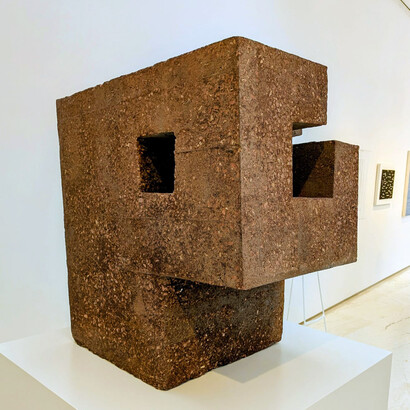
Spatial intensity is also central to Eduardo Chillida’s Leku III (1970). Constructed from reinforced concrete, the sculpture emphasises volume, void, and the tension between mass and openness. Chillida’s work does not represent space; it creates it. The coarse texture and weight of the concrete assert gravity and permanence, yet the internal apertures invite movement and contemplation. In MACA’s galleries, Leku III functions as a pause—a sculptural syntax that slows perception. If hyperreality is an excess of meaning, Chillida offers an alternative: meaning as a spatial encounter. The sculpture is neither symbol nor narrative but an experiential proposition, grounding the visitor in physical presence.
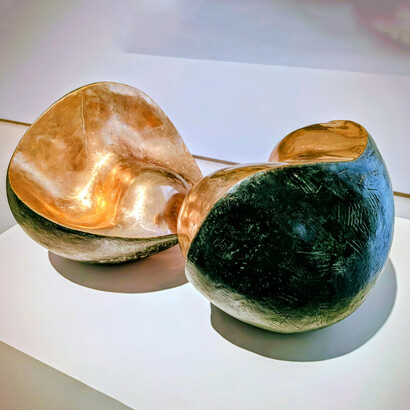
Pablo Serrano’s Unidad Yunta (1973–1977) similarly explores duality, though through contrast rather than void. The bronze sculpture’s exterior bears a dark, patinated surface, while its interior curves gleam with polished gold. The form suggests pairing, labour, and interdependence—“yunta” evoking yoked animals or collective effort. The hyperreal effect arises from the material dialogue: roughness against refinement, concealment against revelation. The sculpture stages unity not as harmony but as tension, a condition that must be continuously negotiated.
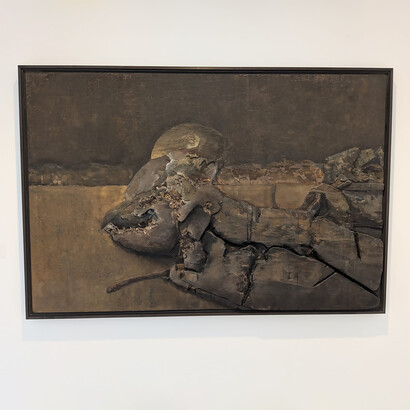
That tension explodes into material expressivity in Lucio Muñoz’s Caída del Pecún (1976/1977). This mixed-media relief, combining oil, wood, and other materials, obliterates the boundary between painting and sculpture. The surface is wounded, fractured, and layered, evoking geological collapse or organic decay. There is no image to decode, only material insistence. In the aftermath of post-war abstraction, Muñoz’s work embodies a hyperreality of matter itself: texture becomes content, and damage becomes meaning. The “fall” of the title is less a depicted event than a physical condition enacted on the panel.
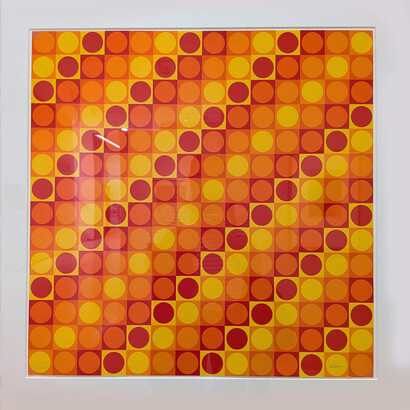
The optical restraint of Joël Stein’s untitled work (1975) introduces a different register. As a member of GRAV, Stein pursued perceptual instability through optical systems. His work at MACA engages the viewer’s eye rather than emotion, producing subtle vibrations and shifts. The hyperreal here is perceptual: reality destabilised by vision itself. There is no illusion of depth or narrative, only the awareness that seeing is an active, unreliable process.
Taken together, MACA’s modern collection constructs a layered journey through Spanish and European post-war art, where politics, perception, and materiality intersect. The museum does not offer a single narrative of modernity but a series of intensified realities—some seductive, some oppressive, some obstinately mute. In Eco’s terms, this is not hyperreality as spectacle but as condition: a world in which representations, objects, and materials exceed their assigned roles. To travel through MACA is to encounter art that insists on being more than itself and, in doing so, reveals how fragile our definitions of the “real” have always been.
Yet this journey through hyperreality ends not in alarm but in a quiet, almost disarming reassurance. There is a slight sense of security afforded by the collection’s historical distance, its concentration around the 1960s and 1970s, and the now-familiar languages of modernism and late dictatorship critique. These works speak of repression, material struggle, and ideological conflict, but from a terrain that feels resolved, archived, and culturally metabolised. In contrast to the uncertainties of much contemporary art—mirroring today’s geopolitical volatility—MACA’s collection reassures and delights more than it challenges or destabilises. In the present climate, this restraint feels less like avoidance and more like relief.