English
 Español
 Français
 Deutsch
 Italiano
 Português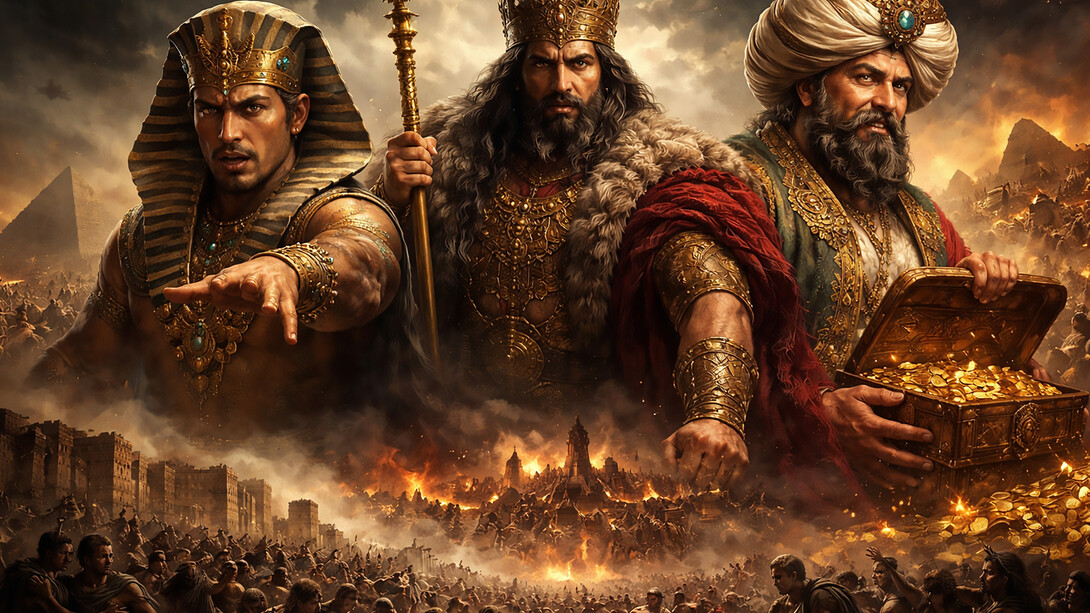
The contemporary world is witnessing an alarming escalation of violence, moral breakdown, and abuse of power. Across different regions, children are being killed, civilians are subjected to collective punishment, political leaders are imprisoned or kidnapped, and entire populations are exposed to war, displacement, and systemic injustice. These actions are often justified through political rhetoric, ideological narratives, or economic interests, while accountability remains absent or selectively enforced. Such realities point not only to geopolitical conflict but also to a deeper psychological crisis rooted in leadership personalities marked by dehumanization, moral disengagement, and unchecked ego.
Each generation will produce its own Pharaoh, Qarun, and Nimrod. These figures are not just present in ancient history, nor are they mythological or symbolic; they serve as lasting archetypes that exist within the human psyche. The phenomenon of an individual's domination over others occurs as a consequence of the intersection of wealth, power, and ego, with the absence of a moral check against that domination. Therefore, history does not repeat itself; however, history continues to develop, continuing to express itself in new and diverse contexts of individuals, societies, and technologies. As such, history has evolved to present a new question: how do the underlying traits associated with Pharaoh, Qarun, and Nimrod combine as a new psychological "cocktail" that defines contemporary leadership? Addressing this question requires moving beyond political descriptions toward a personality-based analysis of power, one that examines how ancient patterns of tyranny continue to shape modern realities.
Modern tyrants often exhibit different forms of tyranny, which are typically not isolated; however, they are a fusion of unique typological versions of tyranny. Pharaoh is representative of totalitarian (i.e., absolute) political control, while Nimrod represents defiance towards any form of authority, which exists through the will of the Creator and/or through the Word of God, and Qarun is the personification of the excessive accumulation of wealth and materialism, leading to immoral and corrupted behavior. The combination of these different forms creates an extremely harmful psychological make-up, which accurately represents the current (new) type of leadership style in today's democratic societies, characterized by a focus on populism, media coverage of politics, popularity of celebrities, and the importance of personal character rather than responsibility to the people they serve.
Islamic tradition portrays Pharaoh, Nimrod, and Qarun as three different representations of the same type of injustice, but at the same time, all were interconnected through their togetherness. Each character represents a different kind of injustice: Pharaoh represents the injustice from the perspective of power, Nimrod from the perspective of belief & ideology, and Qarun from the perspective of wealth/money & material excess. Even though they may have existed in different time frames and in varying degrees of domination, their psychological make-up is remarkably similar. All three demonstrated a sense of superiority (arrogance), a feeling of entitlement (my place in society), denial of personal responsibility/accountability for their actions, and complete disregard/respect for the rights/dignity of others. These characteristics form the psychological foundation of their oppressive rule. Each of these types of leaders and their characteristics will be examined further, with emphasis placed on the similarities to current leaders and the way tyrannical leaders continue to express these similarities.
The Pharaoh represents a fusion of political absolutism with a kind of divine narcissism (a personality structure where the Pharaoh sees himself not only as an administrative authority but as a sacred authority). The Pharaoh's authority did not stop at being the head of an administration to govern people and their territory, but included control over the very "transcendent" (God) as well. As a consequence, the pharaoh considered himself to be the supreme and final authority. He stated, "I am your Lord, the Most High," which demonstrates the most extreme case of grandiosity (narcissism), where an individual elevates him- or herself to a divine level and where anyone who follows him is automatically subject to his divinity and is therefore sacrosanct/untouchable.
Despite ruling during a period of remarkable civilizational advancement, Pharaoh did not channel progress toward collective human flourishing. Instead, technological and administrative power became instruments of domination. His leadership style was characterized by humiliation, dehumanization, and coercion, most notably through the systematic killing of Israelite male infants while sparing the females. This policy was not an impulsive act of cruelty but a calculated strategy of demographic control and psychological terror, revealing a personality oriented toward control rather than governance and fear rather than legitimacy. His drowning symbolizes the inevitable moral and psychological collapse of any system built on absolute domination, revealing that power severed from ethical restraint ultimately destroys itself.
While Pharaoh represents political and divine tyranny, Nimrod embodies ideological and epistemic oppression. Nimrod’s authority went beyond mere governance and into the regulation of meaning itself. Psychologically, the personality of Nimrod is that of an individual who cannot tolerate the existence of any truth that is greater than himself. Nimrod’s greatest crime was not only oppression but also the extreme lack of intellectual humility he exhibited. This is clearly exhibited in his encounter with the Prophet Abraham (peace be upon him). When Abraham stated that God is the one who gives life and death, Nimrod’s immediate rebuttal was to assert that he had the same capability.
This exchange shows Nimrod was not an ignorant or confused person and instead chose to defy the transcendent truth to raise himself to a level comparable to God. Nimrod’s pathology lies in the conscious distortion of reality when any aspect of reality threatens his ego. Nimrod’s death by a mosquito shows that arrogance is not defeated by dramatic confrontation or external force, but by the smallest reminders of human weakness. His lack of humility illustrates that egos that defy divine and ethical order may gain power temporarily but ultimately collapse through self-destruction.
Qarun represents a third dimension of tyranny: domination through wealth. Unlike Pharaoh and Nimrod, Qarun did not rule through armies or claim divinity. His power derived from vast stores of materials and his financial superiority over the masses. His wealth also constituted so great a quantity that even the strongest men could not lift his treasure key due to the oversized vault; this vault has all the riches of the Earth. The wealth increased Qarun's arrogance rather than his generosity. Wealth produced a sense of miserliness rather than the opposite. Qarun would refuse to give money to anyone in need; he could not be helped by anyone he viewed as morally inferior to him, and as such, he rejected moral advice.
Although Qarun displayed his extravagant wealth and lifestyle publicly, it was not merely vanity to show off his wealth but instead was a deliberate act to dominate others and to project superiority over them. The more wealth Qarun demonstrated, the more he fostered social stratification, envy, fear, and dependence on others. Being swallowed by the earth along with his wealth symbolizes the ultimate emptiness of material obsession. Once wealth has been severed from the construct of ethical accountability, wealth begins to serve no function as a source of comfort and/or a source of destruction. Therefore, the wealth of Qarun is demonstrated to deteriorate qualities.
Determining which of these figures represents the “worst” form of tyranny is ultimately impossible, as each embodies injustice through a different psychological pathway. Pharaoh represents tyranny through absolute political control combined with claims of divinity, making him the most collectively violent and murderous. Nimrod represents the pinnacle of ideological arrogance, directly confronting truth and rejecting divine authority with conscious defiance. Qarun represents corruption through wealth, greed, and ingratitude, demonstrating how material power can enslave both its possessor and society.
Comparing Pharaoh, Nimrod, and Qarun is therefore not a matter of ranking evil but of understanding its manifestations. Each reflects the same underlying pathology: an uncontrolled ego fueled by worldly power—whether political, ideological, or material. Together, they form a comprehensive psychological map of tyranny, one that continues to reappear in different forms across time. Their stories serve not only as moral warnings but also as enduring personality profiles that help us recognize how injustice evolves, adapts, and survives in every era.
The contemporary landscape of leadership rarely presents tyrannical figures as isolated reflections of a single archetype. Instead, modern tyranny most often emerges as a composite personality, integrating elements of Pharaoh, Nimrod, and Qarun into a single psychological structure. Although some leaders exhibit Pharaoh-like qualities: they demand complete obedience, show little tolerance for disagreement, are obsessed with being recognized as “the leader,” and strive to control every aspect of their followers’ lives. Others reflect Nimrod’s ideological arrogance, disregarding objective truth and assuming it is their responsibility to shape the world according to their own desires. Yet others display Qarun-like tendencies, marked by excessive wealth, a relentless drive to acquire more, and a transactional rather than principled approach to ethics. Leaders who combine traits from all three archetypes often define business ethics not by moral standards, but by how a business can enhance their personal profit and deliver direct benefits and economic interests to themselves.
When combined, these three elements create a very potent form of pathological leadership that is ideally suited for an age in which mass media, celebrity culture, and social media dominate. In this environment, the display of spectacle often outweighs substance, emotional arousal often substitutes for moral reasoning, and performance is confused with ability. This pattern is evident in the leaders of the world’s most powerful countries. These leaders are not only powerful or wealthy but are theatrical, self-centered, and largely insulated from accountability. In such situations, authority is performative, truth is negotiable, and morality is sacrificed to create an image. The psychological core of this composite personality is pathological narcissism, which possesses an inflated sense of self-worth; shallowness of emotion; lack of empathy; hypersensitivity to the critiques of others; and a compulsive need for the admiration of others. Thus, rather than merely seeking approval, pathological narcissists must have continuous affirmations to maintain their fragile self-image of superiority and infallibility.
In today's world, narcissistic leaders do not have a view of themselves as someone who is not perfect, can learn, grow, and has responsibility through ethical struggles. Instead of seeing themselves as an individual and growing through their experiences, they see themselves as an object that is grand, perfect, and cannot be harmed, limiting them from experiencing the emotional development that makes them a better leader. This difference is extremely important to recognize; we can learn from our mistakes, have boundaries, and hold ourselves accountable for our morals. An object, on the other hand, demands that we admire, have loyalty to, and show obedience to it without requiring the same in return. When our leaders no longer think of themselves as being subject to society and, instead, think of themselves as being an object of veneration for the citizens, society will no longer function as a moral community and will instead be a reflective image of our leaders' ego.
The current leadership style of one of the biggest countries is an excellent example of this psychological dynamic that is playing out on a global scale. His level of narcissism exceeds that of self-absorption, bordering on an extreme level of grandiosity, which is evident in his communication, actions, and decision-making. He does not appear to see himself or his actions as morally justified or empathetic toward others who do not agree with him, nor does he believe that he can learn or develop through ethical decisions. Rather, he portrays himself as a uniquely talented, instinctively correct, and inherently superior leader who has the answer to everything and whose authority does not need to be challenged, and he simply states that he is the authority.
His leadership is an example of an archetypal ‘leader’s cocktail’ from the psychological viewpoint. He has a strong authoritarian stance, like Pharaoh, and demands total loyalty from his followers. He has little regard for what is true or who is qualified to give advice, such as experts and those with institutional norms or requirements. His association with wealth, success, and transactional ethics is very pronounced and can represent the same extreme materialism for which Qarun is known. This behavior, whether through political critique or psychological interpretation, is not an isolated incident; rather, it fits into a wider trend of leadership behavior today that favors dominance, theatricality, and self-promotion to the detriment of the development of humility, competence, and moral restraint.
The stories of Pharaoh, Nimrod, and Qarun have a far greater purpose than simply pointing out old tyrants. They provide context for how to identify today’s tyrants when they surface; tyranny is not limited to one particular form, but instead can take many external forms depending on the ruling political system and the methods of control used by the ones in power; however, the internal source of control will always be the same. The power and wealth that leaders seek to acquire, coupled with the desire for self-aggrandizement, will necessarily cloud any leader’s judgment about the truth, accountability, and morality.
A societal danger occurs when an individual is not seen by their leadership role as someone hired to be governed by society but as the representative embodiment of "greatness," or when they rise above their station as a servant to others to glorify themselves; in other words, when their governing focus shifts to serving themselves instead of those below them and thus authority becomes equivalent to domination.
Thus, the true "cocktail of the contemporary age" is not found in the actions of one individual alone, but rather where many individuals who possess a “Greatness” mentality have been allowed to flourish and thrive—these include those we admire as leaders and those we allow to behave in such a way or make excuses for allowing this behavior to go on unchecked. In addition, the onus of accountability falls not only on our leaders but also on the society that allows them to continue doing so or excuses their behavior. Tyrants in all of history always and ultimately fail, regardless of the amount of power or wealth they possess, and the only question is how many people/places a tyrant will injure between now and when they fall.