English
 Español
 Français
 Deutsch
 Italiano
 Português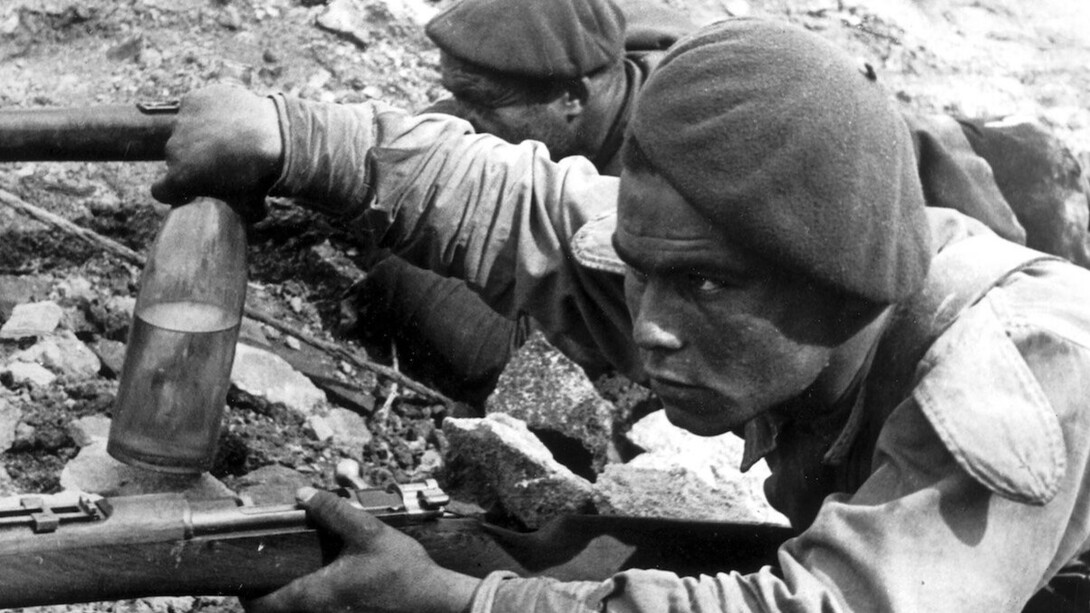
In the words of Karl Marx, the French Revolution represented “the victory of bourgeois ownership over feudal ownership, of nationality over provincialism, of competition over the guild, of the division of land over primogeniture, of the rule of the landowner over the domination of the owner by the land, of enlightenment over superstition, of the family over the family name, of industry over heroic idleness, of bourgeois law over medieval privileges.”
Such was the case, at least initially, in the French, American, and Russian Revolutions, as well as the rise of the Spanish Republic’s Cortes before the counter-revolution sponsored by militarist fascists, including Adolf Hitler, Benito Mussolini and Francisco Franco.
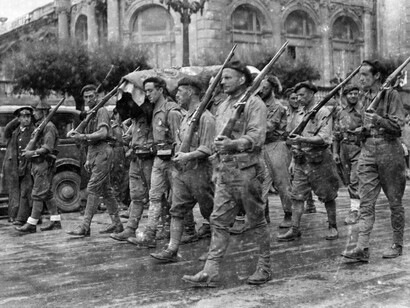
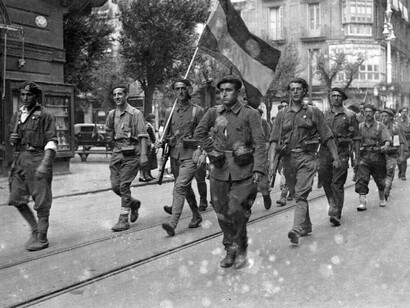
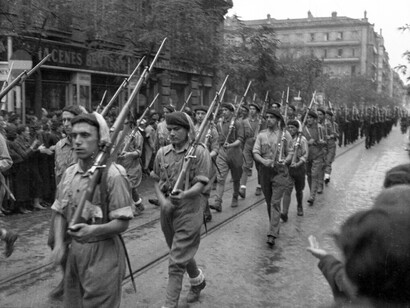
The loyalist government of Spain was supported by nearly 3,000 American volunteers and millions of other working and middle-class Americans ideologically aligned with the cause because it was thought to be legal, constitutional, republican, liberal and democratic — i.e., consonant with the values associated with the American Revolutions, which was heavily influenced by Enlightenment era discourse. Petitions were signed, speeches were delivered, and lives were risked not for the cause of Bolshevism… but for a faith in the movements that had dealt with George III and Louis XVI.
Depression era fascism, Eric Hobsbawm wrote in 2007, “was opposed in principle to the causes that defined and mobilized intellectuals,” particularly the “values of the Enlightenment and the American and French Revolutions.” Spain seemed to many American volunteers and intellectuals, such as Hobsbawm, to be the last chance for a representative government and pluralistic society in a Europe that had turned with horrifying speed toward dictatorship and totalitarianism.
At a time when militant Fascism defied the unreasonable, the Spanish Republic seemed to represent the Enlightenment’s faith in reason as the faculty by which human beings have a natural right to govern themselves without the threat of tyranny.
For many American volunteers and their supporters, the Spanish Republic was symbolic of free speech, a free press, the right of assembly, the separation of Church and state, minority rights, and most especially liberty, equality and fraternity. Millions of Americans, volunteers for the Republic of Spain in particular, seemed honestly to have believed in the ideal of a fundamentally decent and reasonable people making steady progress under representative institutions.
In that sense, as much as they were fighting in what is erroneously referred to as the Spanish “Civil War,” the clash between fascism and a democratically elected government in 1930s Spain was a continuation of the American, French, and Russian Revolutions, as well as subsequent revolutions in Latin America and Asia. For many American volunteers, the Spanish Revolution of 1931 that toppled a monarchy was another 1641 or 1789 or, most commonly, 1776.
By the 1930s, the American and French Revolutions had helped inspire revolutions around the world, including Cuba, the Philippines, Mexico, Russia, and many other places. Paul Wendorf, a historian and economist from Columbia who volunteered to fight Fascism in Spain, wrote in a letter to his wife that the first anniversary of the Defense of Madrid coincided with the twentieth anniversary of the Russian Revolution. The American Revolution especially demonstrated that it was plausible for Enlightenment ideas about how a government should be organized to actually be put into practice.
Some American diplomats, like Benjamin Franklin and Thomas Jefferson, had lived in Paris, where they consorted freely with members of the French intellectual class. Furthermore, contact between American revolutionaries and the French troops who served with the Colonial Army in North America helped spread revolutionary ideas to the French people and throughout the Atlantic World. In other words, the American and French Revolutions fed each other, much like those two revolutions triggered others in subsequent generations.
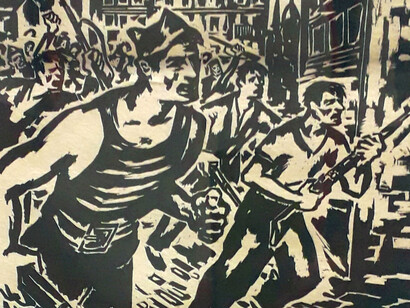
Many International volunteers, including many Americans, were a kind of redux to the sans-culottes — commoners in late-18th century France that rebelled against the Church and Monarchy. The sans-culottes’ struggle was, like the majority of Spanish people in the twentieth century, in large part inspired by their poor quality of life under the Ancien Régime.
The most fundamental political ideals of the sans-culottes were, like those expressed in many of the American volunteers’ letters, social equality, economic equality and popular democracy. Like the sans-culottes, many who aided the Republic of Spain advocated the abolition of the traditional authority and privileges of the monarchy, nobility, and Roman Catholic clergy.
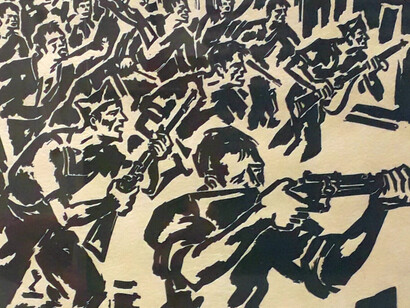
The Spanish War, which pitted an emerging bourgeois class tenuously allied with a peasantry, was a class war every bit as much as was the French Revolution. The backbone of the resistance against Francisco Franco’s nationalist forces was comprised primarily of those with the greatest to gain through social and economic revolution — the working class, especially urban trade unions, whose political power grew the more Spain industrialized.
It is, as George Orwell notes, “important to remember the working class remains the most reliable enemy of Fascism (and monarchy), simply because the working-class stands to gain most by a decent reconstruction of society.” Sid Kaufman, an American volunteer, likewise noted that, “in all wars the proletariat suffers the greatest losses — they supply the largest part of the army, living standards go down, working class organizations are destroyed by patriotic pleas to aid the government in her hour of need, and the labor movement most always gets set back a while.”
But there are also some distinct differences between the French and American Revolutions and the Spanish War. For one, the Spanish War was a bit more industrial and global in scope than the French and American Revolutions, in large part because by the 1930s, industrialization as well as the proliferation of Enlightenment era discourse had helped more widely spread class-consciousness around the globe than during the eighteenth century.
Industrialization in particular was increasingly dictating where people, such as peasants from Eastern European hinterlands, lured to North and South America at the turn of the twentieth century, could find livelihoods. The more people were forced from their traditional homelands in search of steady work, the more widely ideas were circulated and exchanged.
But even the differences in centrality of agrarianism in contrast to industrialization that separated the revolutions of the eighteenth century, compared to the industrialization of the twentieth century, point to broad commonalities in revolutions. The American, French and Russian Revolutions and the Spanish Republic were all largely inspired by centuries of oppression of workers by landed aristocracies, resulting in uprisings and sometimes actual revolts, to secure ownership of the land they worked and subsequent political rights associated with owning land.
The cultural and social continuity between the French Revolution of 1789 and the rise of the Spanish Republic is especially pronounced. In both cases, Enlightenment philosophy de-sacralized the authority of the King and the Church, and promoted a new society based on “reason” rather than traditions and the emergence of an influential bourgeoisie, which was formally part of the Third Estate (i.e., commoners) but had evolved into a caste with its own political agendas and aspired to social equality with the aristocracy. Such was the case in Spain, Russia and the Americas as a result of class distinctions associated with industrialization during the nineteenth and twentieth centuries.
Paul Geiser, who was a member of the Communist Party, had likely imbibed Karl Marx’s Eighteenth Brumaire in which he wrote, “The revolution is thoroughgoing. It is still traveling through purgatory. It does its work methodically.” Spain in the 1930s was, according to Geiser, another stage in the series of revolutions leading to a break in history in which workers rather than employers would enjoy the balance of economic and political power, which Marx prophesized.
The American, French and Russian Revolutions all pitted economic and social elites with a monopoly of power against largely powerless workers (except the power and politics of violence), followed by counter-revolutions sponsored by national elites. Such was the case in Spain: poor workers together with somewhat reluctant bourgeois allies toppled a monarchy, only to face a counter-revolution by economic and social elites.
But the American volunteers’ desire to fight Fascism in Spain was more an immediate manifestation of liberal traditions in the U.S. polity than the French and Russian Revolutions. “The things he’ll be fighting for with the Lincoln Battalion are the things, in one way, that I’ve fought for all my life — in a word, democracy, peace, security, freedom — the things they fought for in 1776,” Fred Williams’ father proudly boasted to a reporter for The Southern Worker in 1937.
The American Revolution, like Spain’s Popular Front Government, subverted the power of the traditional aristocracy, for the movement of opposition to parliamentary taxation, 1760-1776, originally controlled by conservative elements, had been taken over by extremists nourished on Enlightenment radicalism, and the once dominant conservative groups had gradually been alienated. Independence gave control to American radicals, who, imposing their advanced doctrines on a traditional society, transformed a rebellious secession into a social revolution. Such was the case in 1930s Spain.
But the remnants of the earlier American aristocracy, though defeated, had not been eliminated. They were, like Franco’s allies in Spain, able to reassert themselves. In the 1780s, they gradually regained power until, in what amounted to a counterrevolution, they impressed their views indelibly on history in the new federal Constitution, in the revocation of some of the more enthusiastic actions of the earlier revolutionary period, and in the Hamiltonian program for the new government.
Politics in America, as in 1930s Spain, could be seen to have been a dialectical process in which an aristocracy of wealth and power struggled with the proverbial “People,” who, ordinarily ill-organized and inarticulate, rose upon provocation armed with powerful institutional and ideological weapons, to reform a corrupt and oppressive polity. Such was the case in 1930s Spain.
In all of this the underlying assumption is the belief that Enlightenment thought – the reforming ideas of advanced thinkers in eighteenth-century England and on the Continent — had been the effective lever by which American, French, Russian and Spanish radicals had turned a dispute over imperial relations into a sweeping reformation of public institutions and thereby laid the basis for politics and economics in each nation. But in each case, revolution was followed by counter-revolution. In many cases, political revolutions led to worse economic and social situations than the climate that inspired revolutions in the first place. Such was the case in 1930s Spain.
The romantic themes central to the Enlightenment, American and French Revolutions — natural rights, religious liberty, liberal religion, free thought, universal progress and education – were also central to the Russian Revolution, which significantly influenced the war in Spain, especially the Anarchist-led social revolution between Trotskyists and Stalinists. But the Anarchist-led revolution in Spain is especially instructive in two profound ways:
It demonstrates how far Josef Stalin had taken Russia away from the Revolution led by Lenin after World War I.
The discourse of revolution central to the American volunteers’ correspondence helps demonstrate that they were by no means in Spain to fight for Stalin or the Soviet Union.
The conservative coup led by Franco, not inconsequentially, coincided with a leftist revolution led by Spanish anarchist groups, such as the National Confederation of Labor and the Iberian Anarchist Federation (CNT-FAI). The Anarchists and the Workers' Party of Marxist Unification (POUM) were integrated into the Republican Army, but with stiff internal resistance from the Anarchists, who wanted no allegiance to the Communists; the POUM was later outlawed by the Communist Party and, like Trotskyists in general, falsely denounced as allies of Franco’s Fascists.
The Spanish Revolution was a workers’ social revolution that began during the outbreak of the Spanish War in 1936 and resulted in the widespread implementation of anarchist and more broadly libertarian socialist organizational principles throughout various portions of the country for two to three years, primarily in Catalonia, Aragon, Andalusia, and parts of Valencia.
Much of Spain’s economy was put under worker control in anarchist strongholds like Catalonia, where the figure was as high as 75%. Anarchist influence was, however, lower in areas such as Madrid, where there was a heavier Communist Party influence. Factories in anarchist strongholds were run through worker committees, and agrarian areas became collectivized and run as libertarian communes. Even places like hotels, barbershops, and restaurants were collectivized and managed by their workers.
The economic policies of the anarchist collectives were primarily operated according to the basic communist principle of “From each according to his ability, to each according to his need.” In some places, money was abolished entirely and replaced with vouchers and coupons distributed based on need rather than individual labor contributions. The agrarian collectives had considerable success despite opposition and a lack of resources.
This revolution was opposed by both the Soviet-supported Communists, who ultimately took their orders from Stalin's politburo (which feared a loss of political control and requisite discipline needed to win a war), and the Social Democratic Republicans (who worried about the loss of civil property rights).
As the war dragged on, the spirit of the revolutions’ early days waned in large part due to demonization on behalf of the Soviet Union, the Republic’s reluctant ally. Comintern policy was that the war was not the time for the revolution because wars cannot be won without order and discipline, and that until total victory had been won, there could be no social revolution in Spain.
The primary goal in the Spanish War, Communists believed, had to be the defeat of the Nationalists, not the abolition of capitalism. In 2007, Eric Hobsbawm justified the Soviet reaction to the anarchist revolution in an editorial published in The Guardian:
A serious war conducted by a government requires structure, discipline and a degree of centralization. What characterizes social revolutions like that of 1936 is local initiative, spontaneity, independence of, or even resistance to, higher authority — this was especially so given the unique strength of anarchism in Spain… The conflict between libertarian enthusiasm and disciplined organization, between social revolution and winning a war, remains real in the Spanish Civil War, even if we suppose that the USSR and the Communist Party wanted the war to end in revolution and that the parts of the economy socialized by the anarchists (i.e. handed over to local workers' control) worked well enough. Wars, however flexible the chains of command, cannot be fought or war economies run in a libertarian fashion. The Spanish Civil War could not have been waged, let alone won, along Orwellian lines.
Many other left-wing parties, particularly the anarchists and POUM (who George Orwell fought amongst during the Spanish War), vehemently disagreed with the Soviet Party line; to them, and many American volunteers, the war and the revolution were the same. In this sense, the Soviet Union was a counter-revolutionary force whose main goal was a political ally and bulwark against Germany, not the end of capitalism in Spain.
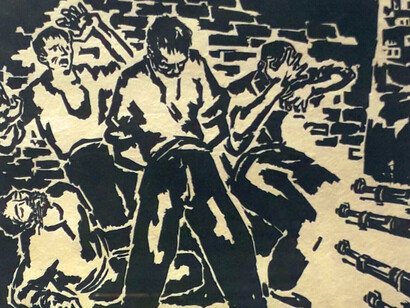
Alexander Orlov, the chief of the Soviet organization known as the People's Commissariat for Internal Affairs (NKVD), went to Spain at the end of August 1936 with the major task of purging the Revolutionary Marxist Party (POUM). On December 17, 1936, Pravada, Soviet Russia’s most prominent ideological organ, wrote that in Catalonia “the cleaning up of the Trotskyist and Anarcho-Syndicalist elements… will be carried out with the same energy as in the USSR” (i.e., with murder and gulags). A few days later, the Comintern executive wrote to the Spanish Communist Party that “whatever happens, the final destruction of the Trotskyists must be achieved.”
The inauguration of the Popular Front in Spain in 1936, ironically, caused a shift in Communist Party dogma, diverging significantly from the discourse of revolution that marked the Russian Revolution that began in 1917, which was heavily influenced by Karl Marx, whose work was especially informed by the French Revolution.
The Soviet Union’s support of a centrist, non-communist, non-socialist Republican Spanish government demonstrated that Stalin was a conservative political force dedicated to maintaining the political and social status quo inside Russia above all else.
The presence of Soviet military advisors and Soviet-built equipment, many of which were antiques acquired from museums, nevertheless increased the prestige and power of the Spanish Communist party, enabling Stalinist agents to throttle rival anarchist and social revolutionary parties, ultimately crushing the revolution and unwittingly aiding Franco’s forces.
Nevertheless, the American volunteers’ sense of idealism was especially rooted in a profound sympathy for the Spanish people, and ultimately more consonant with the Anarchists of Spain than for the Soviets, thereby complicating conservatives’ assertions that Americans were fighting to advance Bolshevism.
American volunteers’ letters consistently express solidarity with and affection for the worker, the intellectual, the peasant for those who had deposed the centuries-old monarchy, instituted land reforms, built schools, and brought to the Spanish Cortes a program of government that could bridge the gap between the remnants of feudalism and industrialization and the benefits of an enlightened democracy. Many letters especially evoke revolutionary discourse rooted in the dialectics of the Enlightenment.
Americans who went to Spain were thus ultimately impelled by the domestic and international crises of the 1930s to defend what seemed to them to be the “cause of western civilization itself,” especially a preservation of liberty, equality, fraternity and democracy they believed was threatened by fascism.