English
 Español
 Français
 Deutsch
 Italiano
 Português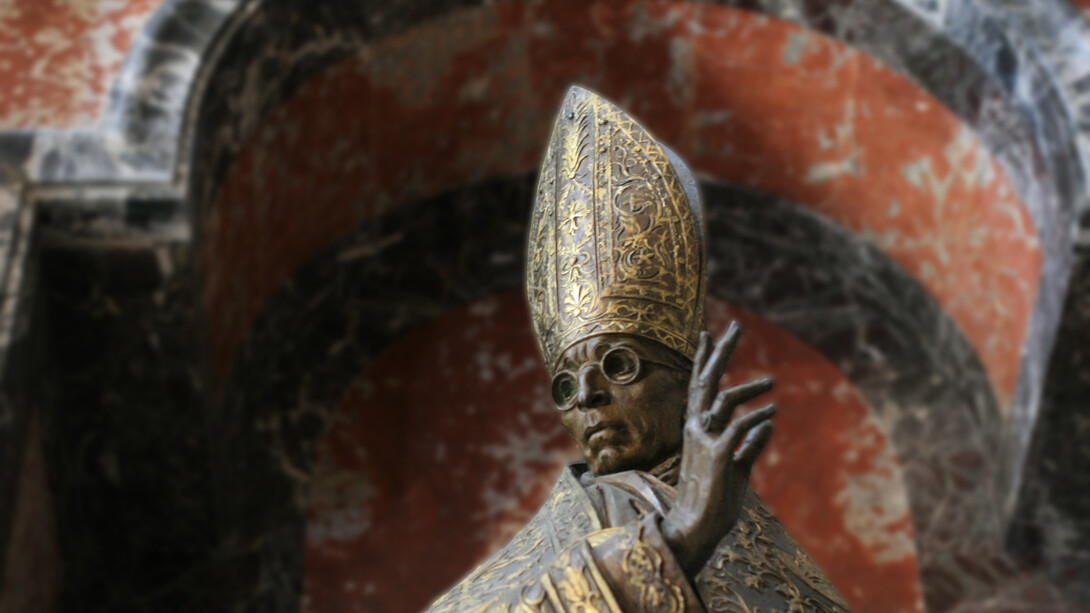
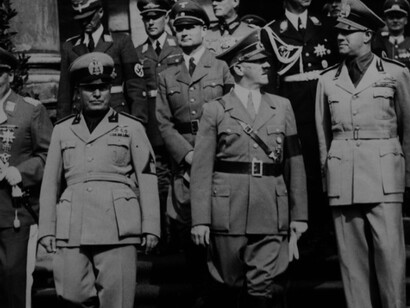
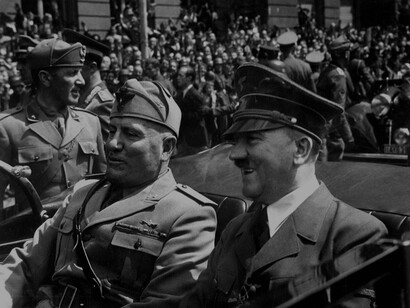
Rome, 1929: Mussolini said that the Jewish people have been in Rome since the time of the Etruscan kings. He suggested that maybe the Roman Jews provided the clothes after the Sabine women were taken. There were thousands of Jews during the time of Augustus, and they were asked to mourn at Caesar’s funeral pyre. They will be left undisturbed.
Unfortunately, Mussolini changed his attitude towards the Jews of Rome and by 1938 implemented the Racial Laws against the Jews of Rome.
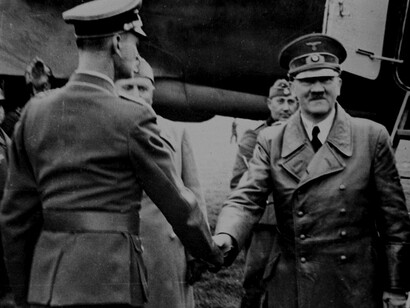
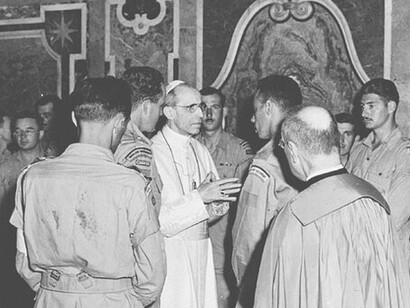
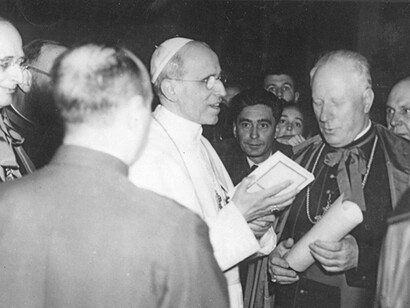
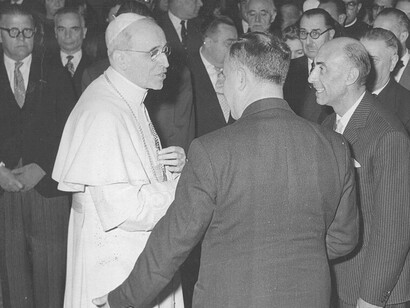
From the very beginnings of the rise of Hitler, another noted Catholic Italian plays a bigger role. His name is Eugene Pacelli, who would later become Pope Pius XII. There are letters where he says he was disgusted by the Italian government importing German antisemitism.
Pacelli sent many handwritten letters to the Vatican warning the Curia of the rise of Hitler. For example, in one letter he stated that he is an “untrustworthy scoundrel capable of trampling on corpses.”
In another letter report on the newly elected pope, sent to Washington from an American diplomat, it was stated that although he was aware of Pacelli’s hatred of Hitler, he had no idea of his extremeness.
Is there another story to be told about Pacelli and Hitler?
Orthodox Jewish commentator Ben Shapiro produced a four-part documentary on the truth of Pope Pius XII and Adolf Hitler.
Narrated by Michael Knowles on the Daily Wire, based on actual documents, proving the life-saving efforts of Pope Pius XII to the Jewish people and the circumstances in which he had to function under constant German threats.
During my ongoing research, I went back to carefully begin to analyze copies of original letters found in Gary Krupp's book:
Pope Pius XII and World War II: The Documented Truth—A Compilation of International Evidence Revealing the Wartime Acts of the Vatican.
As I reread Krupp’s book, I contacted Gary Krupp via telephone during my visit to the USA for the Thanksgiving holiday with my family.
In your book, you mention Eugenio Pacelli’s continuous effort to create a Jewish homeland in Palestine began in 1917 with his first meeting with the head of the world Zionist organization (not Sacco), continuing in 1925 and in 1948, encouraging old Catholic countries to vote for the partitioning of the holy land. Can you elaborate more?
Krupp: In my book, you will see the images of the handwritten letter from Nahum Sokolow, president of the Zionist organization in Switzerland. Pacelli granted him an audience in 1917 and wrote a letter to Rome in order to enable Sakolow to meet the Vatican Secretary of State. Sakolow discussed a Jewish homeland in Palestine.
Then again in 1925, when Pacelli was hospitalized, he requested an audience with him, and although he was told he could only spend a few minutes with him, Pacelli spent over 45 minutes with him and then arranged for Sakolow to meet with the Pope. Again to discuss a Jewish homeland in Palestine.
Then in 1948, when the question of the partitioning of the Holy Land came up for a vote in the United Nations, Pope Pius XII encouraged all Catholic countries to vote in favor of the partitioning, thereby creating the Jewish homeland, Israel.
In a 1958 New York Times article about the death of Pius XII, his childhood Orthodox Jewish friend, Guido Mendes, was quoted saying that Pacelli always told him, "Soon you will have a Jewish homeland." This article can be seen in my book as well.
Another question I would like to ask you, Mr. Krupp. In your book you mention that Pacelli had an Orthodox Jewish childhood friend, Guido Mendes. You say that he commented on Pacelli’s death in 1958 and that he would often say, “Soon you will have a Jewish homeland.” Can you explain?
Krupp: When Pope Pius XII died in 1958, Guido Mendes was interviewed in a New York Times article, which is in my book. Mendes commented that Pacelli was a childhood friend and that he always commented that “soon you will have a Jewish homeland.”
Evidence of this was in a book written by Michael Mendes, the son of Guido Mendes, who became an Israeli ambassador. In that book, he describes the relationship of Eugenio Pacelli and his father, saying that Pacelli would enjoy Shabbat dinner with the family. Learn to speak Hebrew and borrow the books of the great rabbis. Michael Mendes also recalls how in 1938, when Italy adopted the German antisemitic laws and his father was fired as a physician, Pacelli reached out to him and said, "I need to send you and your family to safety in Switzerland." Mendes said I would prefer to go to Palestine, which is where the family lives to this very day.
These accounts complicate the narrative surrounding Pacelli, challenging the long-standing accusations that he remained passive or indifferent to Jewish suffering. Instead, they suggest a figure navigating a perilous landscape, balancing diplomacy, conscience, and survival under Nazi scrutiny. While debate continues among historians, the growing body of documented evidence invites a reevaluation of his legacy—and perhaps a more nuanced understanding of his role.
Sources
Krupp, G. (2022). Pope Pius XII and World War II: The documented truth (4th ed.) Pave the Way Foundation.
Shapiro, B. officialbenshapiro.
Wikipedia contributors. (n.d.). Nahum Sokolow. In Wikipedia, The Free Encyclopedia.