English
 Español
 Français
 Deutsch
 Italiano
 Português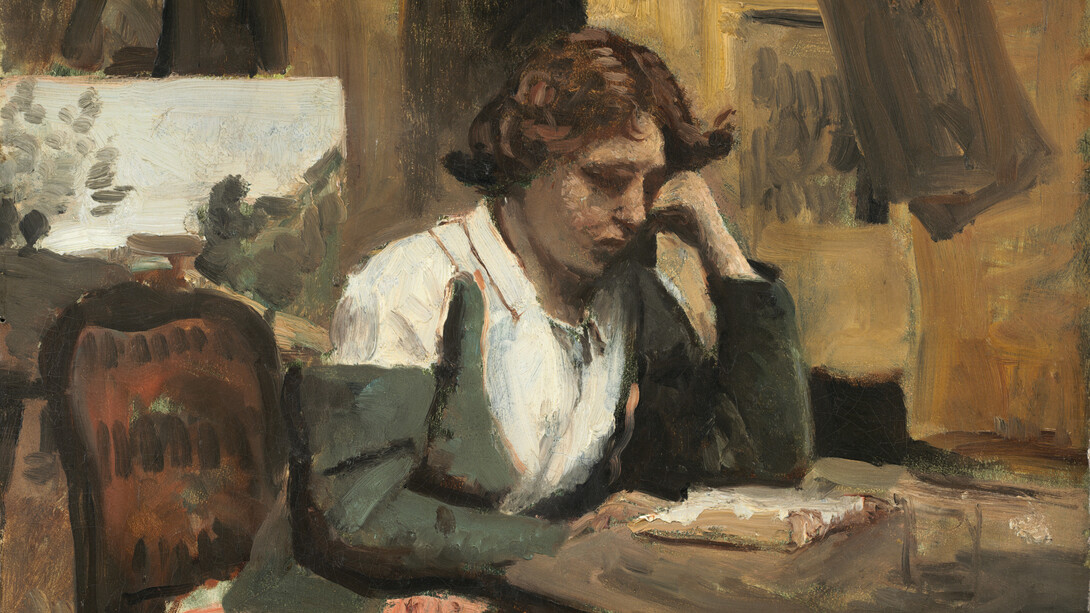
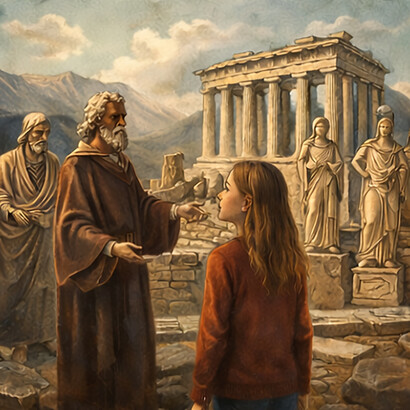
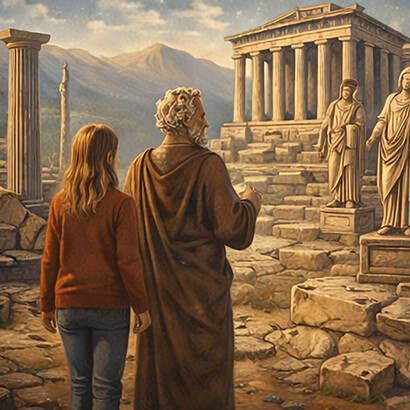
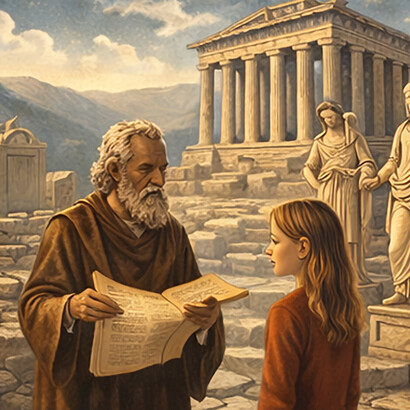
Sophie’s World is the story of Sophie Amundsen and Hilda Molle Knag, one a fictional character seeking to escape the bounds of fictional reality and the other a schoolgirl reading a book. Both are seeking to learn about philosophy, and the book takes the reader through intellectual thought in chronological order from ancient Greece to modern existentialism.
The story shows how theories are developed by criticising and evaluating what has gone before. Beginning with the myths of Homer, criticised for creating gods in the image of man, with all their petty imperfections. Parmenides was the first rationalist, relying on reason rather than the senses. He believed nothing could change, as nothing could be created from nothing. Heraclitus took the sensory approach and stated that nature was in a constant state of flux. Empedocles sought to bridge the gap between the two. He argued nature consisted of four elements – earth, air, fire and water – along with natural forces which either brought together or drove apart. Anaxagoras stated that all particles have an element of everything in them; today, we refer to this as DNA, but he labelled these particles 'seeds', and Democritus referred to these building blocks as 'atoms'.
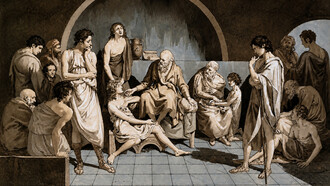
The novel does not just address the material plane but also the Ancients' view of reality. The Sophists suggested there were no absolute norms, a view Socrates disagreed with. Plato argued there was a limit to natural phenomena, and these forms he named 'ideas'. Reality then became about the world of senses and ideas, with the body linked to the senses and reason to ideas. Aristotle criticised Plato for claiming the natural world was a reflection of the world of ideas, as he stated this confused the human imagination with the real world. The difference between the real world and fiction is one of the themes of the book.
Cultural and moral influences are not only represented by the three main religions but also refer to the Stoics, who believed in natural law that did not alter with time or place. Sickness and death are natural processes which man must accept. This contrasted with Epicurus, who developed the pleasure ethic but argued that the results of an action must also be weighed against its side effects. He said pleasure is not exclusively sensual but includes appreciation of art and friendship. The mediaeval world was also Christian, influenced by St Augustine, who characterised evil as the absence of God. He saw the conflict between God and the world played out in people’s lives. In addition, Thomas Aquinas saw two paths to God, one through faith and revelation and the other through reason and the senses.
Advancement is represented by the Renaissance, driven by technology, namely the compass, firearms and the printing press. Voyages of discovery could now be made using the compass, and firearms allowed them to subdue the natives. The printing press facilitated the distribution of ideas such as humanism. This emphasised the worth of man as a unique individual. In the sciences, Copernicus argued the earth revolved around the sun, Kepler mapped the orbits of the planets, Galileo formulated the law of inertia and Newton suggested the law of gravity. Through the Reformation, the church emphasised an individual’s relationship with God, having the Bible translated into national languages.
Enlightenment philosophers embraced reason as a solution to oppression, which they believed depended on ignorance and superstition. Thus, Locke stated there were no innate ideas and that knowledge was gained from the senses. Hume separated impressions from ideas, arguing impressions were the immediate sensation and ideas the recollection of those impressions. Nature became synonymous with reason, and this is why Rousseau argued humanity should go back to nature. Philosophers wanted to establish natural rights which belonged to people just for being born. Kant, following Hume, stated we cannot know what the world is really like, only what it is like for us. Man knows the world through the material of knowledge perceived through the senses and through the perception of events happening throughout time and space. Kant believed man could only know the difference between right and wrong due to reason, not sentiment.
The Romantics formed a backlash against Enlightenment reason by emphasising feeling, the imagination and experience. The universal romantics were preoccupied with nature, the world soul and artistic genius. The national romantics were concerned with the history of the people, their language and culture. Hegel’s philosophy is mainly a method for understanding the progress of history. Previously, philosophical systems had tried to set up external criteria for what man could know about the world. Hegel stated you could not detach thought from its historical context and that human knowledge is constantly progressing.
Kierkegaard thought the idealism of the Romantics and the historicism of Hegel obscured the individual's responsibility for his own life. He said it was important to find the kind of truths that are meaningful to an individual. It is only when we act and make significant choices that we relate to our own existence. Kierkegaard referred to the different stages of life; the aesthetic stage sees people living for the moment, in the world of senses, with a reflective approach to reason. The next is the ethical stage, which is characterised by serious and consistent moral choices. There is an argument that this intense focus on choices will become draining, and the person will either revert to the aesthetic or move to the religious stage, which for him was Christianity. For Sartre, existence takes priority over who we are. When people realise their life is finite, they experience angst. He says man feels alien in a world without meaning and a sense of despair and boredom. Freedom makes us responsible for our own actions, obliging us to achieve and love authentically. Although he believed life must have meaning, we create that meaning for ourselves.
Marx looked at economic productivity and stated that, due to slave labour, there was no need for technical innovation to increase production. He called the material, economic and social relations the basis of society, and the political structure, law, religion, morality, art, philosophy and science the superstructure. He felt within capitalism were the seeds of its own demise, as increases in technology would reduce the need for labour, reduce disposable income and reduce the demand for goods, causing a downward spiral.
Darwin put forward a theory of biological evolution, and together with Freud’s theory, individual action was seen as based on animal urges or instincts. Malthus believed man’s ability to procreate meant there were more children born than would survive. Also, food production could never keep pace with the population. Freud argued that there is a constant tension between man, his drives and the needs of society. At birth, our own physical and mental needs are paramount, and he called this pleasure principle the 'id'. When we mature, desires are subject to society's reality, and this he calls the ego. When the world's moral expectations become part of us, then it is called the superego.
Although this book was created for children as an introduction to philosophy and the boundaries between fiction and reality, it is a good starting point for adults wishing to learn about significant thinkers.