English
 Español
 Français
 Deutsch
 Italiano
 Português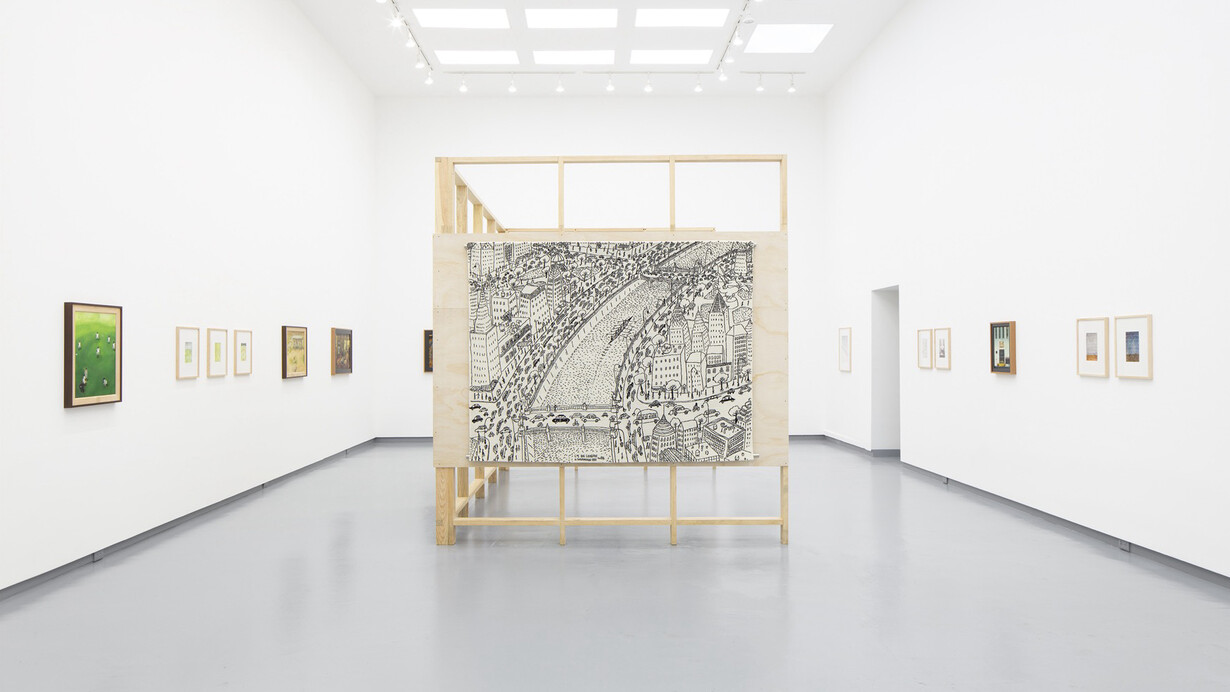
Abel Quezada (Monterrey, Nuevo León, 1920—Cuernavaca, Morelos, 1991) was one of the most prominent artists in Mexico during the twentieth century, successfully transitioning through various media like journalism, advertising, and art to reflect critically and bitingly—always with a sense of humor—in a way that positioned him as an important chronicler of political and social life in our country.
Self-taught by his own intuition, Quezada was quite young when he established himself in Mexico City, where he started out by working for newspapers such as Ovaciones and Esto. In the 1950s he worked for Excélsior and, by the 1970s, for Novedades, to which he brought his special genius for summing up, in the synthetic lines of drawings, his opinions about the events that were characterizing Mexico’s evolution, amidst the discourse of progress and modernity that the postrevolutionary state was proclaiming.
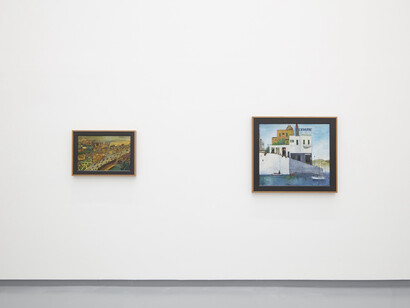
Quezada relocated for a time to the great metropolis of New York (1946), to which he would dedicate countless works on subsequent trips. Quezada’s experience there offered him what would become an enduring theme: representing the chaotic, dynamic everyday life of big cities.
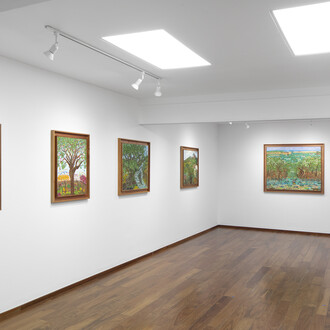
Over the course of his career, Quezada was especially inclined toward drawing; nevertheless, around the 1970s he started working with painting as a way of carrying out a series of compositions that had been impossible for him to address in the one-dimensional medium of caricature. Color, volume, and the use of new techniques and formats afforded a more intimate, personal approach to the diverse scenes that the artist conceived, which alternated between chronicles of daily life and travel memoires, whereby some characters filtered through in allusion to the dynamics of Mexican society.
Regarding his painting, Abel Quezada once pointed out that this exercise was “a weekend hobby,” a sort of pastime that did not mean anything important. This unduly modest and self-critical view was entirely untrue, in that Quezada’s paintings enable us to appreciate the artist’s close proximity to his surroundings, the range of emotions that are revealed in each brushstroke, the rhythm of days, and the uniqueness of the characters depicted.
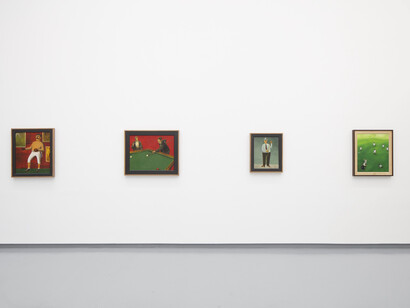
In each composition we can also share some of Quezada’s most personal interests, such as athletics. Over the course of the twentieth century, playing several different sports spread widely, turning them into major spectacles that reached large audiences through the press, radio, and television. In this sense, art was not exempt from these new representations of modernity in which the fascination with mass spectacle was mixed with the popularization of a few athletes who became society’s new heroes.
In several of his paintings, Quezada took baseball, boxing, and even billiards as main themes in his compositions, in which he captured precise moments of sport action, perhaps as a way of confronting emotions, pulses, strategies, and links, all of which were heightened both on the field of play and in life itself.
In the 1980s, the artist and illustrator traveled back to New York City, where he created cartoons and covers for the Sunday magazine of The New Yorker. During that stay, Quezada completed a series of watercolors that focused on portraying different places in the city, urban landscapes with teeming streets and tall buildings, which seemed to fascinate him and to allow him to experiment with the versatility of colors and plays of light so that he could also create nostalgic scenes amidst the hustle and bustle of the U.S. city.
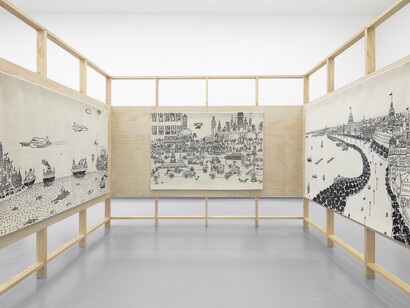
As part of a regular exercise in his life—comparable perhaps to the possibility of verbalizing ideas, emotions, and postures—drawing in Abel Quezada’s work arose as a means by which he was able to represent his impressions of the world and the reality around him, capturing those fleeting moments in quick strokes that made up a sort of itinerary.
In this way, the work he developed across the different periodical publications to which he contributed satirical cartoons led Quezada to create such emblematic characters as “el tapado” (loosely, “the one under wraps”)—alluding to the political tradition of keeping the identity of the next presidential candidate a secret until it was time to reveal or “unwrap” (destapar) him as having been chosen by the president as the next in line for succession—“the charitable lady from Las Lomas,” “Matthias the cowboy,” “Gastón billetes” (a difficult to translate pun, maybe something akin to “Big-Spender Spencer”), the dog “Solovino,” and many others besides, which came to characterize the social dynamics that ended up on display and caricaturized in the national media, despite the strong censorship that prevailed in the country.
Beyond his work in Mexican journalism, Abel Quezada developed a body of visual art that was connected to his need to record everything that caught his attention, that presented itself to his gaze which was scrutinizing the changing face of modern life. Whereas Quezada’s cartoons were related to a political and social evolution, his drawings and paintings set those events aside to focus instead on the simplest expressions of collective dynamics: the traffic in the city, urban landscapes, moments of sociability in some café or pool hall, the game of baseball, or the random scenes that solidified in time and in the jottings of the person who was doing the observing, seeking to encompass the entirety of what was presented before his eyes, through a language of clean, synthetic lines that avoid being overwrought and try to produce a direct effect.
During the years of his prolific career, Quezada stood out as a faithful heir of the Mexican political cartoons of the nineteenth century, which had developed in the pages of newspapers like El Hijo del Ahuizote, Gil Blas Cómico, and El Colmillo Público, publications in which the great ideological fights of Independence-era Mexico were played out. In the same way, Quezada’s body of work broke a path for contemporary caricaturists and “moneros” (political satirists), who have seen the fruits of his day job as a formal source for addressing such fundamental topics as changes in political administration, drug-related violence, and the election of Mexico’s first woman to the president.
Over the years, Quezada has become a mandatory point of reference for understanding the Mexican sense of humor, which enables us to laugh at ourselves, at the multiple crises we have undergone since the end of the twentieth century, and even to sarcastically confront the collective disenchantment at the grand failure of the national political system.
Nevertheless, Quezada’s work will always remind us of his ability to play with reality, to represent it in scenes that strike us as familiar, close, and recognizable, but that still surprise us by showing us those intimate moments when the landscape, the people depicted, and every element of the composition send us back to the slow rhythm of observation. Aerial images, close-ups of architectural details, tiny people intermingling on the streets, and late afternoons in autumnal colors also fell under Abel Quezada’s gaze, which was always open to marveling at the ordinary.
(Abel Quezada’s visual memoires, by Dane Cruz Porchini)