English
 Español
 Français
 Deutsch
 Italiano
 Português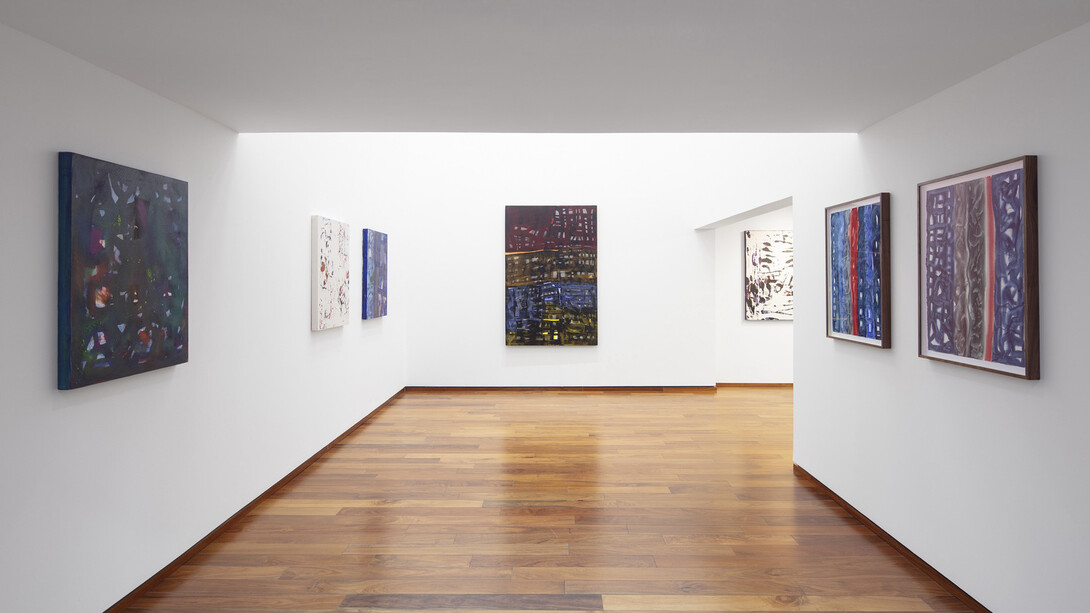
This character that you see is realer than I.
(Jippies Asquerosos)
The year 1917 was a turning point in the history of the Soviet Union. Two revolutions—a bourgeois one in February, and a proletarian one in October—installed one of the most peculiar regimes in living memory. March of the same year also saw the opening of the first solo exhibition of a 26-year-old whose meteoric artistic career is paradigmatic of the relationships between art and political power. The event was carried out at the Club of the Youth Federation in Moscow, which would later be included in the Professional Syndicate of Artists, or Profsoiuz, organized by avant-garde artists like Vladimir Tatlin and Rodchenko himself. The exhibition brought together the works that the artist had produced since 1910. The “youth” wing of that syndicate included futurist, cubist, and suprematist artists who, like Rodchenko, saw themselves as “prophets of the future.”
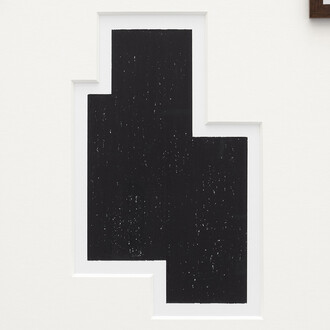
Revolutions inevitably entail the destruction of the old and the construction of the new. The avant-garde artists of the left were among the first groups to ally themselves with the Bolsheviks, but even in 1915, at the Last futurist exhibition of paintings: 0:10, it was clear that the participating artists sought to reconfigure the practice of painting from scratch. Shown there for the first time were the suprematist works of Kassimir Malevich, including the famous Black square on white ground, to the disgust of Vladimir Tatlin, who was showing some of his non-objective reliefs. And although Rodchenko took something from both masters in his early stage, he soon rejected their influence and took his own path through a collective artistic discussion that forged many of the coordinates with which we still discuss the evolution of the arts today.
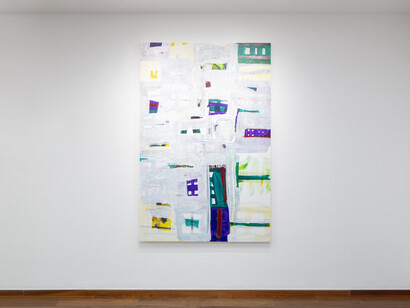
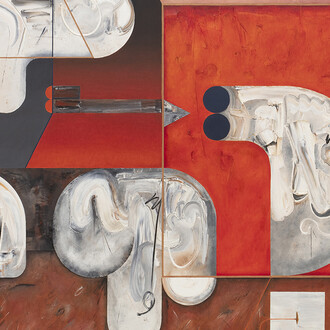
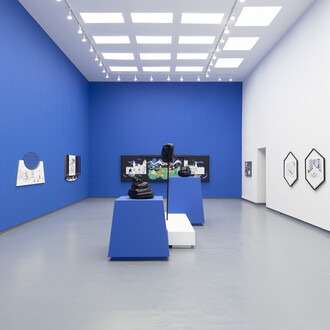
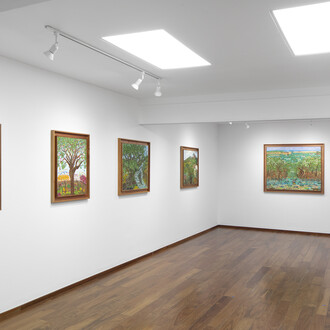
Willy Kautz’s exhibition Gravitational counter-painting at Proyectos Monclova suggests to us that, despite all our postmodern or postcolonial affinities, it is not so easy to be rid of the discursive field of the first European avant-gardes. A few years ago, as an unusual complement to his work as director of the SAPS and La Tallera, Kautz began to post photographs of his exercises in painting on Instagram, making evident a talent that was not very well known, since the large majority of the works he had made until then—including those that had been made on stretchers, like the series Quid pro quo from the mid-2010s—did not involve this process of working on paintings in a studio himself, having instead been produced by specialized craftsmen. Here Kautz confronts us with colorful planes featuring diverse sgraffiti, the compositions having an enigmatic dynamism that works quite well in the digital medium. Facing these paintings, the first effect is one of familiarity and the second one of strangeness. Something in them seems to mix different periods from the genealogy of painting, but one must remember that several of Kautz’s previous works establish a dialogue with the history of art. The most relevant example would perhaps be his animated reinterpretation of Paul Klee’s famous drawing Angelus Novus (1921), which shows the celestial being as if it were a fly buzzing against a window (the screen), trying desperately to get out. In Walter Benjamin’s well-known interpretation, this angel watches the past in horror while being dragged catastrophically by progress toward the future.
But why paintings, precisely now? Perhaps we can agree that in the past two decades painting has had a sort of re-renaissance in the world of Mexican art. The pictoriphobia that was clearly felt in the 1990s and 2000s has been receding to the point reaching a sort of apogee. Kautz dedicated some of his curatorial proposals to analyzing and recording how this particular schism in the Mexican artistic sphere in the 1990s. Kautz’s interest in the “death of painting” theme was registered clearly in an exhibition he curated in 2018 at the ESPAC gallery, the title of which, El cordón umbilical retiniano (The retinal umbilical cord), “recognizes the intricate relationship between contemporary art and the legacy that comes from the avant-gardes—not just modernist abstraction—which makes evident the nexus between conceptualisms and the history of painting.”
One of the clearest examples of this conceptual-pictorial nexus is precisely one of Rodchenko’s emblematic works: the triptych Pure red color, pure yellow color, pure blue color (1921), also titled The end of painting or The death of painting, which was part of another historic group exhibition, 5 x 5 = 25. The piece consists of three canvases, each covered with a uniform layer of oil paint in one of the three primary colors. Rodchenko proposed this work as the end of the production of art. Thereafter, as he co-wrote with his wife Varvara Stepanova in the “Productivist Manifesto”: “The mission of the productivist group is the communist expression of constructive materialist work.” After this triptych of materialist monochromes—which arose, to be sure, as a critique of the premises of Malevich’s idealist monochromes—Rodchenko decided to abandon painting definitively and dedicated himself to carrying out the visual production of the Soviet project through photography, graphic design, industrial design, etc. But despite Rodchenko’s explicit intentions, doing away with the painter’s job through monochromy ushered in the end of neither painting nor art. What happened was precisely the opposite: the exercise of the monochrome became a field of discussion involving artists from the most varied contexts and with quite distinct intentions, including Yves Klein, Ad Reinhardt, Agnes Martin, Lucio Fontana, Mathias Goeritz, Lee Ufan, Robert Rauschenberg, Santiago Sierra, Rubén Ortiz-Torres, etc. The monochrome impulse went far beyond the Soviet Revolution.
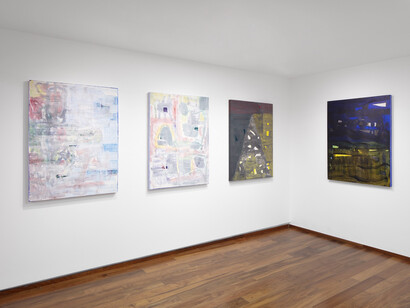
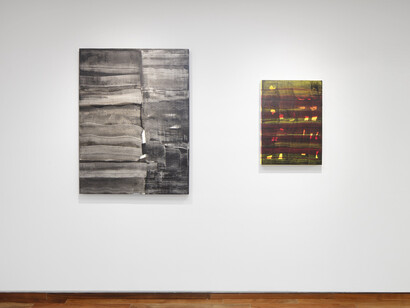
This whole historical prelude was necessary because in the paintings at issue in this exhibition, Willy Kautz has decided to reprise the discussion about the death (and possible resurrection) of painting through the monochrome. Rodchenko’s triptych appeared as a constitutive part of the exhibition ¿Quién es el dueño del mundo? (Who is the owner of the world?, 2015) at Casa del Lago, which considered coffee production in Brazil through the appropriation or détournement of different works of modern art. Nevertheless, seeing Kautz’s new paintings, the allusion to the monochrome might seem odd: none of them is composed by a single color! But as in the paintings of the Russian avant-gardes, the meaning of these works of art depends on a textual framework. What we see here is that, according to the artist, each of these works follows a “conceptual” pattern, that is, a format of instructions, that consists in making a painting and subsequently covering it with a monochromatic glaze that partially obscures the original composition. It is worth pausing over both stages of this process.
The initial painting is an exercise in improvisation that culminates in a non-figurative (or perhaps it would be better to borrow Malevich’s term, “non-objective”) composition. In each painting we see rhythmic brushstrokes in acrylic colors. Several of them combine red, yellow, and blue, likely alluding to the modernist pictorial reduction of Mondrian, Rodchenko, Torres García. Other compositions are in different colors. The brushstrokes follow a diffuse structural pattern but there does not seem to have been any intent to allude to anything other than painting itself. In this sense, these compositions could be interpreted within the coordinates of the beginnings of the European avant-garde.
The second element is the one that Kautz labels “monochrome:” once the initial painting is complete, a thin layer of a single color covers almost the entire surface, partially obscuring the original composition. The translucent membrane obstructs, cancels, annuls, or sabotages the painting it covers, adding another stratum of uncertainty to what already enigmatic by itself. But all these operations are partial and the original pictorial matter can still be seen through the imperfect monochrome. In this way, the original painting survives and acquires a new potency, becoming a “counter-painting.”
Just as in the Russian avant-garde some artists used very simple and affordable materials to make works that took into account concepts from mathematics like the fourth dimension, influenced by the work of the mathematician, inventor, and science fiction author C. H. Hinton, so Kautz often relates his works to processes coming from the techno-scientific domain. Kautz notes that his counter-paintings take up “concepts from quantum physics, such as the graviton, a subatomic particle that in theory regulates gravity, but whose existence has not yet been proven empirically.” In one of those happy coincidences that one encounters when drafting a text, it turns out that the General Theory of Relativity postulated by Einstein in 1916, is contemporaneous with the Soviet Revolution, and thus with monochromy in avant-garde painting. I noted above that in Kautz’s paintings it seemed as though there were no allusions to anything other than painting itself, but the allusion to the world outside the picture is there, with the brushstrokes in parallel lines that break through the translucent layer (the monochrome), in different dynamic directions. Here Kautz pictures nothing more and nothing less than gravitational waves, which Einstein predicted in the aforementioned theory, and evidence of which was discovered by a team of scientists at the LIGO observatories in 2015.
That said, gravitational waves are invisible and undetectable by everyday intuition. But Einstein’s theory also predicts the existence of particles called gravitons that despite being massless must exist, although as I mentioned above, no one has found evidence of them. Kautz thus declares his affinity with the genealogy of abstract painting, which sought to associate itself with the grand themes of existence, the “spiritual” (Kandinsky) and the “purely universal” (Mondrian) being but two examples among many. The difference—a hundred years later—is that Kautz does not see his work as part of either a radical transformation of art or a program for organizing reality. Given his earlier work, we can say that Kautz is definitely skeptical of grand political and aesthetic narratives. We find evidence of this in the animation Cinemarx, haunting for an audience (2016) in which “Marx appears as a specter on a gold monochrome singing The International in an empty red cinema.” In that same exhibition, the gold monochrome paintings from the series Quid pro quo, mockingly covered in gold leaf, treat Marxist texts about political economy like holy phrases.
Kautz’s fascination with the surface is prominent in several of his previous works: in addition to the gold coverings, one has to consider the screens in the aforementioned works, Mosca novus (New fly, 2017) and Cinemarx, haunting for an audience. In another exhibition, La crítica serotonínica del algo(ritmo)dopamínico (The serotonergic critique of the dopaminergic algo[rhythm]), we find several blank digital screens featuring only the spinning circular symbol that indicates the process of downloading characteristic of our imperfect cybernetic world. In the artist’s words:
The idea was for everything to be an experience of suspense on a loop, the download icons as a hypnotic loop… In theory if no information is downloaded, there’s no release of dopamine, so you go into a trance that releases the molecule or hormone of spirituality: serotonin.
To leave no room for doubt about the heterogeneity of Kautz’s proposal, that same exhibition had a series of improvisations with painting on circular tables that allude to this “download symbol,” which I see as the direct antecedents of the counter-paintings. There is a parallel between the nullifying power of the “download symbol” superimposed on the image in the LED screen, and the translucent monochrome, which falls on the surface in the counter-paintings.
But despite all these historical references and allusions to Willy Kautz’s polymorphic creative trajectory, I still have not succeeded in answering the question of why we now find this turn toward painting. Why go from a modus operandi that digitally, textually, and sculpturally “samples” (so to speak) the history of art to these objects that are already fully pictorial? The first answer might have to do with another aspect of Kautz’s creative output: his experimentation with sound.
Although it is too vast a theme to develop fully here, I believe that it is fair to identify two (among several) main methodologies in the art of the last 120 years: on the one hand, the algorithmic process, the invention of creative machines, evident since Raymond Roussel’s instruction-generated texts, which influenced Marcel Duchamp, John Cage’s instruction-generated work 4’33” (inspired in turn by Erik Satie), and Yoko Ono. In the pictorial aspect, there is a continuity from the European and Soviet avant-garde programs up to Theo van Doesburg’s intention that the work of art “should be entirely conceived and shaped by the mind before its execution,” which in turn anticipated Sol Le Witt’s famous definition in his “Paragraphs on Conceptual Art.”
Like many artists of his generation, Kautz has configured his work on the basis of the conceptualist paradigm. But as for his work with sound with his alter ego, Jippies Asquerosos, he has followed a second methodology, namely, the development of improvisation, which has a dominant place in many styles of music (especially since the advent of jazz) and also, since abstractions such as those of, say, Kandinsky, in some currents of painting. Improvisation is a constitutive part of the counter-painting proposed by Kautz. But the exercise of improvisation is not simply some arbitrary gesture. To be pulled off successfully, the painter must go into a trance, and so must those who gaze at the painting. As in jazz and other musical genres, it is necessary to establish a field of action about which the fascination of uncertainty is developed to the limit. I conjecture that for Kautz the activity of pictorial improvisation can be recuperated, separating it from its scientific, metaphysical, political, or spiritual instrumentalizations, which were so common in all these “–isms.” Nevertheless, the resource of radical skepticism with respect to the narrative of the heroic author or artist is indispensable. As in the case of the graviton, there is a theoretical component for which definitive evidence has not yet been found: the fraud as producer.
The artistic avant-gardes are at the same time effect and constitutive element of the politico-technological singularity of the early twentieth century. Boris Groys, who has carefully analyzed this period, summarizes the end of the Russian avant-garde as follows:
The avant-garde’s dream of placing all art under direct party control to implement its program of life-building (that is, “socialism in one country” as the true and consummate work of collective art) had now come true. The author of this program, however, was not Rodchenko or Maiakovskii, but Stalin, whose political power made him the heir to their artistic project.
Today we find ourselves faced with an exponentially more catastrophic singularity than the one from a hundred years ago. Through humor, irony, and pastiche, Kautz invites us to ask ourselves about the role that the arts still have to play in the present. Perhaps what resists dying is not simply painting or bourgeois art; perhaps it is a question of salvaging the perception and action of the human body against the automatic implementation of a productivity that is directed increasingly brutally at capitalist accumulation. Historian of science Matteo Pasquinelli argues that the large language models (LLM) of so-called “artificial intelligence,” like other decisive technologies in the development of today’s society, are “crystallizations of human activity” that aim to concentrate the means of production more and more. Faced with a new level of automation that threatens to displace and alienate human beings even more from the product of their work and from themselves, there can arise the impulse to recuperate the uncertainty involved in the activity of the hands, of vision, the fine and coarse movements of people in the act of painting or any other manual skill. Advocating for a reconnection with work of course has a definitively Marxist echo, but it seems to me to be an inescapable goal. In the face of the destructive capacity of the politicization of technology, there persists the slogan of inventing new manners of human interaction, new disciplines, and new forms of organization as acts of resistance. Within these new assemblages perhaps some residues of those strange practices that were previously known as “fine arts” can be perceived and reactivated in unexpected ways.