English
 Español
 Français
 Deutsch
 Italiano
 Português
In contemporary Western collective memories and imaginaries, the Swastika is associated with the Nazi horrors in collective memories in the West. It confronts us with the taboo of antisemitism and the holocaust. It is the symbol of the alleged racial purity and superiority of the Germanic population attributed by the National-Socialist regime between the 1930s and 1950s. Unfortunately, it is also the reference and core trademark of Neonazi movements infesting post-WWII Europe with their ideologies of hatred and rejection (European Ethno-Nationalist and White Supremacy Groups, n.d.).
It would, however, be erroneous to think that the racism of the Third Reich emerged out of nothing. Indeed, it is an outcome of a longer and broader history of racist ideas, representations, and theories produced in scholarly milieus during the nineteenth century. In the course of what George L. Mosse defined as the ‘Brutalisation’ of European (if not Western) societies, pseudo-scientific views dividing Humanity into races were adopted by ideologues and ideologies that substituted class struggles with Race-Struggle as far-right movements posed themselves as the main antagonist of the Left (Juan, 2005) (Historical Materialism, 2023).
These lines aim at shedding light on the longer history of the svastika symbol, contemplating its role in Indian religious cultures - mainly, Hindu, Buddhist, and Jaina cults - and its reappropriation by Western indology, first and, subsequently, by far-right ideologies in the West. The purpose is to explain how nineteenth-century indological knowledge contributed to preparing the terrain for racialist prejudice to mature in a complex ideological apparatus in the course of the twentieth century that supported first the imperialist and then the fascist/nazi iniquitous violence against others. Doing so, this piece of writing evidences the common matrix within which imperialist and fascist brutalities incubated.
The origin of the symbol
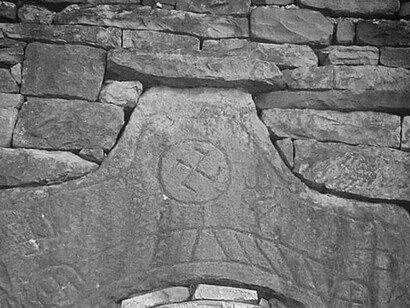
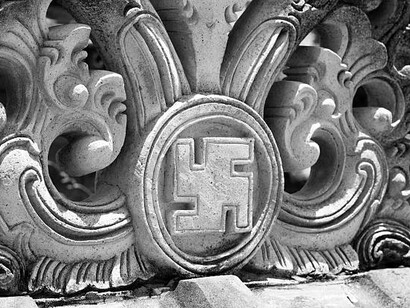
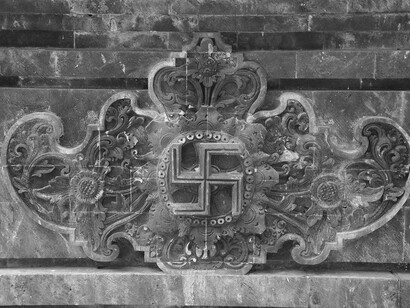
As mentioned above, the Svastika existed long before becoming a symbol of National Socialism. The swastika was almost omnipresent in India, even when the East India Company took control of the eastern coast northern areas of India. It possibly is a representation of the Sun, a symbol of good fortune, and it was already used in prayers of the Rig Veda (Sunder, 2022). Yoga has it as “Swastikasana”, position of the Swastika (Berwal & Gahlawat, 2013; Joshi & Joshi, 1989), a torsion which helps prevent lower back injuries. The symbol figures in monuments in India, whether they are Hindu, Buddhist, or Jain. It has also been adopted by Muslims who used it in the decorations of mosques in Cordoba (Sunder, 2022). The Swastika seems to also figure the four Yuga or ages of cyclical time in Hindu mythologies, the four aims or objectives of life, the four stages of life, and the four Vedas (Sunder, 2022).
The swastika is also present in Buddhism, which is not a surprise if one considers the fact that Buddhism is originally part of the Indian systems of creeds. Just like many other figures originating in India, like the Bodhisattva Avalokitesvara (Jap., Kanon), the symbol can be found in countries where Buddhism is the religion followed by a vast majority of the population (Silverblatt & Zlobin, 2004; Powers, 2007). In fact, the term Manji, which is the Japanese name for the Swastika, derives from the Chinese Manzi. In China, its esoteric significance also relates to Daoist concepts of the forces or energies at play in the universe. Jainas worship the swastika as a symbol of spiritual teaching.
The cross would represent the Samsara, or cycle of reincarnation. Very generally, the symbol is widespread in South Asian cultures, with various qualities attributed. In some cases, such as that of the Ananda Marga movement, this symbol is also imbricated in a six-branched star quite similar to the star of David. This may seem paradoxical, but it is important to bear the fact that this and other stars are also symbols of light and godly power before vesting deplorable meanings in modern times. The Ananga Marga probably sought to restore the swastika to its original spiritual meaning just as many others attempted in South Asia. It may also seek to approach the concept of universal spiritualism.
From this bird’s-eye view of the South Asian background of the Swastika leads to the question of how this solar symbol of good fortune was hijacked to be made a symbol of racial hatred and mass assassination. What is the responsibility of European modern culture in this grave appropriation/distortion? The answer to the question is apparently simple: it is so because of the Nazi. Nevertheless, the Nazi’s choice of this figure to be the symbol of National Socialism is a question in itself, and it deserves to be more thoroughly enquired into. The main point here is that there’s a rather ambiguous relation between indological ethnography, German ultranationalism in its most extreme form (National-Socialism), and the swastika symbol of ‘Aryanity’.
The symbol of the Aryan Race
The figure is found in the archeological sites of Harappa and Mohenjo-Daro, dating back to about 2500BC (Mayank and Nishav, 2010). This indicates that the Swastika symbol was current in cultures that are possibly anterior to the coming of Indo-Europeans (also known as Indo-Aryans, the latter name not being synonymous with the Aryan race imagined by National Socialists) in the Indus valley. Therefore, it is likely to have been used by populations speaking Dravidian languages (related to Tamil and Telugu). Dark skinned Dravidian speakers were excluded from ‘Higher Caste’ fair-skinned North Indians by many British and Indian indologists in the ethnographical literature of the nineteenth century (Thapar, 1996), and this was one cause of the South Indian/Dravidian movement during the British colonial domination, as well as after the independence of India.
Hence, it is possible to argue that there was a marked presence of Aryan vs non-Aryan discrimination already before the emergence of National Socialist hijacking of both the concept of the Aryan race and the Swastika. However, it is important to point out that the fact that the Swastika was not as intimately connected to racial ideology and antisemitism yet. Neither was it linked to German supremacism until the 1870s and the archaeological scholarship of H. Schliemann, the ‘discoverer’ of Troy/Ilion. Schliemann discovered there a Swastika-like hooked-cross, which he knew would also figure in old German pottery. The figure was soon attributed to the putative ancestors of nineteenth-century inhabitants of the unifying Germany. According to the Holocaust Encyclopedia, “other European scholars and thinkers linked the symbol to a shared Aryan culture that spanned Europe and Asia(History Of The Swastika & Its Use As A Nazi Symbol | Holocaust Encyclopedia, s. d.).”
Blaming Indology as a prejudicial ideology at the source of Nazi antisemitism would, however, be exaggerated. Germany’s then most famous Indologist, Max Müller, wrote to Schliemann and warned him to avoid using the word swastika on the icons: "Swastika is a word of Indian origin, and has its history and definite meaning in India. I know the temptation is great to transfer names, with which we are familiar, to similar objects which come before us… the occurrence of such crosses in different parts of the world may or may not point to a common origin (Sunder, 2022)." In fact, the Swastika symbol, as explained, figures in many archeological items from Asia to Africa, passing by Europe.
Nevertheless, the association between Aryan ancestors and the Swastika was rapidly adopted and passed in imagination beyond scholarly erudition. The use of the Swastika was rather widespread in Europe by the beginning of the twentieth century. Still, it seems that it was (still) symbolising good fortune and had not yet had the meaning of racial hatred. It seems that it was so until Adolf Hitler designed it at the centre of the banner of his National-Socialist party in the 1920s.
The reason for the adoption of the Swastika is indeed related to this speculative affiliation to the so-called Aryan ancestry that was the foundation of Nazi ideology (History Of The Swastika & Its Use As A Nazi Symbol | Holocaust Encyclopedia, s. d.). Before being exclusively adopted by the Nazi, the symbol was also widely used by other far-right movements as a reference to an ancient state of blood purity that was to be recovered and regenerated. As the Nazi party became hegemonic, they gained the exclusive use of the symbol, which Hitler allegedly designed himself, as he said in Mein Kampf: “I myself, meanwhile, after innumerable attempts, had laid down a final form; a flag with a red background, a white disk, and a black swastika in the middle. After long trials, I also found a definite proportion between the size of the flag and the size of the white disk, as well as the shape and thickness of the swastika (History Of The Swastika & Its Use As A Nazi Symbol | Holocaust Encyclopedia, s. d).
The Nazi flag was officially flown with the republican flag after Hindenburg and Hitler decreed it compulsory on March 12, 1933. Only one and a half months had passed since Hitler was elected chancellor and the Swastika banner was officially there “to connect the glorious past of the German Empire to the powerful rebirth of the German nation. Together they embody the power of the state and the inner solidarity of the national circles of the German people! (History Of The Swastika & Its Use As A Nazi Symbol | Holocaust Encyclopedia, s. d.)” The Nazi flag quickly replaced others and became the only official banner of the Reich. In the framework of the racial laws, raising this flag was indeed prohibited to the Jews.
Orientalism and imperialism
The case of the unfortunate fate of Swastika evidences that orientalist representations of Indian culture have played a role in the construction of Nazi ideology. Therefore, colonial/imperial prejudices had deleterious effects beyond the British dominion to Europe as well. British orientalists may well have been the first to figure out the affinities between ancient Indo-Aryans and their European counterparts. This was already the intuition formulated by Sir William Jones in his Third Discourse to the members of the Asiatic Society in Calcutta (Kolkata) in 1786:
“The Sanscrit language, whatever be its antiquity, is of a wonderful structure; more perfect than the Greek, more copious than the Latin, and more exquisitely refined than either, yet bearing to both of them a stronger affinity, both in the roots of verbs and in the forms of grammar, than could have been produced by accident; so strong indeed, that no philologer could examine them all three, without believing them to have sprung from some common source, which, perhaps, no longer exists: there is a similar reason, though not quite so forcible, for supposing that both the Gothick and the Celtick, though blended with a very different idiom, had the fame origin with the Sanscrit; and the old Persian might be added to the same family, if this were the place for discussing any question concerning the antiquities of Persia. (Jones, 1786)”
From Jones’ intuition, philologists researched the common points of what is now called the ‘Indo-European’ family of languages. By the 1820s, the concept of linguistic races emerged among European savants. The concept of human races was already used during the late eighteenth century; notably, in Linnean taxonomies. In his 1779 Handbuch der Naturgeschichte (Handbook of Natural History), Johann F. Blumenbach (1752–1840) had argued that Humanity was divided into races, which he listed into five in his 1795 De generis humani varietate nativa: Caucasiae, Mongolicae, Aethiopicae, Americanae, Malaicae. Just like Linnen, Blumenbach based his theories on taxonomical measurements. However, Blumenbach was quite misunderstood: what he initially dubbed as race was the result of climatic ‘degeneration’ of human beings, mainly due to climatic factors. Under the influence of Immanuel Kant, he eventually revised his theories and argued in favour of a more fixed concept of race.
Another central contribution was that of Gobineau and his Essai sur l’inégalité des Races Humaines (1853-55), which is one of the first scholarly books to claim the superiority of the ‘white race’ and associate it with the name ‘Aryan’. Probably, Gobineau was not the first to match the name Aryan with the idea of European. It was also used at about the same time by Ernest Renan (1823-1882) in his Histoire générale et systèmes comparés des langues sémitiques (1855).
In this book, his doctoral dissertation compares the Aryan (Indo-European) languages with the Semitic Languages to conclude the intellectual and moral superiority of the former over the latter. Whereas the Aryans were the race of Philosophers and Scientists, the Semites were confined to the realm of religion and bigotry. According to Leon Poliakov (2015), Renan’s theses had him criticised by the Jewish Austrian Orientalist Moritz Steinschneider (1816-1907), who qualified them as antisemitic. It is on this occasion that, still according to Poliakov, the term antisemitism was coined. Perhaps, this word substituted that of anti-Judaism, but this fact is not certain.
Renan was rather Islamophobic and philosemitic. Therefore, he devoted part of his work to explain that the jews were more Aryan than actual Semites: they were Semites from a racial standpoint, yet Aryan because of their contribution to philosophy and their adoption of European uses and customs (Le judaïsme comme race et comme religion; conférence given at the Cercle Saint-Simon, le 27 janvier 1883). Quite at the same time, he amended his racial determinism in his reflective ‘Qu’est-ce qu’une Nation?’, in which he attempted to provide answers to the moral crisis that the country was currently living through after the defeat of France by Prussia in 1871 and the unrest caused by the Commune.
A man of the intellectual establishment, he also became - as Léon Daudet called him - “the God of the Third Republic”, partly because of his anticlericalism. And, it was also in 1883 that he gave a conference on Islam and Science (L’Islamisme et la Science), in which he accused this religion of being antithetical to the Scientific spirit that defined European culture. To him, Islam represented the climax of the Semitic spirit, asserting that ‘God is God’, achieving the rise of monotheist absolutism once started in the Old Testament. Thus, his racial view and feud with the Semites were directed more toward the Arabs at the origin of Islam than to the Jews, who were integrated into the Aryan cultural fabric.
Of course, Renan’s philojudaism and restriction of antisemitism to the Arabs and Muslims was not consensual in the France of the 1880s. Suffice to mention that the Affaire Dreyfus would take place only ten years later, and that anti-Jewish movements had taken considerable space among the political, cultural, and military elites. Antisemitic prejudice was not confined to the Right. One of the crucial exponents of Aryan supremacism in France, Vacher de la Pouge, was an anticlerical socialist persuaded of the ultimate victory of the Aryans over the Jewish race. What is certain is that the defense of ‘Aryan’ supremacy was one of the motivations for the 1880s aggressive expansion that followed the ‘Scramble for Africa’ and the subjugation of almost all of Africa. In the name of the ‘Aryan’ race, genocide was inflicted on the Hereros and Nama populations in Namibia in 1908 (Le Génocide des Herero et Nama - Mémorial de la Shoah, 2020).
At this point, the view that the Aryan race struggled to rise to paramountcy was beginning to be quite consensual among decisive circles of imperialist powers. The breaking out of WWI would radicalise this pseudo-scientific worldview. It is during this period that, as said, the Swastika was becoming the rallying symbol of the Far Right movements, beyond Germany. The swastika was chosen purposely because it had become interpreted as the sign of the Aryan (white European) race alongside the Eagle. The swastika and the Eagle would be part of the symbolic ensemble of the Nazi regime.. This bird figure was inherited as the sign of imperial conquest from ancient Rome, and later adopted by the Habsburgs as the flag of the Holy Roman Empire. Later, Napoleon Bonaparte made the Eagle the symbol of his military might. Though stylized, the Eagle (or was Eagle for the Nazi) was thus no Nazi original creation at all.
If the Eagle has long been associated with things military and imperial conquests, the Swastika was not originally so. This symbol has become appropriated by adepts of hateful ideologies, but it was initially not meant to be so. It was hijacked in the process of general brutalisation of Western views of the world because it was a symbolic material that was ready at hand. It was also so because of the maturation of the concept of ‘Aryan’ ancestry and the elaboration of a philosophy which saw that the course of History was determined by the struggle of races; the Aryans being meant to preside to the destinies of Humanity (Renan), at the end of an apocalyptical battle which outcome was to be the final victory of Europe.
The Nazi invented neither their symbol nor their ideology. They appropriated things already available. They did not imagine new concepts but subverted representations. Arguably, the cultural terrain was prepared for their ideology to prosper. In this perspective, it is possible to agree with Edward W. Said’s assertion that ‘Orientalism’ has close links with Antisemitism. They had common origins, at least partly, and were constructed on the basis of common representations, imaginaries, and symbolic languages. These questions further the relationship of Europe with its other, and shed further light on the development of murderous ideologies both on European soil and in dominated territories. Finally, this leads to reconsidering antisemitism from a different standpoint, relating it to Europe’s view of Oriental cultures at large. Broadly viewed, it is thus Western cosmographies since the end of the early modern age that should be questioned.
References
Berwal, S., & Gahlawat, S. (2013). Effect of Yoga on Self-Concept and Emotional Maturity of Visually Challenged Students: An Experimental Study. Journal Of The Indian Academy Of Applied Psychology, 39(2), 260.
Ikhlef, H. European colonialism and the 'Oriental Renaissance'. Meer.
Ikhlef, H. (2025b, septembre 29). Adorno’s critique of popular culture and its relevance today. Meer.
Ikhlef, H. The phantom within the machine. Meer.
Indian Journal of History of Science. (2010).
Joshi, K. S., & Joshi, K. S. (1989). Yogic Pranayama: Breathing for long life and good health. Orient Paperbacks.
Le génocide des Herero et Nama - Mémorial de la Shoah. (2020, 16 novembre). Mémorial de la Shoah.
Powers, J. (2007). Introduction to Tibetan Buddhism. Shambhala Publications.
Silverblatt, A., & Zlobin, N. (2004). International Communications: A Media Literacy Approach. Dans Medical Entomology and Zoology.
Sunder, K. The ancient symbol that was hijacked by evil. Consulté le 10 novembre 2025, à l’adresse.
Sunder, K. Swastika : comment un symbole religieux est devenu un emblème du nazisme. BBC News Afrique.
Thapar, R. (1996). The Theory of Aryan Race and India: History and Politics. Social Scientist, 24(1/3), 3.
United States Holocaust Memorial Museum, Washington DC. (s. d.). History of the Swastika & Its Use as a Nazi Symbol | Holocaust Encyclopedia. Holocaust Encyclopedia. Consulté le 10 novembre 2025, à l’adresse.