English
 Español
 Français
 Deutsch
 Italiano
 Português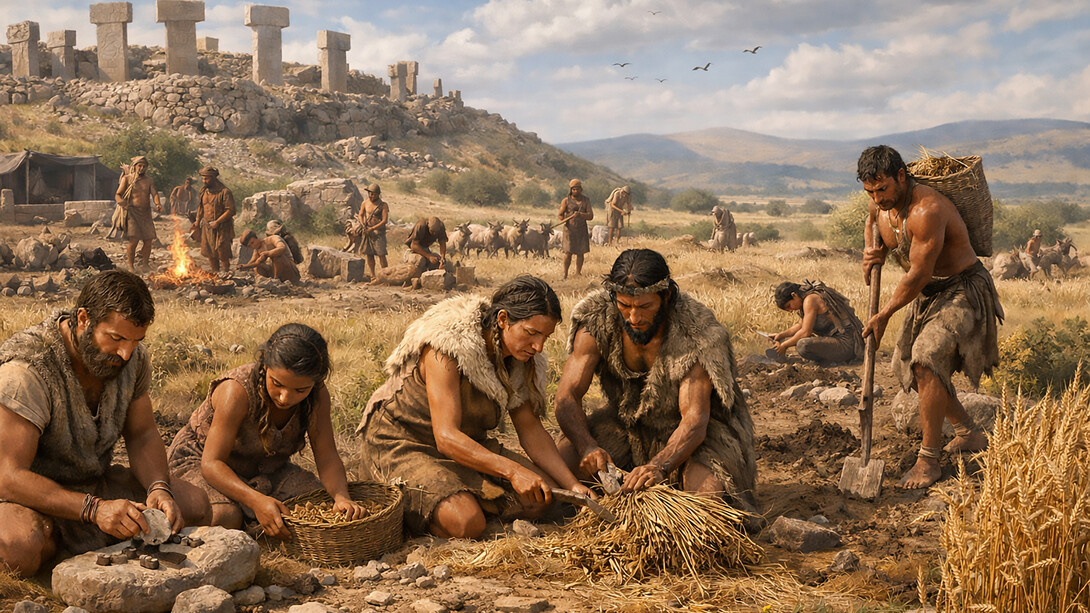
Humans are often described as the most cooperative species on Earth. We form large societies, share knowledge across generations, and collaborate with strangers in ways unmatched by any other animal. But is cooperation the defining trait that made us human? And if so, what does this mean for how we understand the evolution of the human mind?
Modern humans (Homo sapiens) have existed for roughly 300,000 years, spreading across the globe and adapting to an extraordinary range of environments. While we share many biological and cognitive traits with our closest relatives, the great apes, only our lineage developed complex language, cumulative culture, and large-scale cooperation. This pattern has led many researchers to argue that cooperation was not simply a social behaviour humans adopted but a fundamental force shaping human cognitive evolution.
Rather than emerging suddenly, cooperation appears to have evolved gradually alongside other cognitive capacities, including imitation, shared intentionality, and language. Together, these abilities transformed inherited primate intelligence into something uniquely human.
Cognitive evolution: building on an Ape foundation
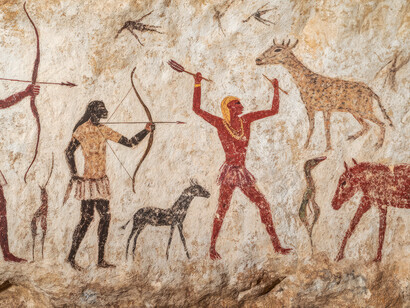
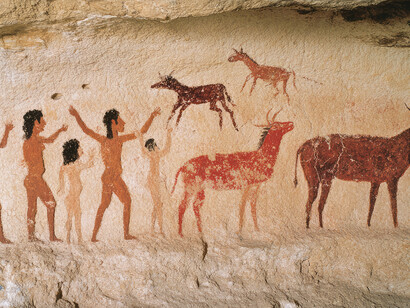
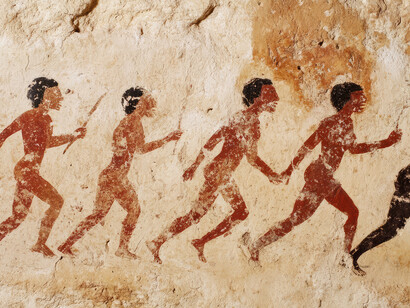
Early humans did not begin with entirely new cognitive abilities. Fossil evidence shows that brain size and shape changed gradually over time, suggesting a long process of cognitive evolution rather than a sudden leap. Symbolic behaviour, such as ornamentation, cave art, and complex tools, began to appear around 100,000 years ago, roughly coinciding with significant changes in brain organisation.
However, brain size alone does not explain human intelligence. Archaeological artefacts provide stronger clues. Stone tools, paintings, and material culture reflect learnt behaviours passed across generations, revealing how cognition operated within social contexts. These artefacts suggest that early humans were not just thinking individually but learning collectively.
Research on non-human primates further complicates the picture. Certain aspects of culture, such as tool traditions and regional behavioural norms, are also found among chimpanzees and other great apes. This indicates that the roots of culture predate humans. What changed in our lineage was not the presence of culture itself, but its scale, stability, and cumulative nature.
Humans developed the ability not just to copy actions but to understand why others acted as they did. This capacity for imitation with understanding allowed knowledge to accumulate rather than reset each generation, accelerating cultural and cognitive evolution.
Shared intentionality: thinking together
One of the most influential concepts in explaining human cooperation is shared intentionality, the ability to share goals, intentions, and attention with others. This capacity allows individuals to coordinate actions toward a common purpose, forming the basis for teaching, communication, and social norms.
Shared intentionality is present to a limited extent in some cooperatively reared apes, but it is far more developed in humans. Even before they can speak, human infants use gestures, eye contact, and pointing to direct attention and share experiences with others. These behaviours rely on mutual understanding: both individuals know they are focused on the same thing and know that the other knows it too.
This ability is central to learning. Parents actively guide children’s attention through play, gestures, and repeated interaction. Through these shared moments, children acquire language, social norms, and cultural expectations. Curiosity plays a key role here; children are naturally drawn to what others attend to, allowing social learning to flourish.
Importantly, shared intentionality did not require entirely new cognitive machinery. Instead, it built upon existing primate abilities, reshaping them to function within more cooperative social systems.
Cooperation and the problem of scale
Cooperation poses an evolutionary puzzle. While helping others can benefit a group, it also creates opportunities for exploitation. In most species, cooperation is therefore limited to close kin or small groups. Humans are exceptional in their ability to cooperate in large, flexible communities.
One explanation lies in interdependence. At some point in human evolution, survival and reproduction increasingly depend on collaboration. Hunting, gathering, childcare, and defence all require coordination. As cooperation became necessary, selection favoured individuals better able to understand others’ intentions, regulate their behaviour, and maintain social bonds.
Cooperative breeding may have played a crucial role. In humans, childcare is often shared among individuals beyond biological parents. This system encourages tolerance, reduces aggression, and heightens sensitivity to others’ needs. Evidence suggests that regular participation in allomaternal care promoted prosocial motivations and laid the groundwork for advanced cooperation.
These social pressures did not merely shape behaviour; they influenced cognition. Understanding others’ mental states became increasingly important, reinforcing shared intentionality and social learning.
Language as a cooperative tool
Language represents one of the clearest outcomes of cooperative cognition. Unlike animal communication systems, human language is flexible, symbolic, and used to share information beyond immediate needs.
Before spoken language emerged, early humans likely relied on gestures, miming and non-verbal communication. These systems allowed coordination and shared understanding long before words existed. Over time, increasing brain size and social complexity supported the transition to structured language.
Studies comparing humans and great apes highlight key differences. Even socially trained apes struggle with cooperative communication tasks that human children master easily. Humans use language not only to request resources but also to inform, teach, and coordinate actions for collective benefit, clear evidence of shared intentionality at work.
Language also reinforced group identity. Early human groups developed distinct traditions, rituals, and symbolic expressions, strengthening in-group cooperation. These cultural systems were passed down through generations, forming the foundation of modern human societies.
Did cooperation make us human?
Cooperation alone cannot explain human evolution, but it may be the thread that ties everything together. Language, shared intentionality, imitation, and culture all depend on cooperation and interaction. None of these traits evolved in isolation; each reinforced the others.
Rather than creating entirely new cognitive abilities, human evolution transformed existing primate capacities through social pressures that favoured collaboration. Over time, these changes produced minds capable of cumulative culture, moral norms, and large-scale social organisation.
Ultimately, cooperation reshaped cognition itself. The human mind evolved not just to survive in the physical world but to function within complex social networks. Understanding this helps explain why humans are so deeply social, and why cooperation remains central to what it means to be human.
References
Burkart, J.M., Hrdy, S.B. and Van Schaik, C.P., 2009. Cooperative breeding and human cognitive evolution.
Henrich, J. and Muthukrishna, M., 2021. The origins and psychology of human cooperation.
Richerson, P., Baldini, R., Bell, A.V., Demps, K., Frost, K., Hillis, V., Mathew, S., Newton, E.K., Naar, N., Newson, L. and Ross, C., 2016. Cultural group selection plays an essential role in explaining human cooperation: A sketch of the evidence.
Tomasello, M. and Gonzalez-Cabrera, I., 2017. The role of ontogeny in the evolution of human cooperation.
Tattersall, I. (2010). Human evolution and cognition. Theory in Biosciences.