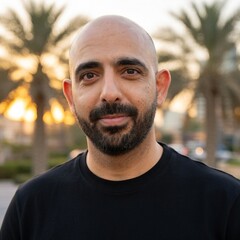
Melo Wajed Doumani is a venture architect and AI product builder based in Dubai, UAE—and a writer who has never been able to separate the two impulses. He is the Founder and Principal Architect of Metron Ventures, a UAE venture studio operating five digital platforms across professional networking, commerce, the creator economy, productivity, and artificial intelligence. He builds things that think. He writes things that refuse to be decorative.
Metron Ventures operates on a single methodology: measure over excess. The name is rooted in the Greek concept of measure—not measurement, but measure. The space between excess and deficiency. That philosophy governs every product decision, every build priority, and every line of copy on the site. The studio’s two live tools reflect that discipline precisely. METRON Local TPD Studio installs 350 of history’s greatest strategists, philosophers, and economists directly onto your machine—no cloud, no API, no data leaving your device. You convene a panel, state your challenge, and walk away with clarity you could not buy at any consulting rate. ScreenBuddy does the same for screenwriters, placing legendary directors and writers in the room with you as collaborators—running locally, permanently yours. Both are sold with a personal installation session over Google Meet. One payment. No subscription. No renegotiation.
Five ventures are in active development behind them. PlusOne reimagines professional networking as an act of vouching rather than volume. Sahara connects WhatsApp, invoicing, inventory, and payments into a single operational layer for UAE small businesses. Executive Email surfaces what matters and filters everything else into noise. Tanwir is a creator economy platform built on ownership—because every audience built on someone else’s platform can be erased tomorrow. Project AGI is the studio’s long-horizon artificial intelligence research initiative, grounded in the Metron framework: character first, synthesis over analysis, and timeless principles over trending architectures.
His writing comes from a different place entirely—one that is harder to summarize and more honest for it. He is the author of Perspectives: 100 Quotes, a published collection born from decades of philosophical observation compressed into statements designed not to comfort but to reorient. He has written ten screenplays. Through MeloQuotes, he has built a body of work rooted in a single, uncomfortable admission: that near 42, after years of character building, hard-won insight, and external achievement, he has circled back to the same conclusions he held as a defeated nineteen-year-old. That movement can feel futile. That the mind loops. That the only escape is spontaneity—something sharp enough to surprise the brain out of its own automation and return the soul to something resembling freedom.
That admission is not resignation. It is the foundation of his Melonomics framework, which argues that intellectual hunger—not credentials, not status—is the only real currency. He has no patience for the social habit of pitying the feeble-minded, which he reads not as compassion but as projection: the soft extending their softness and calling it mercy. His position is harder and more generous: we are all responsible for being both teachers and students, masters and apprentices. The goal is not to arrive at answers but to possess the humility to say, "I don’t know," and the strength to demand, "Teach me"—to carry a library of methods, a collection of reminders, and a passport to the role models who can still change how you see.
That is what he builds toward. That is what he writes toward. Both are the same pursuit, measured differently.
Melo believes the real divide in humanity isn’t based on gender, race, religion, class status, or sexual orientation but on how we think. “Our character determines our mindset, motivates us to acquire skill sets, and encourages us to discover and build toolsets. I would like to consume libraries of methods and have a passport to role models.”





















 English
 Español
 Français
 Deutsch
 Italiano
 Português