English
 Español
 Français
 Deutsch
 Italiano
 Português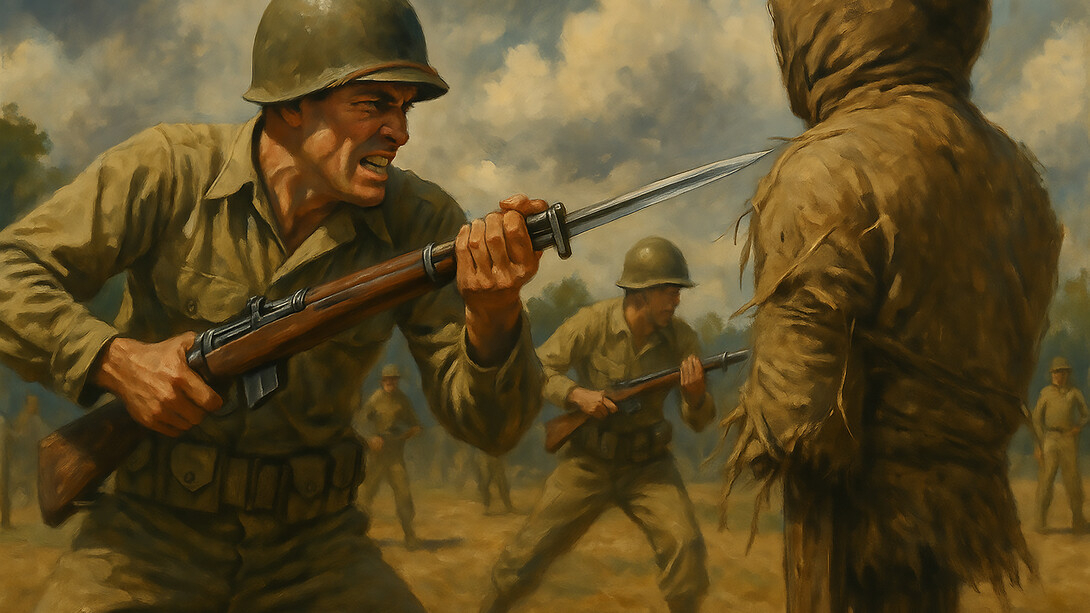
In reading author and historian Joanna Bourke's 1999 book, 'An Intimate History of Killing,' a disturbing paradox at the heart of modern warfare emerges. For centuries, military commanders believed that transforming civilians into effective soldiers was a straightforward process, involving equipping them with weapons and instructing them to follow orders. Fire your rifle, thrust your bayonet, and throw your grenade. These were simple, instinctive acts that any man could perform when his life, or his comrades, depended on it.
Yet the uncomfortable truth, revealed through decades of research and battlefield experience, is far more unsettling: most human beings possess a profound, almost biological resistance to killing other human beings. The real work of military training isn't teaching soldiers how to kill but is rather in overcoming their deeply rooted reluctance to do so. This revelation fundamentally challenges our assumptions about human nature and the character of war itself.
It also exposes something darker about the evolution of military institutions: the systematic development of psychological techniques designed to strip away our natural inhibitions against taking human life. From the trenches of the First World War to the jungles of Vietnam, the story of military training is one of institutions struggling, and often failing, to manufacture killers from ordinary citizens.
The problem that wouldn't go away
Consider the case of Lieutenant Colonel Robert G. Cole, commander of the 502nd Parachute Infantry, one of the most elite units in the US Army during World War II. On 10 June 1944, along the Carentan Causeway in France, Cole found himself in a situation that should have been straightforward: his men were being attacked, they had weapons, they had training, and they had clear targets. Yet when the moment came to return fire, Cole made a horrifying discovery. "Not one man in twenty-five voluntarily used his weapon," he lamented. Despite being under direct attack, despite months of training, despite the very fact that their lives depended on fighting back, his soldiers just simply couldn't bring themselves to shoot.
Cole's experience wasn't isolated by any means. It was symptomatic of a problem that military forces had confronted throughout the twentieth century but struggled to acknowledge. During the Second World War, concern about what was euphemistically called "passive combat personnel" reached almost hysterical levels. Statistical research revealed the uncomfortable scale of the issue: no more than 15 percent of soldiers had actually fired at enemy positions or personnel with rifles, carbines, grenades, bazookas, or machine guns during the entire engagements. In some actions, it was barely possible for at least 80 percent of men to have fired, and nearly all men were within firing distance of the enemy.
The implications were staggering. Military-psychologist research suggested that three-quarters of soldiers, when faced with the opportunity, or indeed, the necessity, to kill the enemy, simply refused to do so. They didn't flee. They didn't panic. They performed other duties admirably. But when it came to the fundamental act of combat, the taking of enemy lives, they became inexplicably passive. Why was this?
The myth of natural aggression
This widespread passivity demolished long-held assumptions about human nature and military effectiveness. Before the First World War, military doctrine had operated on the premise that the incitement and control of state-legitimized violence was regarded as a relatively simple matter, requiring little effort. The professional military, with its traditions stretching back centuries, believed that certain fundamental military traits could be instilled through teaching: toughness, alertness, loyalty, and discipline.
Combat itself, however, was seen as something different. It was not "a theoretical business like pure mathematics, or pure science, or pure anything else" but something dependent on instinct and character. The ideal soldier was epitomized by the young Fourteenth Royal Welsh recruit who could bayonet a German "in parade-ground style, automatically exclaiming: 'In, out, on guard!'"
This confidence in human aggression as a natural, easily directed force persisted despite mounting evidence to the contrary. Military psychology decreed that men had to be taught to become "practical realists," conscious only of the necessity to kill or be killed, arriving at the battlefield emotionally intact and ready to kill with cold efficiency. After all, these theorists reasoned, bloodlust, rage, and hatred were counterproductive responses, making men's hands tremble. Military training was supposed to transform instinctive violence into controlled, tactical aggression. Yet the reality on the battlefield told a different story. Soldiers arrived with all the technical skills they needed, and yet something deeper, something more fundamental, prevented them from using those skills to take human life.
The psychologization of warfare
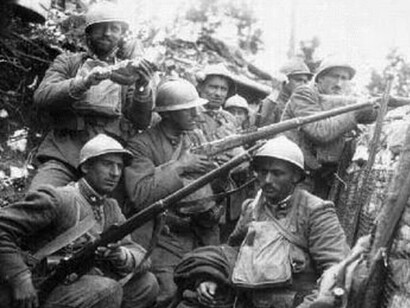
Faced with this crisis, military institutions in the twentieth century embarked on an unprecedented project: the systematic psychological engineering of human beings to overcome their resistance to killing. From 1916 onwards, mass conscripted armies, together with startlingly new technologies of war, forced military training out of complacency. The old methods of drill, physical fitness, and weapon familiarization were clearly insufficient. What was needed was the fundamental restructuring of human psychology. A structured form of brutality that could reshape a family man and turn him into a killer.
The brutality was often extreme and deliberate. Private Stephen Graham, describing British Army training in 1919, captured the dehumanizing essence of the process: "To be struck, to be threatened, to be called indecent names, to be drilled by yourself in front of a squad to make a fool of you, to do a tiring exercise and continue doing it whilst the rest of the squad does something else, to have your ear spat into, to be marched across the parade ground under escort, to be falsely accused before an officer and silenced when you try to speak in defense—all these things take down your pride, make you feel small, and in some ways fit you to accept the role of cannon fodder on the battleground."
This was, in the words of a Marine trainer in 1951, about ensuring that "the combatant's sole function is to kill the enemy... The possible criticism that such training will result in a lack of control and 'trigger-happiness' is not tenable. The problem is not to stop fire but to start it." Fear, they argued, would make soldiers freeze in battle, so the solution was to make them angry instead. "Fear will cause you to die," instructors would yell. "Get angry and kill!"
The spirit of the offensive
But more was needed beyond mere anger. One influential approach came from John Frederick Charles Fuller, arguably the most prescient military philosopher of the twentieth century. Fuller believed that the "spirit of the offensive" could best be inculcated through a process of slow, continuous, and almost imperceptible indoctrination. Human psychology, he argued, was crucial. After all, he pointed out, "the firer and not his weapon" was the determining factor, and "the fear of death" was the fundamental challenge.
Fuller drew on his own brand of instinct theory and crowd psychology, advocating for training methods that would bombard soldiers with "warlike impressions" until their reflexes became "wholly warlike." The army, Fuller proclaimed, should function as a crowd, with individual will subsumed into the collective. Like individuals within crowds, soldiers were "ruled by voices from the past." The training regime would sway the "army-crowd" through the voice of instruction, creating "uniformity of environment" and "character or spirit." Bombarding recruits with "warlike impressions" was crucial, yet as Fuller recognized, training regimes couldn't replicate actual battle. Without the crucial ingredient of live bullets, he proposed using colored flags to simulate enemy fire, teaching recruits to respond differently depending on the perceived level of threat.
Colonel S.L.A. Marshall took these insights further after the Second World War. Marshall also believed in the importance of realistic training for men to act aggressively, and he agreed with Fuller that men had to be taught to act upon their own initiative. Automatic movements and precise drills were damaging, in Marshall's view. Officers and their men had to understand psychological processes, particularly how contact with an enemy would encourage men to touch each other; literally "patting another on the back... may turn a mouse into a lion." Human warmth, or merely being able to see another man, was essential to the offensive spirit, as was movement, even if it was merely digging or administering first aid to a comrade.
Perhaps no aspect of this psychological engineering was more disturbing than the language employed to describe and justify it. Military training developed what can only be called a lurid discourse around violence: a way of speaking about killing that simultaneously acknowledged its transgressive nature while working to normalize and even eroticize it.
Consider the testimony of Michael Rosenfield, drafted into the US Army in 1969-70: "They'd give you a rifle with a bayonet, and they'd say, 'What is the spirit of the bayonet?' And you had to yell, 'To kill!' And, I'll never forget, I'd pantomime. I wouldn't say it. So, to make us say it louder, the sergeant would yell, 'I can't hear you!' People would scream, 'To kill!' And I was pantomiming. Once, they said, 'If you don't say it louder, we're not going to give you people lemonade!' And, I'll never forget, at one point I yelled that the purpose of the bayonet was to kill—the first time I ever did that—and it was to get some lemonade because I was so exhausted and dehydrated."
This vignette reveals the perverse economy of military training in the deliberate cultivation of murderous intent through methods that deliberately infantilize and dehumanize. The creation of what one Canadian instructor called "charms to ward off 'fear'"—such linguistic and behavioral rituals were designed to transform the natural human reluctance to kill into automatic, unthinking aggression. The language itself became increasingly explicit. Military instructors told recruits they were "men who could not take being shouted at and kicked in the ass," rationalizing brutality as necessary preparation.
Philip Caputo, who served in Vietnam, captured this dynamic perfectly when he described how instructors would proclaim, "A man who could not take being shouted at and kicked in the ass" (rationalized during the Vietnam War) "could never withstand the rigors of combat." Brutalization in training camps lowered an individual's sense of self-worth, making soldiers "even more anxious to prove that he was 'equal to the Corps' exacting standards."
The problem persists
Yet for all this psychological engineering, military training remained deeply inadequate. Even with increasingly sophisticated techniques, even with brutal regimes designed to strip away human inhibitions, the fundamental problem persisted. Men trained to kill often still wouldn't kill when the moment arrived. The evidence was overwhelming. During the Second World War, of the 800 reinforcements posted to the US 50th Division, Eighth Army, only one quarter had done any field firing. Seven soldiers had never fired a rifle in their lives, nine had never fired a Bren gun, 131 had never thrown a live grenade, and 138 had never fired a Thompson submachine gun. The gap between training and combat readiness remained enormous.
Even when soldiers received training, passivity remained the norm. Studies of the famed 51st Fighter Wing in Korea revealed that half of their F-86 pilots had never fired their guns, and of those who had, only 10 percent had ever hit anything. The fighter pilot Hugh Dundas observed, "When it comes to the point, a sincere desire to stay alive overpowered any incentive to 'engage the enemy.'" A Canadian military instructor wrote bluntly in 1951 that the combatant's "sole function is to kill the enemy... The possible criticism that such training will result in a lack of control and 'trigger-happiness' is not tenable. The problem is not to stop fire but to start it, and it is far better to have some excess of enthusiasm than the present lassitude displayed by some of our so-called riflemen."
The bayonet's symbolic power
Of all weapons, the bayonet occupied a peculiar place in this system of manufactured aggression. Even as modern armaments made hand-to-hand combat increasingly rare, bayonet training remained central to military preparation across all three major conflicts examined here. Why? The answer reveals something profound about military psychology. Bayonet training wasn't really about the bayonet; it was about crossing a psychological threshold. As the British Army training manual of 1916 explained, "Sacks for dummies should be filled with vertical layers of straw and thin sods (grass or heather), leaves, shavings, etc., in such a way as to give the greatest resistance without injury to the bayonet." The goal wasn't to simulate actual combat conditions but to create a visceral, intimate experience of penetrating human flesh.
Men's accuracy was tested through discs attached to dummies that could only be "carried" by a vigorous thrust and clean withdrawal. The assault had to begin from a trench six to seven feet deep; soldiers were to cheer until close to the enemy, and dummies were to be hung from galleys or placed on tripods. The vulnerable parts of men's bodies would be painted onto sandbags, and instructors were reminded that the Navy taught men to use the bayonet even at sea. Lawrence described training under a Canadian naval officer: "You've got to want to come to grips with the enemy. No captain can go far wrong by putting his ship alongside that of the enemy. Board them. Give them a taste of cold British steel. Shoot them. Club them. Subdue them!"
This training bordered on the ritualistic, even the sexual. One instructor at the Royal Military College, Sandhurst, described his approach: "Taunts about virility and competence could be irresistible to young, immature men trapped in hostile environments miles from home." The language itself betrayed the psychological operation at work: overcoming inhibitions against violating another human body by rendering that violation automatic, even pleasurable.
Consequently, soldiers were constantly tested in training camps. The British Army training manual of 1916 informed instructors that men carrying out final assault training should be brought to the assault course already exhausted to test their accuracy in bayoneting. Instructors at Fort Benning, Georgia, described training under Lieutenant William Calley, who became infamous for the My Lai massacre: "One thing we were taught at OCS for twenty years was that we had thought it was bad to kill, and suddenly they tell us to kill, and we have to learn to do it. We sat around, and he kicked another man in the kidney: a few inches lower, really, and this could be a lethal kick. It was just gruesome: a POP, and I thought, Oh god. No one can live through that."
This visceral nature of bayonet training revealed its true purpose. It wasn't preparation for a likely battlefield scenario, as modern warfare had already made bayonet charges obsolete. Rather, it was a psychological initiation, a controlled transgression designed to habituate soldiers to the fundamental act of intentionally harming another human being.
The limits of science
By the Second World War, military institutions increasingly turned to psychology and social science to solve their killing problem. Clinical psychologists, social workers, and psychiatrists were recruited to develop more effective ways of transforming civilians into killers. These social scientists brought new language, new theories, and new legitimacy to the enterprise of manufacturing aggression.
Yet even this scientific veneer couldn't fully mask the fundamental problem, as the role of behavioral scientists in enabling men to kill was only very rarely, and then extremely obliquely, mentioned by historians. This silence was telling. The great instruments of destruction were not impersonal tools but intimate weapons, and while physical scientists pretended emotion was irrelevant, social scientists took human experience seriously and placed excitement, fear, and fantasy center stage.
These experts attempted to convince the military hierarchy that unless officers were trained in psychology and were able to counter the effects of mechanization and anonymity, their expertise with guns, ranges, and ballistics was useless. The role of behavior in warfare was crucial. After all, no amount of military training could deal with volunteers, conscripts, and even regular servicemen who simply lacked that elusive "offensive spirit."
Ironically, however, this scientific approach often led to conclusions that undermined the very premises of military training. When researchers studied combat effectiveness, they discovered that the best combatants weren't the products of sophisticated psychological engineering but were men who felt strongly attached to effective groups, who would protect each other, and whose interests were identical to their own. Pride of place was given to personality and related factors, including whether the soldiers expressed a desire to kill.
For instance, 48 percent of soldiers who later performed particularly well in combat said they would actually enjoy killing Japanese soldiers, compared with 44 percent of soldiers who performed adequately and only 38 percent of those who didn't fight well. The dirty secret, barely acknowledged, was that military training's most "successful" products in those most eager and willing to kill often resembled what civilian society would classify as psychopaths or sociopaths. The very traits that made someone an effective killer in combat were precisely those that made them dangerous and dysfunctional in peace.
The unresolved tension
The history of training men to kill reveals a fundamental tension at the heart of modern militaries: the need to transform peaceful citizens into effective killers while somehow preserving their humanity and reintegrating them into society afterward. It's a tension that has never been resolved, only managed through increasingly sophisticated but ultimately inadequate psychological techniques.
Understanding this history doesn't resolve its ethical complexities. Military forces will continue to exist, conflicts will continue to occur, and nations will continue needing citizens willing to fight. But acknowledging the profound difficulty of training people to kill and the psychological costs of overcoming that difficulty should give us pause. It should make us question easy assumptions about human aggression and military necessity. And it should remind us that the act of killing, even in war, even when legally sanctioned and militarily necessary, remains a fundamental violation of our nature—one that can be induced but never made natural, commanded, certainly, but never made comfortable.
The uncomfortable truth is that making killers requires breaking something essential in human beings. Military institutions have spent a century perfecting techniques to do precisely that. Whether we should celebrate their success or mourn their necessity remains the question that military training, for all its scientific sophistication, cannot answer.
Sources
This essay draws extensively from Chapter 3, "Training Men to Kill," in Joanna Bourke's ‘An Intimate History of Killing: Face-to-Face Killing in Twentieth-Century Warfare’ (Granta Books, 1999).