English
 Español
 Français
 Deutsch
 Italiano
 Português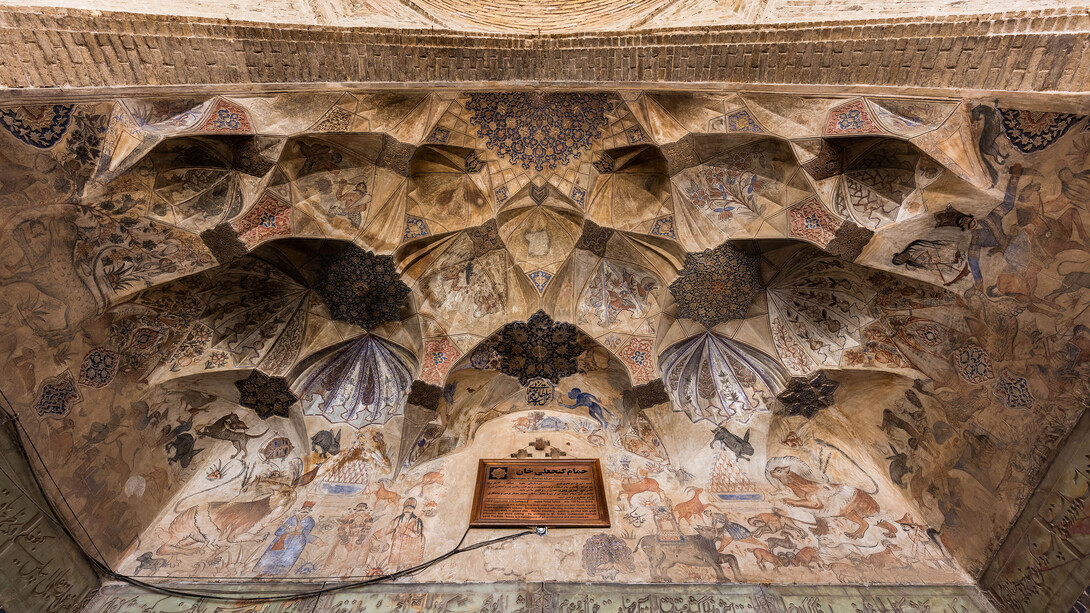
In different eras, cities have been key centers of growth and progress, especially after the French Revolution, when new movements began shaping urban systems and human societies. At that time, broader views emerged around development trends. In Iran, this process began slowly and steadily, with smaller cities like Kerman experiencing more gradual changes. Over time, though, these shifts became more visible across generations, leading to the expansion and transformation we see today.
The key elements that shape a city’s identity can be grouped into three main categories. The first includes unique, irreplaceable elements valued for their importance, status, or sacredness. The second group consists of rare global elements with deep historical roots in both form and function, reflecting a civilization’s legacy. Lastly, the third group includes distinctive and uncommon features in each city that stand out through their unique form and function (Naghizadeh, 2014: 207).

Figure 1: The growth and direction of urban fabric in Kerman.
A city’s growth takes place over a specific period and is shaped by three spatial systems. First is the expanded urban system, which includes networks like roads, commercial centers, and similar infrastructures. Second is the ecological and physical system, an expandable one, covering natural elements such as water resources, forests, and agricultural lands. Third is the planned urban system, which is guided by comprehensive and detailed planning documents (Majedi, Zavarat, and Mejrabi Kermani, 2012: 52).
The structure of the city of Kerman
Kerman’s remote natural location has often made it a refuge for fallen rulers, displaced sultans, and overthrown tyrants who had nowhere else to turn (Bastani-e-Parizi, 2014: 19, 24, 25). It was here that Lotf Ali Khan Zand’s story came to a tragic end and where Kerman began its painful encounter with Agha Mohammad Khan Qajar.
Urban building complexes often take shape in a connected or continuous manner, laying the foundation for the city’s essential institutions to survive and function. These include 1- economic and service-based institutions, 2- social and socio-cultural institutions, and 3- religious institutions. Over time, these three reach a balance with a fourth key system: 4- the government and administrative structure (Flamaki, 2012: 268).
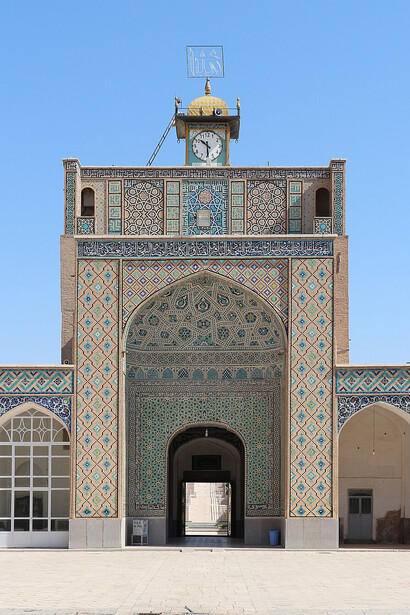
Qajar-era architecture (1796–1924 AD)
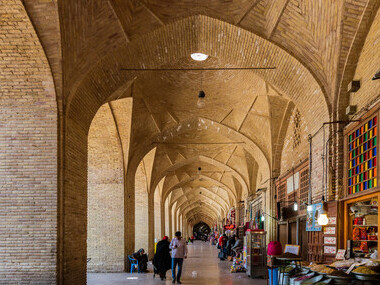
One of the most significant events of the Qajar era was the Constitutional Revolution, and the people of Kerman were involved from the very beginning. At that time, public squares were essential spaces, as they hosted the main scenes of civic life, activities that now often take place indoors. The market square, once the second hub of daily life for our ancestors, has endured to this day, though it too is gradually being replaced by large, enclosed halls (Shway, 2009: 261).
Mushtaqiyeh Tomb
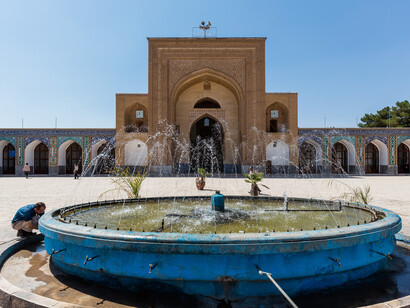
The graceful domes of the Mushtaqiyeh building rise gently above the surrounding trees, revealing three beautifully interconnected domes. This structure is the resting place of three esteemed figures of Kerman: Mushtaq Ali Shah, Kowsar Ali Shah, and Sheikh Ismail—all known for their deep knowledge and wisdom. Mushtaq Ali Shah’s tomb lies in the northern section of the building and features striking interior decorations. It opens onto a courtyard where a serene pond and tall trees seem to quietly honor the memory of those buried here, offering a rare sense of peace in the heart of one of Kerman’s busiest neighborhoods.
Mahan's Shetregalo
Shetregalo is, in fact, the name of one of the unique inventions of the Iranian people. It refers to a traditional architectural method once used to guide water through uneven terrain. When obstacles blocked the flow, this technique was applied to remove them and transfer the water to the other side.
Arg Square
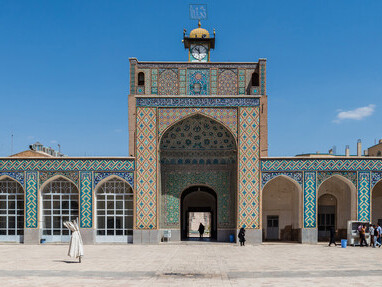
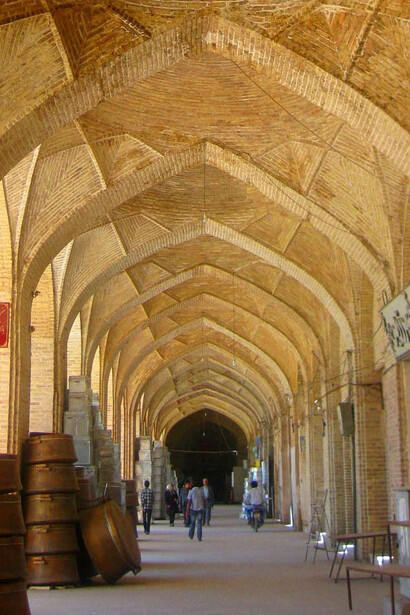
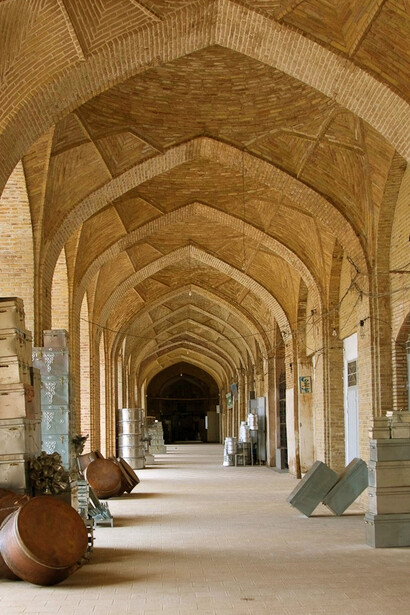
The bazaar route begins at Arg Square and ends at Mushtaqiyeh Square. Each section of the Kerman Bazaar was built during the rule of different city governors, making it unique in Iran. Some of its features are so distinctive that the bazaar is renowned worldwide.
The mystery of the Pahlavi Era (1924–1979 AD)
Fifty years ago, the city of Kerman was still relatively small. A ditch surrounded the city, about 4 to 5 meters deep and 6 to 8 meters wide. Just behind it stood the city wall, no taller than ten meters, but thick and solidly built. The wall had six gates, each named for a specific occasion or purpose.
In 1307 and 1308 (1928–1929), orders came from Tehran to begin demolishing the city gates and walls, to fill in the ditches, and—if a buyer could be found—to sell the ditches at a low price (Kermani, 2010: 457, 459). This marked the beginning of major changes to Kerman’s urban form, a process that started during the Pahlavi era and still continues today. These changes led to the loss of much of Kerman’s traditional fabric—a trend seen in many other Iranian cities as well.
Museum of Contemporary Arts
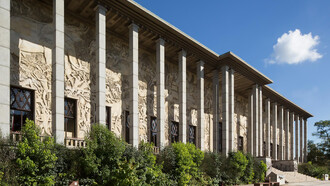
The Kerman Museum of Contemporary Industrial Arts is one of the most beautiful and largest museums in Iran and the Southeast. The building was constructed nearly 80 years ago by a philanthropist named Haj Akbar Sanatizadeh, originally serving as an orphanage for children without families. For around 40 years, it remained a home for orphans, and thanks to Haj Akbar’s kind-hearted guidance and care, many of the children raised there went on to become well-known and respected individuals.
Faculty of Engineering
Since mid-summer 1972, this faculty has officially been authorized by the Ministry of Science to establish a university focused on basic sciences, technology, and engineering in Kerman.
Today, the Faculty of Technology has 132 faculty members, including 15 professors, 23 associate professors, 80 assistant professors, and 14 instructors. It offers education and research services in a facility spanning 23,643 square meters.
Architecture of the Islamic Republic era (1979 - … AD)
In this era, the chaotic urban structure in Iran continues, and in some cases, the disorder has even intensified. Western architectural influences have added to this challenge by introducing a wide variety of different styles, creating what some call a double crisis.
One of the biggest changes in Kerman over the past 30 years has been its rapid urban growth. The city’s area has more than doubled—growing over 2.5 times—with one key factor being the migration of people from rural areas.
Pars Hotel
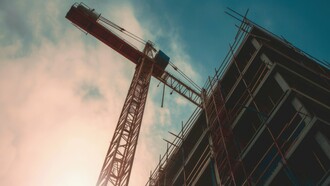
Pars International Hotel Kerman was established in 2002 on a 32,000-square-meter plot, with a total infrastructure of 24,000 square meters spread across 8 floors, including parking and a pilot floor. The hotel offers 164 rooms and 32 suites.
Conclusion
Kerman is a city with a long history, dating back over 2,000 years to the time of the Kerman Girl’s Castle. Throughout various historical periods, the city has undergone many changes and expansions. The most dramatic and rapid transformations took place during the Polovtsi era and the Islamic Republic, with the most significant being the ongoing destruction of much of Kerman’s old urban fabric—a process that still continues today.
References
Bastani Parizi, Mohammad Ebrahim. 2014. History of Kerman. Alam Publishing House, Tehran.
Flamaki, Mohammad Mansour, (2012), Revival of Historical Buildings and Cities, Tehran University Press, Tehran, Iran.
Kermani, Mahmoud Motadin. 2010. Detailed History of Kerman. Goli Publications, Tehran.
Majedi, Zavarat, Mejrabi Kermani, Hamid, Esfandiar, Bahareh, (2012), Analysis of factors affecting the physical growth pattern of large Iranian cities.
Naqizadeh, Mohammad, (2014), City Identity, Jahad Daneshgahi Publications, Tehran, Iran.
Chavay, Françoise, (2009), Urban Planning: Imaginations and Realities, Translator: Seyyed Mohsen Habibi, Tehran University Press, Tehran, Iran.