English
 Español
 Français
 Deutsch
 Italiano
 Português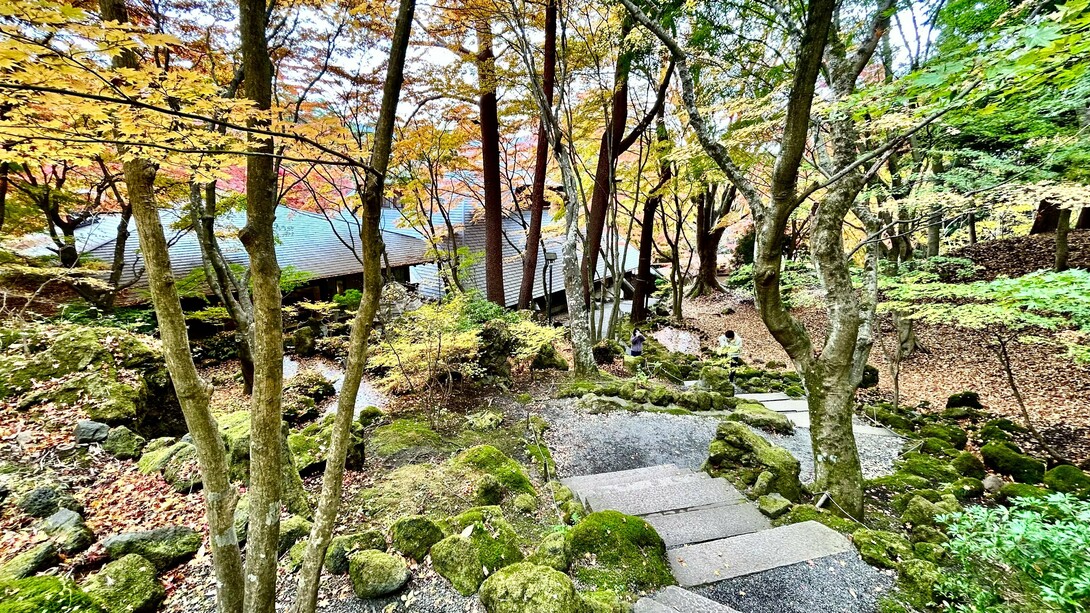
I have cultivated the natural beauty I so dearly love with my own hands, and created a paradise where flowers bloom abundantly throughout the seasons…
(Itchiku Kubota, Translation, Message, Itchiku Kubota Art Museum)
One of the most frequently visited tourist destinations in Japan for stealing close-up glimpses of Mt. Fuji is Lake Kawaguchi in Yamanashi Prefecture. The territory fuses nature with art and culture against the backdrop of maple, cherry blossom, and evergreen trees, along with the unmissable upside-down Mt. Fuji reflection on the lake.
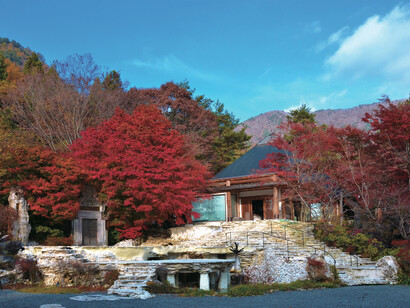
Tucked among the luscious greenery and next to the corridor of sparkling maple trees is the exotic Itchiku Kubota Art Museum1.
This remarkable museum and garden sit on the northern coast of the lake, encircled by wooded hills and pine trees. The main building opened in 1994, and the new building in 1997 with the theme of encompassing the “trinity of people, nature, and art” while promising a sanctuary for peace and relaxation.
Itchiku Kubota2 was a Japanese textile artist who was highly credited for restoring the 15th- to 16th-century textile dyeing technique called “tsujigahana”3(flower at the crossroads). This special dyeing method combines resist-dyeing with painting, gold leaf, or embroidery. Kubota started dyeing at fourteen years old and studied Japanese painting. He established his own dyeing studio at nineteen years of age.
After discovering tsujigahana at the Tokyo National Museum, he devoted his craft to redeveloping the auspicious dyeing tradition, which had been referred to as the “phantom dyed clothing“ for being forgotten after the Edo Period, largely due to the rise of Yuzen dyeing4. Kubota named his revived technique, Itchiku Tsujigahana5, which joins elements from the past and present.
The Itchiku Tsujigahana method produced modern forms of the kimono by combining Yuzen dyeing skills and present-day textiles and dyes with complex resist-dyeing and delicate ink painting. It was a unique attempt to forge tradition with innovation. The inventive process has earned worldwide recognition, serving the artist with multiple awards—Chevalier de l’Ordre des Arts et des Lettres from the French Ministry of Culture (1990) and the Cultural Merit Award from the Agency for Cultural Affairs of Japan (1993), among others.
At the peak of his success both in Japan and abroad, Kubota chanced upon the location of Lake Kawaguchi and its majestic forest landscape and found the “calling” to erect his museum on these grounds. The dramatic silhouette of Mt. Fuji and the solemn current of the lake appealed to him immensely.
He reminisced,
I was led into a slightly sloping red pine forest with the green storm hills behind me, and looking out ahead, I was so moved I could barely breathe. There, sacred Mount Fuji towered shining brightly into the sky, and the lapis lazuli Lake Kawaguchiko called out to me with its rippling waves.
(Translation, Message, Itchiku Kubota Art Museum)
Kubota recalled during the ground-breaking ceremony how the white clouds seemed to have outlined dragon images, which reminded him of his beloved mother. This sentimental memory is interpreted in his artworks exhibited around the museum.
Climbing up the concave stone staircase to the striking entrance gate, one is greeted by the astounding wooden carved doors of an ancient Indian castle. The architrave of the gate is wrapped in an intricately twisted steelwork that resembles a convoluting dragon. Instantly, one hears the echo of the water surging from the stream and the Ryumon waterfall, guarded by the thicket of trees.
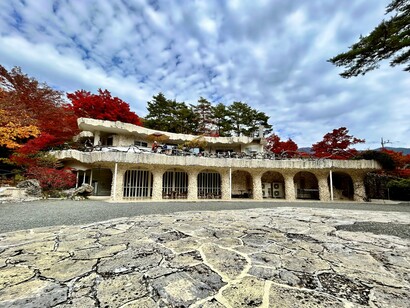
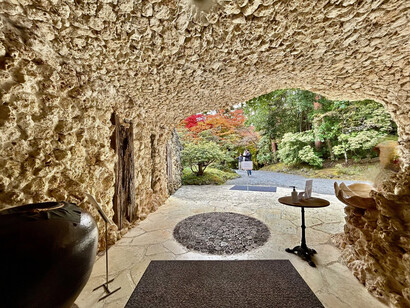
The reception is located in the New Wing annex, which provides the initial introduction to the spectacular Gaudí-inspired architecture. Organic substances and materials like Okinawan corals and limestone adorn the eight angled columns and floors, as well as the hand-plastered walls. Entering the building feels like secluding oneself in a mysterious cave. Together with the Collection Gallery, there are three shops on the ground floor (one with an intimate café) that feature sophisticated textile products, jewellery, and other souvenirs.
The aura complements the interior’s array of decorative furniture and objets d’art from Kubota’s collection from India, Africa, and Southeast Asia.
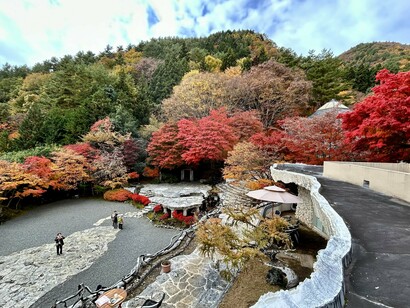
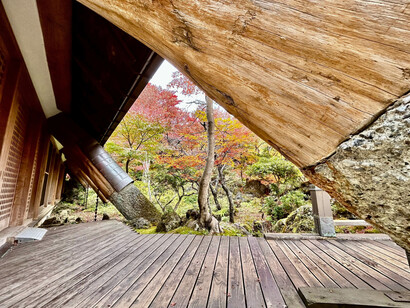
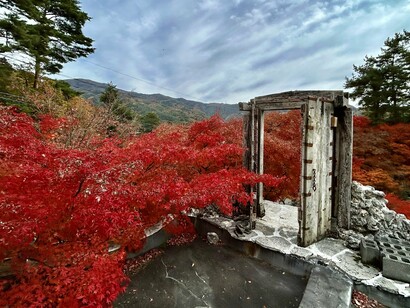
One cannot omit stepping out to the second-floor outdoor deck of the Museum Café Tombo-dama (Glass Beads) Gallery, where dragonfly glass beads originating from around 3000 B.C. are displayed. Here, an absolutely enthralling panorama of the open-air lower ground stone stage, hidden pond, Hiryu Falls, and curtain of forest trees awaits in suspense. Water from the Ryumon Falls cascades down into the pond. In autumn, the spectrum of red, orange, gold, and green paints a euphoric scenery. Relax on the terrace chair with the café’s popular roasted tea tiramisu and embrace the cinema-like Mt. Fuji vista ahead.
The stone steps from the lower ground lead to the main building, which stands out as a pyramidal structure contoured in the shape of Mt. Fuji. The wooden framework is supported by a puzzle of sixteen pillars made from "hiba," Japanese cypress that is over a thousand years old and soars thirteen meters toward the skylight. The design elegantly blends traditional craftsmanship with contemporary log house construction.
The exhibition hall is filled with Kubota’s indescribable textile masterpieces. The "Mount Fuji” series is composed of eleven splendid kimonos, artistically rendered in French Impressionist-like fashion. Kubota was determined to capture the spirit of the mountain in its variant moods and seasons at different times of the day.
Considered to be the artist’s most priceless lifework, the “Symphony of Light” is a continuous series of finely crafted kimonos showcasing colorful rhythms of mystical landscapes bathed in dancing light. Kubota envisioned completing eighty pieces that could fully grasp the textures of the four seasons. Thirty-six of them, in heavy silk crepe woven with wefts of gold or silver, are proudly paraded in this gallery. The soft breeze of patterns, hues, and meticulous handiwork is mesmerizing.
He remarked,
I’m working on Itchiku Tsujigahana to replicate a splendid sunrise, the beautiful movements of clouds during sunset, and the beauty of nature and its landscapes in my works. My goal is to create a kimono that tells a story and delivers warmth to the people who use and touch it.
(Itchiku Kubota Art Museum catalog)
The graceful kimono designs seem to flow through the expansive garden oasis like Shangri-La, blanketed by maple and evergreen trees, decorative rocks, streams, and waterfalls. Kubota was said to have purposely instructed the accurate placement of these forest elements to synthesize the ideal audio and visual appeal for visitors. He planted all the maple trees himself, which makes the entire estate a genuinely personal legacy. While ascending and descending the multiple levels, visitors experience a unique perspective each time.
Numerous art objects, such as wooden chairs, statues, and jars, scatter as aesthetic accents. A small cave with spring water enshrines two statues of Samantabhadra and Bodhisattva that represent Kubota and his mother. He described the idyllic charm of the museum garden as a dedication to his mother, who had suffered greatly in her life.
Kubota passed away in 2003 but the exhaustive depth of his artistic vision and humble homage to ethereal nature lives on eternally.
Notes
1 Kubota Itchiku Art Museum.
2 Itchiku Kubota.
3 tsujigahana.
4 Yuzen dyeing.
5 Itchiku Tsujigahana.