English
 Español
 Français
 Deutsch
 Italiano
 Português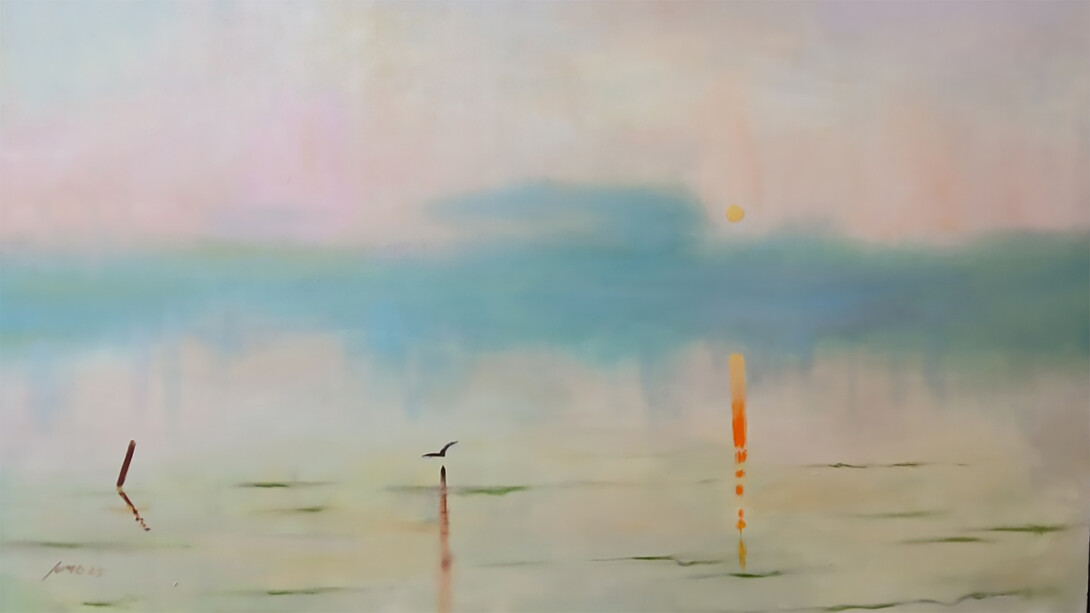
In an age dominated by acceleration, saturation, and the compulsive production of images, Saverio Lucci’s painting proposes a different rhythm. A slower one. A rhythm that does not seek to conquer attention but rather to suspend it. Geographies of the Gaze, Lucci’s solo exhibition in Bangkok, unfolds as a silent cartography—an atlas of inner landscapes and presences that resist easy classification, offering instead a space of contemplation and emotional resonance.
Lucci’s work occupies a liminal territory between landscape and portrait, memory and imagination, nature and presence. His paintings do not represent places, nor do they describe identities. They operate in a threshold zone where the external world and the interior life of the artist merge, generating images that are less about depiction and more about perception. What emerges is a geography not measured in kilometres or coordinates, but in states of being.
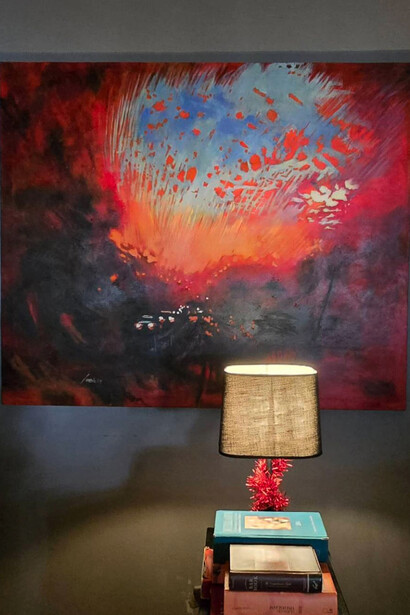
The landscapes presented in Geographies of the Gaze are not anchored to precise locations, even when their titles evoke specific references—Laguna, Sunrise in San Marco, Sunset in Venice. These are not views in the traditional sense, nor are they nostalgic reconstructions of Venice as an icon. Instead, they function as emotional fields, suspended environments shaped by light, atmosphere, and memory. The lagoon, recurring throughout the exhibition, becomes a symbolic space rather than a physical one. It is a zone of transition: between land and water, solidity and fluidity, and appearance and disappearance. In Lucci’s paintings, the lagoon is less a landscape than a state of mind—a metaphor for a perception that is constantly shifting, enveloped in mist, dissolving and re-forming before the viewer’s eyes.
Light plays a central role in this process. Sunrises and sunsets are not moments of spectacle but of quiet transformation. The chromatic transitions are subtle, restrained, and almost whispered. Colour does not impose itself; it emerges gradually, as if surfacing from beneath the painted surface. The result is a sense of temporal suspension, where the image seems to exist outside linear time, inviting the viewer to linger rather than to pass through.
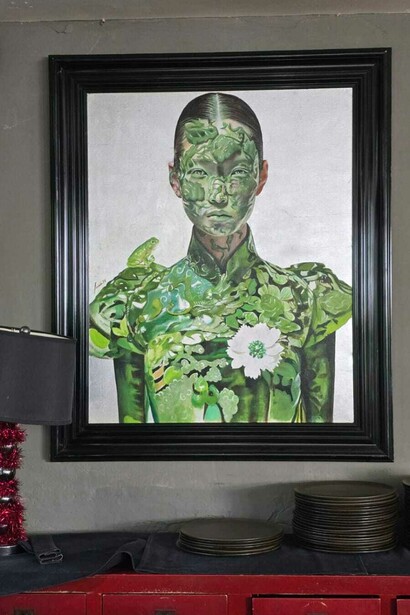
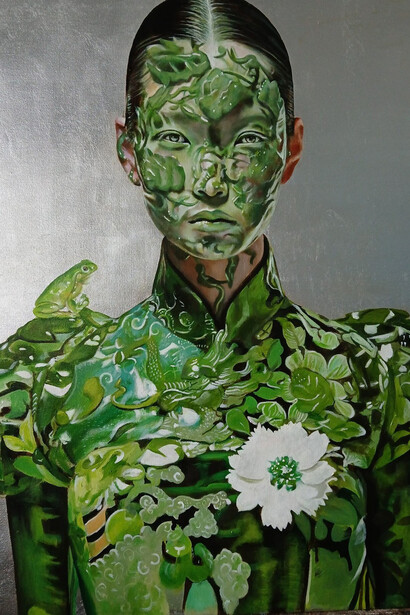
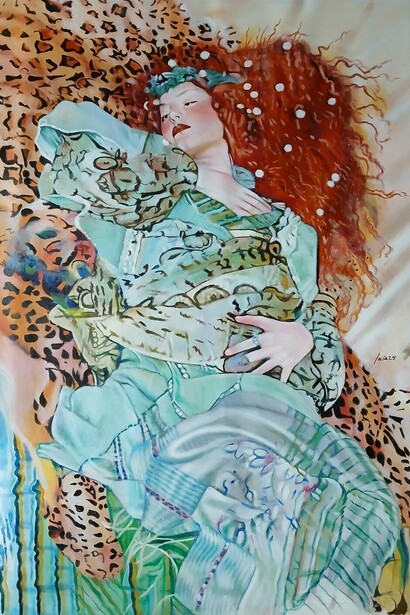
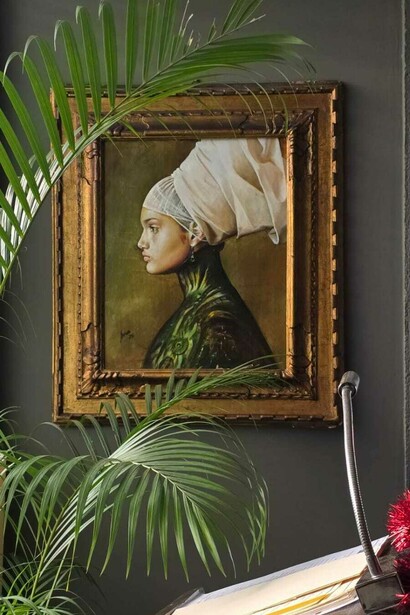
Alongside these landscapes, Lucci introduces presences—figures that cannot be fully defined as portraits in the conventional sense. Faces and bodies appear submerged, partially absorbed by the surrounding environment. They do not confront the viewer; they inhabit the space of the painting with a quiet, almost meditative intensity. These presences are not portraits of individuals. They are not psychological studies, nor do they seek resemblance. Instead, they embody states of being: moments of introspection, immersion, and silence. Identity dissolves into the atmosphere, and the human figure becomes part of the same perceptual field as water, mist, vegetation, and light.
In some works, Lucci evokes the image of an “Asian face emerging from the waters of the lagoon”, a vision that bridges geographies and cultures, memory and imagination. This imagined encounter is not illustrative but symbolic. It suggests a fluid conception of identity, one that is not fixed but porous, capable of crossing boundaries and absorbing multiple influences. Here, the body is not opposed to nature; it is submerged within it. This dissolution challenges the traditional hierarchy between figure and background, proposing instead a continuum where presence and environment coexist on equal terms.
Lucci’s exploration of perception is inseparable from his attention to materiality. The exhibition features works realised through a variety of techniques—encaustic on wood, oil on wood, oil on canvas, and oil on silvered surfaces. These choices are not merely technical; they are conceptual. The use of encaustic, with its layered wax textures, enhances the sense of depth and stratification. Surfaces appear to hold time within them, as if each layer were a sediment of memory. Oil paint, applied with restraint and sensitivity, interacts with the grain of the wood or the reflective quality of silver, creating subtle variations that change with light and viewing angle.
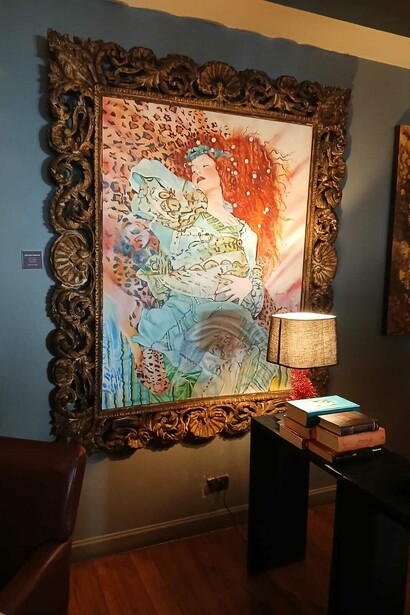
This material awareness reflects Lucci’s broader multidisciplinary practice. Internationally recognised as an interior designer, he brings to his painting a refined understanding of space, texture, and atmosphere. Yet his artistic work transcends design logic. Rather than constructing environments to be inhabited physically, Lucci creates perceptual environments—spaces to be inhabited emotionally and imaginatively. The scale of the works further reinforces this dynamic. Intimate paintings coexist with larger-format works, encouraging a rhythm of approach and withdrawal. The viewer is invited to move closer, then step back, adjusting their gaze and their bodily presence in relation to the image.
Presented in Bangkok, Geographies of the Gaze acquires an additional layer of meaning. The city’s intense sensory landscape—its density, speed, and visual complexity—acts as a counterpoint to Lucci’s suspended worlds. In this context, the exhibition does not seek to mirror the city but to offer an alternative temporal and perceptual space. Displayed within Opus Italian Wine Bar and Restaurant, the works integrate into a setting dedicated to conviviality, taste, and shared experience. This choice is not incidental. Lucci’s paintings, like fine wine or carefully prepared food, require time and attention. They reveal themselves gradually, resisting immediate consumption. The exhibition thus transforms the space into a site of encounter between art and everyday life, where contemplation is not isolated but woven into the rhythms of social interaction. In doing so, it challenges the conventional separation between art spaces and lived environments, proposing a more fluid and accessible model of engagement.
At the heart of Geographies of the Gaze lies a quiet but radical proposition: that seeing can still be an act of listening. Lucci’s paintings do not instruct; they invite. They do not explain; they resonate. Each work functions as a point on a map that is never complete, a cartography that remains open and mutable. This openness is perhaps the most compelling aspect of Lucci’s practice. His images do not seek closure. They remain porous, allowing the viewer’s own memories, emotions, and associations to enter the work. In this sense, the geography of the gaze is not only the artist’s—it becomes shared, co-created in the act of viewing.
In a world increasingly dominated by noise and certainty, Lucci offers ambiguity, silence, and suspension. His work reminds us that perception is not a passive act but a relational one—a meeting point between what is seen and who is seeing. Geographies of the Gaze is not an exhibition to be rushed. It is an invitation to slow down, to inhabit the in-between, and to rediscover the poetic potential of looking.