English
 Español
 Français
 Deutsch
 Italiano
 Português
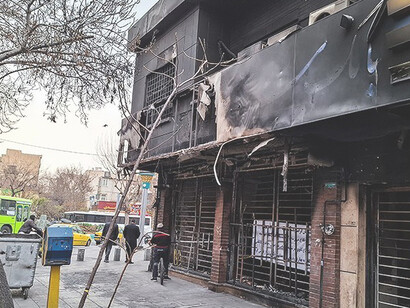
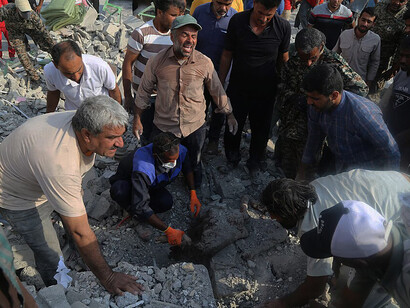
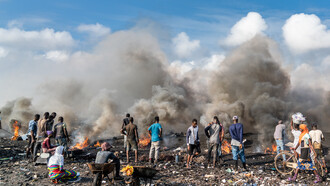
The bombs stopped. The cameras moved on. But Tehran is still burning in the slow way that cities burn after wars. With absence. With the smell of petrochemical smoke that does not leave. With children who no longer have a school to go to, because the school is rubble.
Iran's government put the total direct and indirect damage from the strikes at around $270 billion1—roughly equal to the entire country's GDP for 2026. More than 39,000 residential units in Tehran alone have been seriously damaged. Private businesses are shuttered. Ordinary households have lost their income.
This is not a military outcome. This is a humanitarian catastrophe. And it was visited upon a country of 90 million people, most of whom never made a policy and never had a vote on any of it.
The question now is simple and brutal: who pays?
What was actually destroyed
Before we talk about money, we should be clear about what was hit. The United States and Israel struck Iran's military sites. Yes. But they struck much else besides.
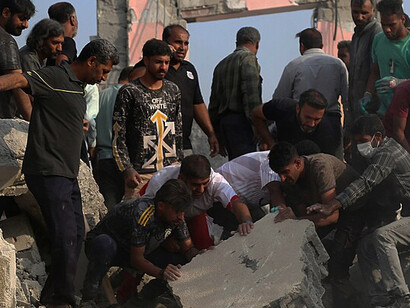
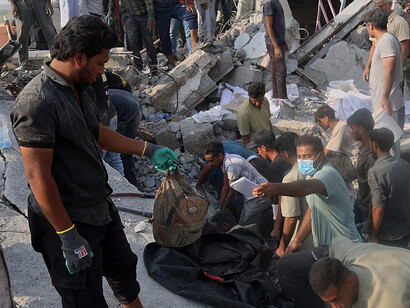
The first day of the war brought a devastating strike on Shajareh Tayyebeh Elementary School in Minab, southern Iran. Amnesty International documented 156 deaths, including 120 children2. Its investigation found that U.S. forces were responsible and raised concerns that outdated targeting information may have led them to strike a school beside a military compound. A UN fact-finding mission later found reasonable grounds to believe the U.S. carried out the attack and concluded that it amounted to a war crime. Neither investigation established that the children were deliberately targeted.
That is where this war began. With a girls' school. US and Israeli strikes damaged at least four UNESCO-protected cultural and historical sites, including the Qajar-era Golestan Palace in Tehran, the 17th-century Chehel Sotoun palace in Isfahan, the Masjed-e Jāme—Iran's oldest Friday mosque—and sites near the Khorramabad Valley, which holds evidence of human occupation dating back 63,000 years3. UNESCO had provided the coordinates of every heritage site to all parties in advance. The bombs fell anyway.
What’s in the US‑Iran peace deal?
Three and a half months after the first bombs fell, the United States and Iran signed a memorandum of understanding. President Trump signed it virtually. Vice President JD Vance signed it virtually. Iran's parliament speaker Mohammad Bagher Ghalibaf signed for Tehran. A formal ceremony is scheduled for Geneva. The text runs about a page and a half. The implications run for decades.
Here is what Iran gets (on paper, at least):
Point six of the fourteen-point MOU commits the United States and its regional partners to develop a plan of at least $300 billion for the reconstruction and economic development of Iran.
Point seven commits Washington to terminate all sanctions against Iran—including UN Security Council resolutions, IAEA Board of Governors resolutions, and all unilateral US primary and secondary sanctions—on an agreed schedule.
Point ten commits the US Treasury to issue immediate waivers on the export of Iranian crude oil, petroleum products, and all associated banking, insurance, and transportation services.
Point eleven commits Washington to fully release Iran's frozen assets.
An estimated $24 billion4 in frozen Iranian funds is to be released during the 60-day negotiation window—half before the final talks even begin.
The naval blockade of Iran begins lifting the moment the MOU is signed. Full removal happens within 30 days. US forces withdraw from the proximity of Iran within 30 days of a final deal.
Who bombed the children of Minab?
The peace deal is a good gesture between both of the countries, but who is responsible for the attack on the children of Minab?
On 17 June 2026, U.S. President Donald Trump says "nobody" attacked Iran's girls' school “on purpose.”
When you bomb a girls' school, you do not weaken the government. You unite the country behind it. When you destroy a palace that has stood for two hundred years, you do not send a message to the Supreme Leader. You send a message to every Iranian who ever visited that palace as a child, who ever learned their history within its walls. You tell them, "Your past does not matter to us."
More than 1,700 civilians have been killed. Around 250 of them were children. Up to 3.2 million5 people have been displaced inside their own country.
These are not collateral. These are the people. The actual people of Iran. The ones who stood in line for bread that now costs three times what it did. The ones whose children studied in the schools that no longer exist. The ones who gave birth in corridors because the maternity wards were hit. They did not choose any of this.
The last line
The bombs stopped. The argument about who pays is just beginning. And the people of Iran—the ones who lost their daughters in Minab, who cannot afford cooking oil, who stand in front of the ruins of a palace that their grandparents built—are waiting to find out whether the world that destroyed their country will help put it back together.
Or whether they will be handed a bill for the rebuilding of the bombs that fell on them. History says they already know the answer.
References
1 Iran says $270bn war loss must be compensated, as fresh talks with US loom.
2 Who bombed the Iranian girls’ school, killing more than 170? What we know.
3 US-Israeli strikes damage Iran's cultural heritage sites.
4 Iran media publish purported details of Iran-US draft agreement.
5 Across the Middle East, a generation of children is being pulled deeper into crisis.