English
 Español
 Français
 Deutsch
 Italiano
 Português
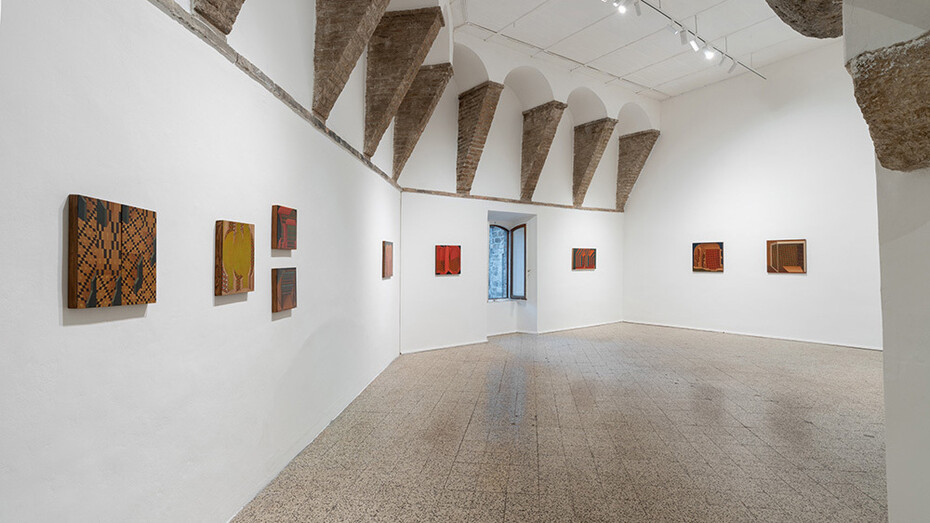
Galleria Continua is pleased to present Tempo manifesto, the first solo exhibition in Italy by Cuban artist Laura Carralero, whose painterly practice explores the relationship between architecture, memory and the perception of space.
Conceived specifically for Galleria Continua's San Gimignano space, the exhibition brings together a group of previously unseen oil paintings on panel created between 2025 and 2026. The works emerge from the artist's engagement with the town's medieval heritage, particularly the frescoes by Memmo di Filippuccio in the Camera del podestà of the Palazzo Comunale, alongside references to Bernardo Daddi and Ambrogio Lorenzetti. Carralero isolates architectural elements, canopies, textiles and ornamental motifs from these fourteenth-century images, removing them from their original narrative context and transforming them into autonomous forms that invite reflection on time and the construction of space.
A single image can simultaneously contain different moments in time. In my work, space does not represent a single instant, but rather the coexistence of different moments in time and multiple points of view within a single composition. Time is no longer linear; it unfolds as a continuous present. This principle also shapes the architecture and objects within the image. Rather than serving as static settings, they bend, multiply and simultaneously reveal different perspectives. Architecture, traditionally understood as fixed and permanent, becomes the most dynamic element of the composition. Through these distortions, I challenge perspective, scale and spatial continuity—not to depict a stable reality, but to reveal the coexistence of multiple times and spaces within a single image.
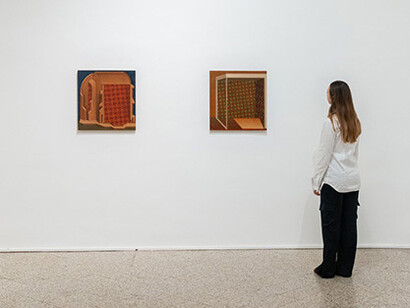
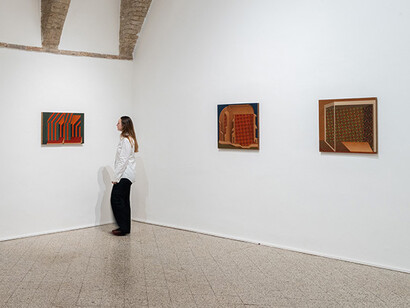
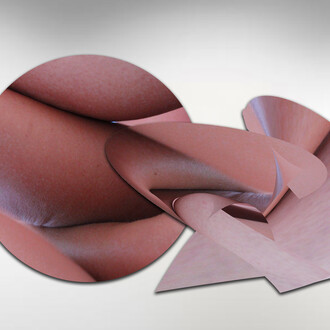
A more immediate connection with San Gimignano is established in the works inspired by the secular fresco cycle painted by Memmo di Filippuccio between 1303 and 1310 in the Camera del podestà. In The encounter (2026), Carralero draws on the scene known as The cradle of love: marriage – The Newlyweds at the bath. The bodies of the two protagonists, positioned opposite one another within the bath, are translated into two rounded, interconnected forms. The red, green, orange and yellow bands echo the chromatic motifs of the painted canopy, transforming them into a continuous skin that envelops the forms. The encounter between the figures is no longer conveyed through gesture or gaze; instead, it becomes a purely spatial relationship, expressed through the proximity, overlap and interlocking of abstract structures.
"Memmo di Filippuccio's frescoes are the exhibition's main point of reference," explains Laura Carralero. "Unlike much medieval painting, they go beyond religious storytelling to show scenes from everyday life and shared human experience. But what really resonates with me is not so much the subject matter as their visual language. In these frescoes, I find a kind of beauty based on the balance between structure and freedom. Architecture is no longer just a backdrop; it becomes an active part of the image, while space, perspective, and narrative each seem to follow their own logic. This way of representing the world—where distortion opens up new ways of seeing—is at the core of my practice."
Midspace (2026) also draws on a scene from The cradle of love, this time depicting the newlyweds retiring to bed. Carralero isolates, in a manner somewhat strained, the vertical rhythm of the curtains, along with the bed canopy and also the chromatic bands of the medieval interior, recomposing these elements into what becomes a sequence of pillars, passages, and suspended planes. The relationship between the two panels of the diptych generates an intermediate space—the "midspace" evoked by the title—which belongs fully to neither painting, but instead emerges through the gap between them, their imperfect symmetry and the dialogue they establish.
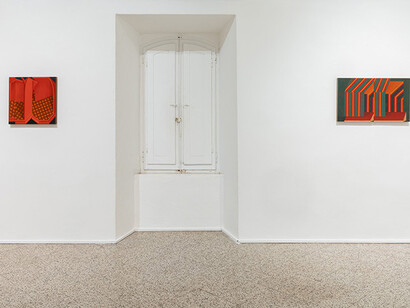
One of the exhibition's most complex works is The glitch (after Storia del figliuol prodigo, Memmo di Filippuccio) (2026). The work reinterprets the large white pavilion that dominates one of the scenes from the Storia del Figliuol prodigo in the Camera del podestà. The curtains, folds and decorative borders of the fresco are translated into light fields traversed by vertical lines and outlined in red and blue. The polyptych can be installed in different configurations: by altering the arrangement of the panels, the same image appears continuous, misaligned, fragmented or interrupted. The glitch of the title introduces the contemporary notion of visual error and digital discontinuity into the medieval visual vocabulary, so that fragmentation becomes not a loss of the image but a way of regenerating it. "Distortion lies at the heart of my practice. I do not see it as a deformation of reality, but as a way of revealing a kind of beauty that emerges when representation is freed from its own conventions. I am drawn to the quiet beauty of medieval art, where compositional rigour coexists with extraordinary formal freedom.
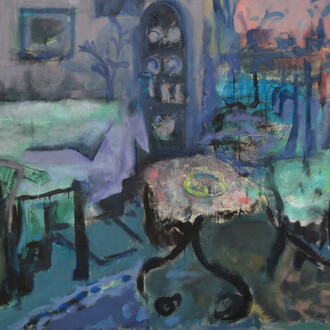
It is within this balance between order and deviation, discipline and invention, that I find a visual language capable of transforming the image and opening up new ways of seeing" the artist concludes. Other works further develop the architectural motifs that recur throughout Carralero's practice. In Baldacchino IV, interior with arches and the modular installation arches, vertical structures, arches and pillars become self-contained forms, suspended between object, sculpture and mental space. In the paintings Laura and Leonor, as well as in a series of small-format panels, grids, lozenges and ornamental motifs gradually take on the character of floor plans, façades or architectures in motion. Finally, in Distorted interior, walls and openings appear to bend and rotate, destabilising the perception of depth and rendering pictorial space fluid and unstable.