English
 Español
 Français
 Deutsch
 Italiano
 Português
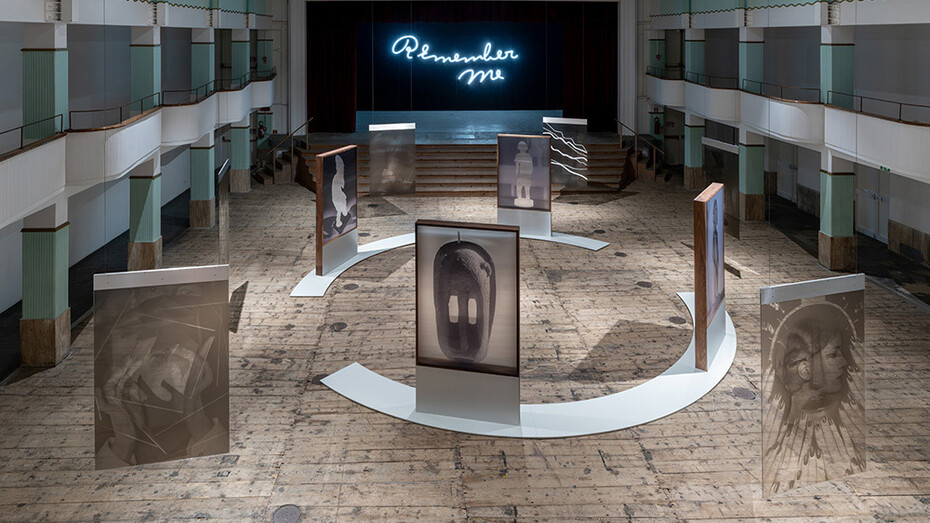
Galleria Continua is pleased to present, for the first time, the work of Hank Willis Thomas at its San Gimignano gallery and, simultaneously in Rome. Organized in collaboration with Territorio and titled Tomorrow I shall contradict myself, the project unfolds across two exhibitions conceived in dialogue with the work of Man Ray, an artist who has long been an important point of reference in Thomas’s practice. The exhibitions mark the beginning of Galleria Continua’s collaboration with Hank Willis Thomas.
Bringing the two artists together highlights a connection that runs throughout Thomas’s work. His affinity with Man Ray lies not only in formal parallels or their shared interest in photographic experimentation, but above all in the way both artists approach the image and its possibilities. For both, photography is never simply a means of recording reality, but a space for transformation — one capable of challenging what we see and the ways we have learned to look. “I first encountered Man Ray’s work during my first year studying photography at NYU’s Tisch School of the Arts,” says Hank Willis Thomas, “where we had the opportunity to experiment in the darkroom with photograms and solarization. Looking back now, though, I realize that experimentation had begun even earlier, in the makeshift darkroom in my mother’s kitchen. My mother is Deborah Willis — a photographer, artist, curator, and educator — and through her, I was already in a kind of dialogue with Man Ray’s ideas long before I fully understood their significance. “There is also a more unusual and personal connection: I was born shortly after Man Ray died. What fascinated me most about his work was the way he pushed beyond the boundaries of the photographic frame, questioning where an image truly begins and where it ends.
That question became the starting point for my first project, A thousand words, which focused on ideas of framing and context. “Since then, my practice has remained open and multifaceted, moving between photography, sculpture, painting, and any other medium that feeds my sense of play and curiosity, much as Man Ray moved freely between different forms of expression. If Ray bent light itself to reveal what the camera alone could not capture — solarizing an image until light and shadow were reversed, or placing objects directly onto photographic paper to capture their imprint in a rayograph — I have pursued that same fascination with light through different materials and processes. “Some images in my retroreflective works remain quiet and still until struck by a flash or beam of light; only then does a second, hidden image emerge from the first. It is the same question Man Ray asked in the darkroom: what does light choose to reveal, and what does it conceal until we look closely enough? To exhibit alongside him now, at Galleria Continua, feels like coming full circle — back to something that began decades ago in my mother’s kitchen.”
Tomorrow I shall contradict myself, brings together works from different periods and contexts, revealing resonances, continuities, and points of departure between the two artists. Man Ray helped free the photographic image from the need to faithfully represent the world, opening it instead to experimentation, ambiguity, and the unexpected. Hank Willis Thomas builds on and reinterprets this legacy through a distinctly contemporary lens. In his work, the image becomes a means of questioning how we perceive and represent the world, as well as the cultural and social structures that shape what we see — and what so often remains invisible. Bringing Thomas’s work into dialogue with Man Ray offers a new perspective on his practice, situating it within a broader exploration of history and the power of images.
“I like contradictions. We have never attained the infinite variety and contradictions that exist in nature. Tomorrow I shall contradict myself. That is the only way I have of asserting my liberty, the true liberty one does not find as a member of society,” Man Ray stated. A pioneer of Surrealist photography, Man Ray broke with traditional approaches to artmaking, embracing chance, spontaneity, and experimentation with materials. His practice spanned painting, sculpture, film, and writing, driven by an innate restlessness and an insatiable curiosity about what art could be and do. In his photography, experiments with light and darkroom processes transformed the familiar into something unexpected: through rayographs, solarization, and bold image-making techniques, bodies and objects shed their original functions and assumed enigmatic, surreal forms. His sculptures and objects similarly transformed the everyday through unexpected associations, alterations, and gestures of irony, challenging the boundary between artwork and ordinary object. Painting offered yet another space for experimentation, where forms, symbols, and dreamlike imagery came together in compositions that resisted any single interpretation. Across these different mediums, Man Ray continually challenged conventions of perception and authorship, rejecting fixed categories and embracing contradiction as both a method and a philosophy.
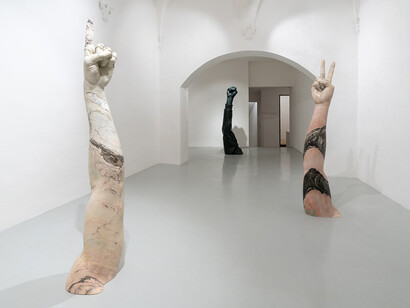
Man Ray uses photography and sculpture to destabilize the familiar, transforming everyday objects and motifs into forms charged with desire, irony, and a subtle sense of unease. Thomas, meanwhile, turns to sculpture to capture gestures and moments of profound symbolic significance and give them new resonance. By isolating essential actions, he explores their expressive power and their ability to evoke questions of individual and collective identity, ambition, perseverance, and community. Gestures that are at once immediate and universal — two hands clasped together, a fist raised in solidarity — are removed from the fleeting moment and rendered monumental in veined marble. Through material and scale, Thomas gives these gestures both an intimate and a public presence, transforming them into monuments to the power of collective action. The use of marble also brings the works into direct dialogue with the arthistorical tradition of classical sculpture, reinterpreting its forms and language through the narratives and concerns of the present.
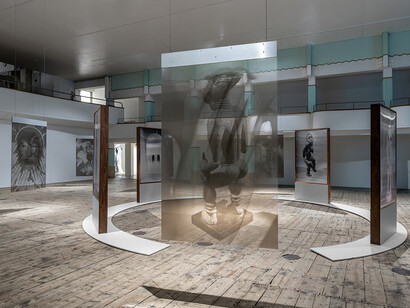
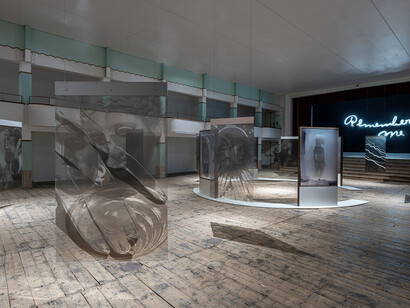
Aimé and Suzanne Césaire, Martinican writers and theorists associated with Surrealism, saw the movement as a means of radically transforming the mind — an ethical and intellectual approach that Man Ray embodied through irony, an openness to chance, and a constant willingness to push formal boundaries. Drawing on this legacy of freedom and subversion, Hank Willis Thomas explores new connections between the histories of art and colonialism, questioning the narratives and systems of representation that have shaped both. Thomas creates a kind of visual chronology in which art history, conquest, and struggles for emancipation are reconsidered in relation to one another. By layering archival material, imagery drawn from the art-historical canon, and references to popular culture, he reveals the ways in which power, struggles for independence, and the growth of commercial exchange have shaped the Western imagination. His work invites us to critically examine the structures that determine what we see, how we see it, and, above all, who has historically been granted the right to be represented.