English
 Español
 Français
 Deutsch
 Italiano
 Português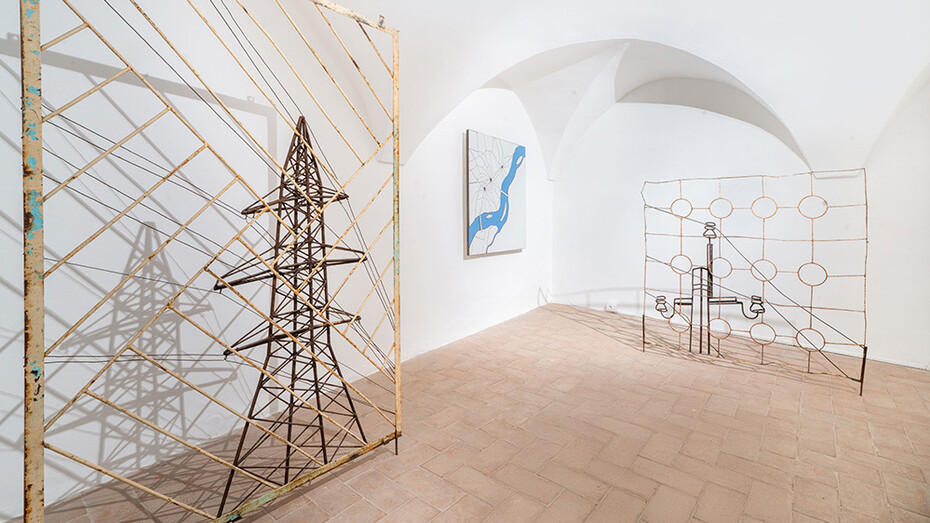
Galleria Continua is pleased to present Instrument, an exhibition by Zhanna Kadyrova, a Ukrainian artist whose work explores themes of hope and resistance through an interweaving of time, space, and history. A messenger of an art that speaks to the present, Kadyrova examines her own personal experience, positioning herself as a witness to war and to everyday life in Ukraine, and invites a reflection on humanity.
Established on the international art scene, in 2025 she received Ukraine’s Taras Shevchenko National Prize for Visual Arts and, in the same year, was awarded the Her Art Prize for international artists. With the exhibition Security guarantees, the artist will represent Ukraine in the national pavilion at the 61st Venice Biennale International Art Exhibition.
Kadyrova translates into artistic form the ordinariness she is forced to live with and endure, revealing the strength that can emerge from horror. Art is the means through which she is able to convey her personal experience, make her voice heard, and contribute to the common good. “I see that every artistic gesture makes us visible and allows our voices to be heard” the artist states.
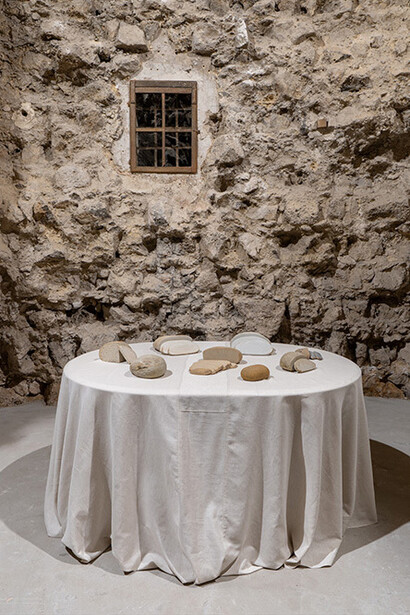
Forced to leave her home and studio in Kyiv following the Russian invasion of February 24, 2022, Zhanna Kadyrova settled in a small village in the Carpathians, a mountainous area lacking any infrastructure. In this new context, without tools or traditional working materials, she began to observe the surrounding landscape, focusing in particular on the mountain rivers, whose smooth pebbles recalled in shape and size the traditional palianytsia, large wheat loaves typical of Ukraine. From this observation emerged the project Palianytsia. The word itself took on a new significance at the beginning of the war: Russian occupiers were unable to pronounce it correctly, and the term quickly became a shibboleth, a way of distinguishing friends from enemies. The association between these two forms led the artist to create laid tables in which the stones, some of them cut as if ready to be shared among diners, suggest a sense of abundance and communal exchange. Palianytsia is a humanitarian project supporting artists involved in the defense of Ukrainian territory. All funds raised are donated by the artist to meet urgent needs at the front line — over three years of activity, more than €550,000 has been donated.
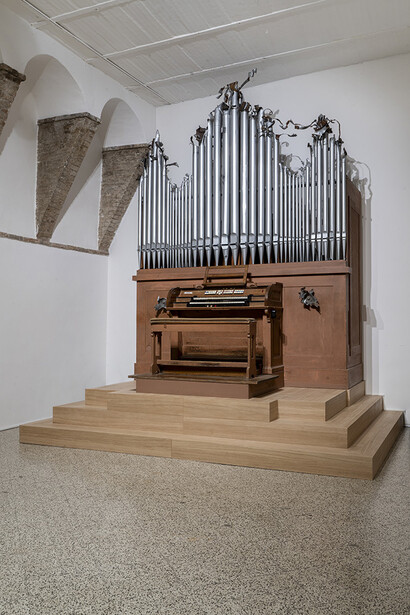
Instrument, the installation at the center of this solo exhibition, is a playable organ that gives form to the analogy between a musical instrument and the remains of missiles launched by the Russian army over Ukrainian territory, torn apart by the force of the explosion. Commissioned by the Pinchuk Art Centre in Kyiv in 2024, it was first presented in the exhibition From Ukraine: dare to dream, a collateral event of the 60th International Art Venice Biennale (2024).
Following its Venetian premiere, the work was transferred and installed inside the building of the Lviv railway station, transforming a space of everyday transit into a place of cultural and social encounter. Here, for nearly a year, until the summer of 2025, Kadyrova organized theatrical performances and a public program of concerts featuring Ukrainian and international musicians, who played the instrument and brought it to life through their musical choices. Additional social activities, including a project for war veterans, further enriched the free program open to the entire community that developed around Instrument. Recordings of the concerts have now been brought together in a new video by the artist, which will be presented on the occasion of this exhibition.
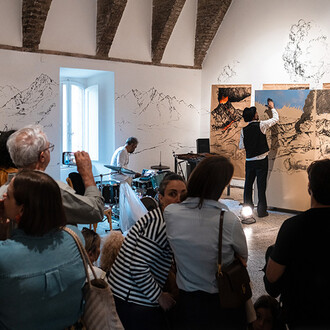
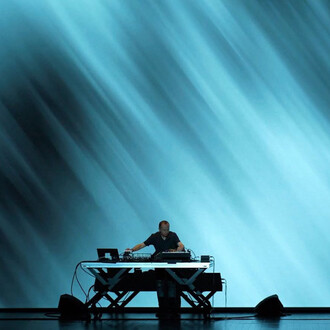
Presented in San Gimignano with a performance by musician Chiara Saccone, Instrument offers a moving meditation on the unbreakable spirit of culture in times of war. In this work, as artist Pavel Sterec, who has collaborated with Kadyrova on several projects, observes, art becomes capable of overturning and transforming metal shells into symbols of resurrection and hope, underscoring the importance of having the courage to fight and to stand up against aggression. Instrument allows space for a moment of inward listening. It opens the possibility of pausing, finding brief shelter, and awakening a renewed and stronger sense of determination.
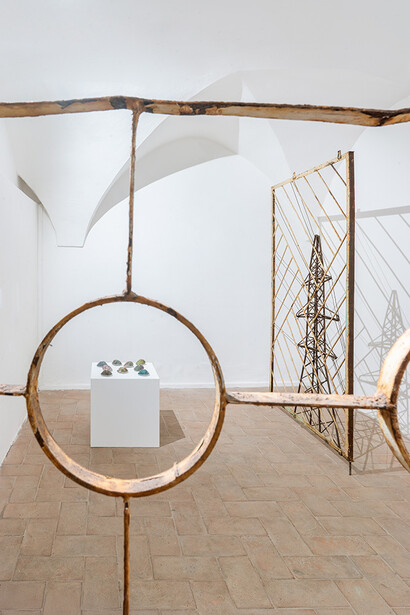
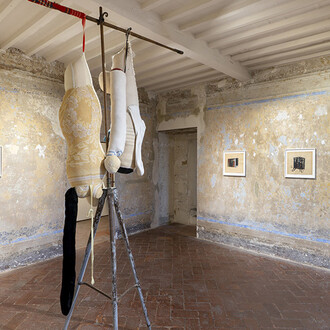
The series Behind the fence (2014) stems from the artist’s direct experience during a visit to the Biryuchyy Peninsula on the Sea of Azov, an area facing Crimea, which has been under Russian occupation since 2014. In these works, Kadyrova uses elements from old Soviet fences to create installations that powerfully evoke notions of separation, enclosure, and violence. This investigation is renewed and expanded in the work Souvenir (2023), in which plastic seashells are transformed into sculptural objects fitted with small peepholes. Here, fragments of personal memory surface as photographic recollections connected to the artist’s experience in the Biryuchyy area in 2014, places that are now destroyed and inaccessible due to Russian occupation. Presented in the gallery’s Torre space, Souvenir takes shape as a poetic and intense reflection on the inaccessibility of one’s homeland, on loss, and on the persistence of lived experience within a context of war. The shells, objects of leisure and memory, become powerful metaphors for identity and nostalgia for a territory that can no longer be reached, reminding viewers not only of what once was, but also of what continues to be denied and destroyed.