English
 Español
 Français
 Deutsch
 Italiano
 Português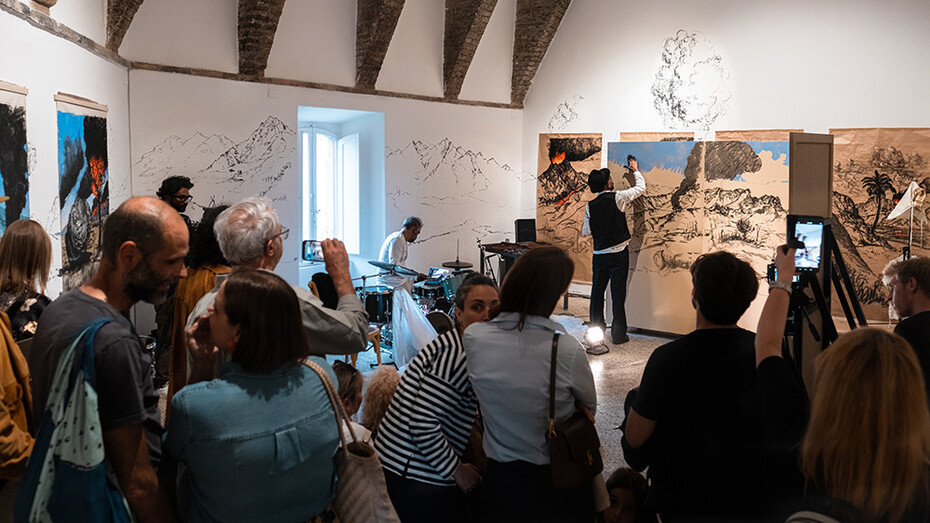
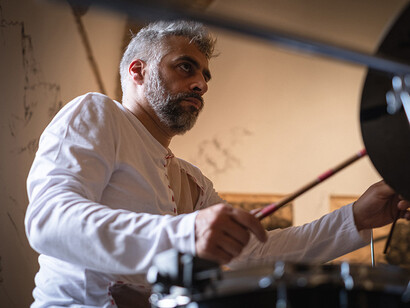
Following the two-part performances at La Pop and Monnaie de Paris in autumn 2024, Nikhil Chopra, together with drummer and composer Uriel Barthélémi, presents Embers / Braci at the Arco dei Becci venue of Galleria Continua in San Gimignano — a new exhibition to add to their dialogue and raise burning questions about the ecological and political precarity of the world we live in.
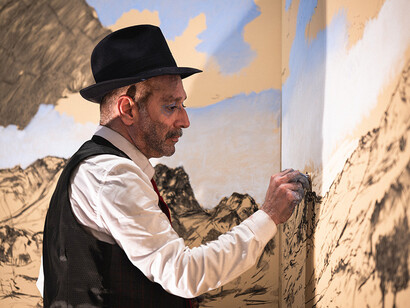
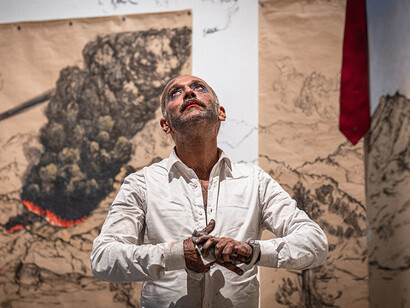
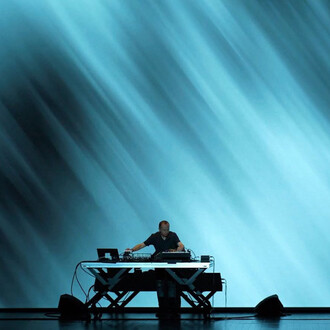
Embers / Braci reactivates the large-scale drawings created by Nikhil Chopra during the performances Fire x fire – Ignition and Fire x fire – Combustion. These works, born from long-duration actions in which sound and image intertwine, now return to the exhibition space at Galleria Continua to form a new narrative. On the opening day, the two artists will present a threehour performance: as the rhythm of the drums fills the space, the landscape will once again be drawn in real time. Sound and drawing merge, extending the questions at the heart of their collaboration: how does fire wound us? How does it comfort us? Are we made of mud, water, air, and fire?
The core of Nikhil Chopra’s artistic philosophy is rooted in process, transformation, and memory. His immersive, performative practice draws on and at the same time breaks down the boundaries between drawing, theatre, live art, and installation. While each of these forms has a long history, what makes Chopra’s work unique is the way they intersect and interact, creating an entirely new artistic grammar. As an artist working outside the traditional conventions of the studio, Chopra creates in real time, often in front of a live audience, allowing the act of making itself to become an integral part of the work. His body thus becomes site, medium, and narrative, through which the work takes shape. His performances, often largely improvised, critically and creatively explore themes such as identity, the role of autobiography, persona-crafting, and self-portraiture. Most of his characters are not anchored to a specific time or place, yet they feel strikingly intimate and familiar, subtly challenging viewers’ perceptions of identity, memory, and history. With an undercurrent of playfulness, there is a palpable play of tension and balance between the artist and the viewer, who may follow and observe closely, but is never fully aware of the act in its entirety.
This gives rise to unexpected reactions, imagined narratives, and an ever-branching field of possibilities, activating the audience's participation in a work that wrestles with the art of storytelling itself, while challenging established histories and conventions of class, and gender. Each performance unfolds as a dynamic process, embracing a vibrant state of flow, metamorphosis, movement, tremor, pulse, vibration, and breath. Chopra achieves this almost mystical effect by surrendering to the temporal nature of the process. He uses time as a watercolorist uses water. In doing so, he creates a neutral emotional space, a space free of judgment. “When you begin to look at a painting or a performance and you give it time (or duration, which for me is very important), you begin to remove the layers, and you begin to understand and reveal the process. There are formal layers, but also contextual ones. Perhaps this is where the value of the work lies: in the process not only in the painting, the drawing, or the performance,” the artist states.
This open and collaborative spirit extends to Chopra's long-standing creative partnership with French musician, drummer and composer Uriel Barthélémi, a relationship that first took shape in 2016 with Floating cities and loaded dice, a three-hour durational performance staged at the Gare du Nord in Paris, in which the two artists jointly inhabited the vast resonating chamber of the train station to build a symbolic narrative around the conditions of refugees in France and Europe. This founding encounter established the terms of a dialogue that has continued to evolve: two practices, both resistant to fixed categories, both deeply invested in the physical, performative, and emotional dimensions of their respective mediums, finding in each other a space of friction, freedom, and shared invention.
The exhibition in San Gimignano places renewed emphasis on the traces of earlier performances, rekindling their flame while generating a new one. Embers / Braci marks a moment in an important chapter. With this exhibition, Nikhil Chopra resumes his artistic practice from where he left off, before taking on the role of curator of the Kochi-Muziris Biennale, titled For the time being, which concluded at the end of March 2026. The exhibition stands as both echo and transformation: a final combustion before a new beginning.