English
 Español
 Français
 Deutsch
 Italiano
 Português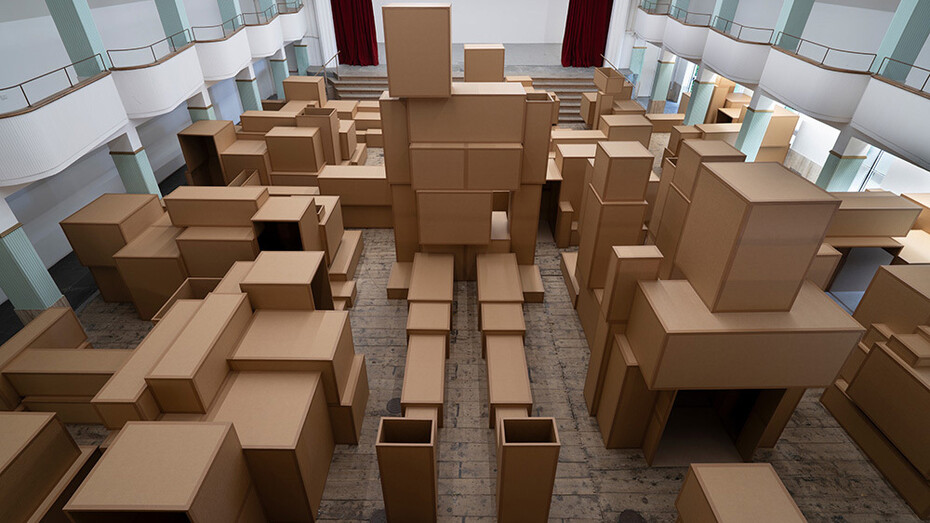
As a sculptor, I speak in the language of stuff: matter, in the belief that all matter has meaning. The possibility of a world starts with the possibility of a body – I want to re-imagine both. I hope this exhibition opens up a built world that we take for granted and allows us to experience it as if for the first time – a point of view shared by newborn and artist.
(Antony Gormley)
Galleria Continua presents What holds us, an exhibition by celebrated British sculptor Antony Gormley that explores our condition as urban animals through the resonance of different materials, from primordial stone and clay to industrial concrete and iron, culminating in the most universal and insubstantial medium: cardboard.
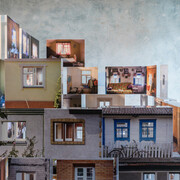
The gallery’s main theatre space is entirely occupied by a site-specific installation, Innercity (2026). Fifteen giant body buildings constructed from cardboard create an urban labyrinth that invites us to move between and through their open and closed spaces, which either deny us access or suggest that we crawl inside them. These works reinvent the body’s anatomy in the language of architecture.
This playful recreation of our present state as city dwellers acts as a reenchantment of environments that have, since San Gimignano’s origins, fascinated us in their dreamworld potential for offering home and safety, a world we would like to think of as permanent – here though, it is rendered in the material used by Amazon to deliver over six billion packages per year worldwide.
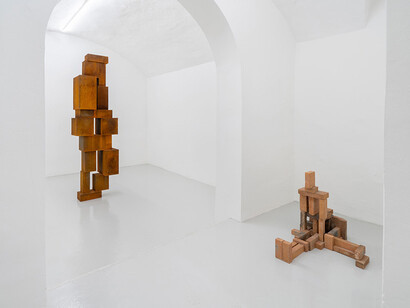
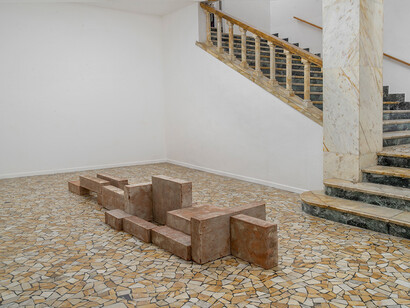
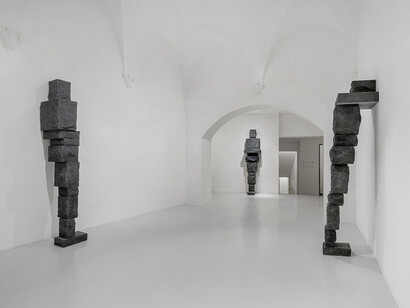
For this exhibition, Gormley works with the whole building, inside and out. Basalt ‘Blockworks’ at the beginning of the exhibition employ stacking, where part relates to part, part to whole, and whole sculpture to building. These works treat the gallery itself as intrinsic to the work, reversing the dynamic of the caryatid by depending on the 14th-century walls for support, conveying a sense of dependency while embodying a potential for collapse. In twice life-size terracotta ‘Slabworks’, Gormley also uses stacked deadweight to combine two bodies like a house of cards, creating unified structures of connection that suggest intimacy. A concrete ‘Bunker’, Skew II (2026), sits within the base of a collapsed tower, a hole at the position of the mouth granting visual access to its dark interior. Within the labyrinth, life-size and half-scale sculptures in concrete, stone, iron and terracotta trace Gormley’s ongoing engagement with material and experimentation with mass, void and states of openness and enclosure. Outside, sculptures are seen against the Tuscan landscape.
Recent drawings on view explore the experience of dark thresholds and other apertures that open onto light.
What holds us engages the viewer in a trajectory of experience that moves from confrontation to exploration, questioning what supports us, what contains us and what we believe to be permanent.