English
 Español
 Français
 Deutsch
 Italiano
 Português
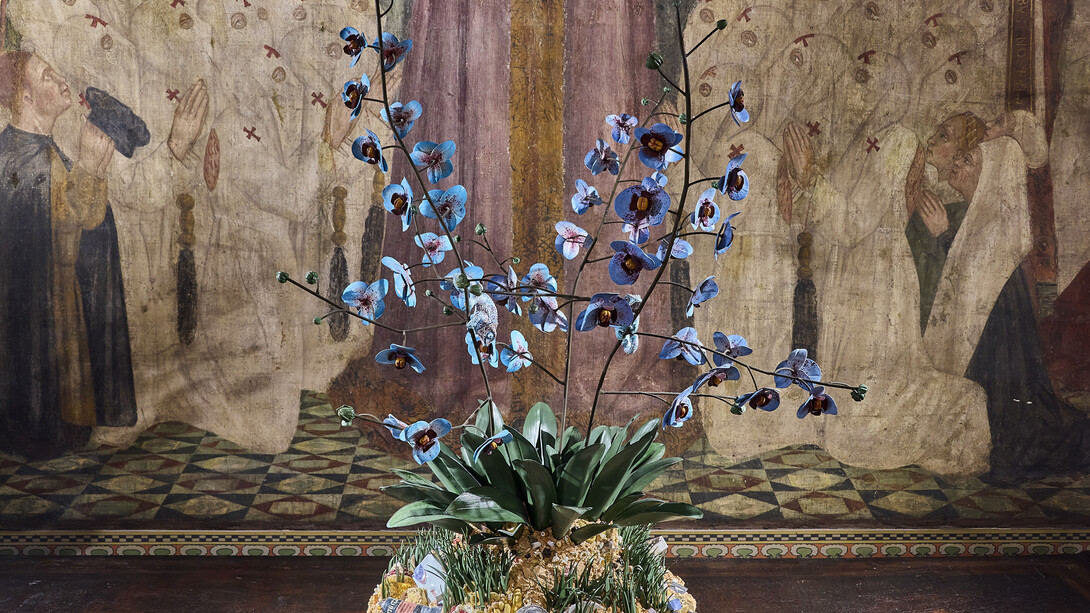
As one exhibition closes in Milan and another opens in Madrid, the work of Bertozzi & Casoni reveals its deepest paradox: the attempt to give permanence to everything our world is designed to consume, discard and forget.
There are works of art that resist time, and others that make time visible. Bertozzi & Casoni have always belonged to the second category. Their ceramics appear, at first, to have defeated disappearance. Flowers do not wilt, fruit does not rot, and leftovers remain exactly where they were abandoned. Plastic, packaging, bottles, plates, insects, bones, domestic objects and fragments of beauty inhabit a strange territory in which decomposition has been interrupted. Everything seems caught at the precise instant before vanishing. And yet nothing in their work is truly preserved. What is preserved is the image of disappearance.
This paradox has accompanied Bertozzi & Casoni for more than four decades, but in the autumn of 2026 it acquires an unexpected resonance. In Milan, Eterne e fragili presenze has just closed at the Museo Bagatti Valsecchi; in Madrid, La Grande Opera Ceramica, curated by Enzo Biffi Gentili at the Italian Cultural Institute, has recently opened, placing their work within a broader constellation of contemporary Italian ceramic practice. One exhibition ends as another begins. It would be easy to regard this simply as a coincidence in the exhibition calendar. Yet between Milan and Madrid, between a house constructed around the desire to preserve the past and an exhibition devoted to one of humanity’s oldest transformative materials, their work seems to ask the same question twice: what remains?
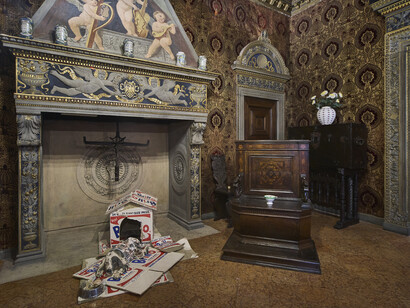
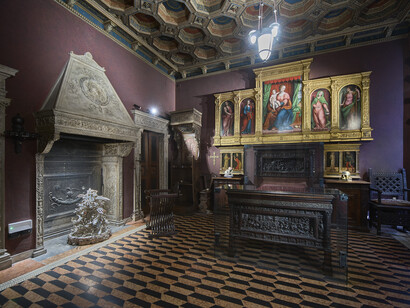
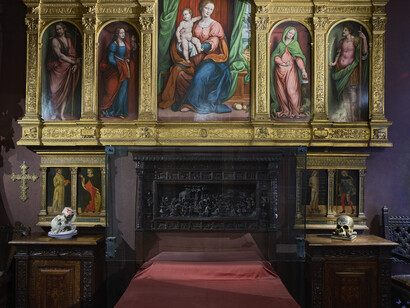
The Museo Bagatti Valsecchi is an unusually appropriate place in which to encounter Bertozzi & Casoni. The Milanese house museum is itself the product of a sophisticated fiction of time. In the nineteenth century, the brothers Fausto and Giuseppe Bagatti Valsecchi created a residence inspired by Renaissance models, surrounding themselves with paintings, furnishings, armour, decorative objects and everyday things. A museum normally changes the status of an object: something once touched, used, desired or ignored becomes untouchable, crossing an invisible border into the protected grammar of cultural memory. Casa Bagatti Valsecchi complicates that border because its objects continue, somehow, to inhabit the rooms.
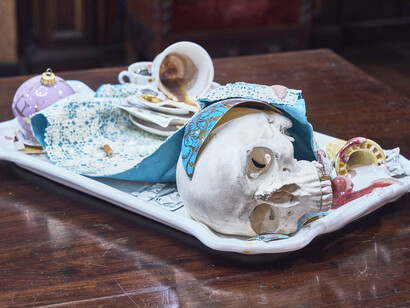
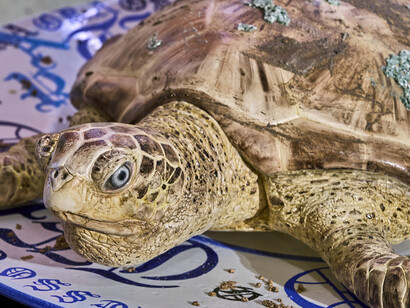
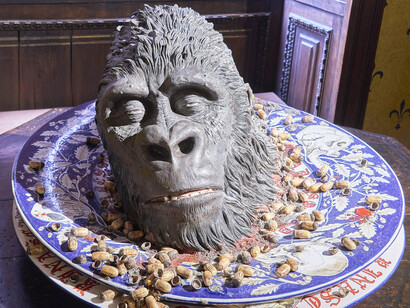
This is precisely what the ceramics of Bertozzi & Casoni know how to do. For Eterne e fragili presenze, curated by Alberto Mattia Martini, more than thirty works, including around ten previously unseen and site-specific pieces, entered the historical rooms and collections without behaving like foreign bodies arriving from the contemporary art world to colonise an ancient interior. They seemed to belong there. A Bertozzi & Casoni sculpture rarely needs the rhetorical authority of a pedestal. Its power comes from proximity. Their objects belong to our world before revealing that they do not belong to it at all. What appears soft is hard; what seems organic has escaped biological time; what looks disposable may survive for centuries. Their virtuosity is undeniable, but virtuosity alone would make the work merely astonishing. They use technical perfection against perception itself: the better the imitation becomes, the more unstable reality appears.
To describe this simply as hyperrealism is therefore insufficient. Hyperrealism describes what the eye experiences, but not what the work does. The real subject is time. Ceramics itself contains a temporal contradiction. Before firing, clay is vulnerable and mutable: a hand can alter it, and water can undo it. Then comes fire. After firing, the same material can survive the person who made it, the society that used it and sometimes even the civilisation that produced it. Archaeology is full of this irony: empires disappear and their pots remain. Bertozzi & Casoni understood the conceptual force hidden inside that transformation.
They chose one of the oldest and most enduring materials of human civilisation to represent some of the most temporary things produced by contemporary society: waste, food, flowers, packaging, remains, objects already consumed or about to be thrown away. A rotting object becomes an object that cannot rot; a flower becomes incapable of wilting; waste becomes a monument; the insignificant becomes archaeological evidence of ourselves. Their work consequently belongs to the history of vanitas, but it also disturbs that history. The traditional still life reminded viewers that beauty fades, food spoils, flowers die and human existence is brief. Bertozzi & Casoni push this contradiction further because their objects do not merely depict permanence: materially, they possess it. A ceramic flower may actually outlive us. The old moral equation is quietly reversed. We are no longer simply looking at an image reminding us that things perish; the thing is looking back at beings who may perish before it. Perhaps we are the vanitas.
There is another inversion at work. Beauty repeatedly appears where cultural convention tells us it should not. A pile of rubbish can possess the compositional complexity of a Baroque still life; a discarded object can demand the attention once reserved for a relic; decay can be reconstructed with almost devotional precision. Bertozzi & Casoni devote enormous labour to reproducing what industrial society has trained us not to see, and that labour changes the ethics of looking. A crushed container, spoilt food or abandoned packaging may receive less than a second of our attention in everyday life. Recreated through an exacting ceramic process, the same object requires an extraordinary investment of time, knowledge and care. Attention and value are suddenly disconnected from usefulness.
The discarded thing is no longer permitted to disappear unnoticed. In a culture built upon accelerated consumption, their work slows the object down until indifference becomes difficult. This may also explain why their practice feels particularly urgent today. We inhabit a visual culture of increasingly frictionless images: images that appear instantly, circulate without weight, can be reproduced indefinitely and need never have existed as physical things at all. Bertozzi & Casoni operate at the opposite extreme. Every wrinkle, stain, petal, crumb, peel, crack and reflection has to negotiate with matter. They use slowness to represent acceleration, craft to represent industry, durability to represent waste, and precious labour to reproduce worthless things. The contradictions accumulate until the object can no longer be comfortably classified as beautiful or repellent, precious or banal, dead or alive, permanent or already ruined. The answer is almost always both.
Today, however, it is impossible to speak about Bertozzi & Casoni exactly as we once did. The partnership was founded in Imola in 1980 by Giampaolo Bertozzi and Stefano Dal Monte Casoni. Together they played a decisive role in establishing ceramic as a fully contemporary artistic language, combining extraordinary technical rigour with conceptual depth. Stefano Dal Monte Casoni died in 2023. The name remained. There is something deeply resonant in this continuity when considered alongside an oeuvre that has always investigated survival, transformation, decay and permanence. Bertozzi & Casoni is now more than the name of an artistic partnership; it has also become a structure of memory. An ampersand has rarely carried so much weight. The “&” once indicated two people working together — dialogue, disagreement, invention, technique, imagination, shared time. Today it also holds together presence and absence.
Giampaolo Bertozzi continues the work, but continuation after the disappearance of the person with whom an artistic language was constructed for more than forty years cannot simply mean repetition: it is itself a negotiation with time. One must be careful not to reduce decades of artistic research retrospectively to biography. The work does not require tragedy to acquire significance; its meditation on mortality and transformation existed long before loss entered the history of the partnership in this way. But artworks do not remain unchanged because those who look at them do not remain unchanged. After 2023, the tension between permanence and disappearance inevitably produces another echo. The title 'Eterne e fragili presenze' suddenly seems almost uncannily precise. Eternal and fragile presences: it could describe ceramic, memory, art, or us.
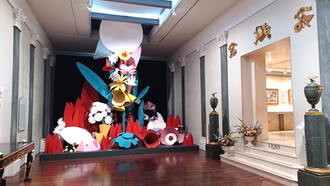
If Milan offered an intimate encounter with this paradox, Madrid changes the scale. At the Palazzo di Abrantes, home of the Italian Cultural Institute, La Grande Opera Ceramica places Bertozzi & Casoni within a wider reflection on contemporary Italian ceramics. Curated by Enzo Biffi Gentili, the exhibition brings together art, craftsmanship, innovation and production while asserting the autonomy of a medium too often relegated to the margins of the hierarchy of the arts; Bertozzi & Casoni appear in the section devoted to figurative ceramic sculpture. Biffi Gentili draws attention to an evocative genealogy: Grande Opera, Gran Obra, Magnum Opus — and therefore alchemy. Ceramics and alchemy share the same elementary imagination of earth, water, air and fire, combination and transformation. Few materials make transformation so physical. Clay enters the kiln as one thing and emerges as another.
Fire does not simply decorate it; fire changes its condition. Within this context, Bertozzi & Casoni make visible something their career itself helped establish: ceramic no longer needs to ask permission to enter contemporary art. The distinction between major and minor arts and between concept and craft belongs increasingly to an exhausted critical vocabulary. Material does not determine intellectual ambition, and technical mastery does not diminish conceptual complexity. In an age fascinated by immateriality, automation and infinitely reproducible images, the stubborn material intelligence of ceramics may in fact feel more contemporary than ever.
Milan and Madrid, therefore, tell different stories but ultimately converge. At the Museo Bagatti Valsecchi, Bertozzi & Casoni entered a house devoted to the preservation and reinvention of memory, establishing a dialogue between historical objects and contemporary sculptures around authenticity, conservation, transformation and time. In Madrid, their work enters another history: the long Italian history of ceramic knowledge, a tradition in which inherited techniques continue to generate new languages. One exhibition looks toward memory, the other toward transformation. Between them stands clay: earth subjected to fire so that it may resist time. And between them stands a name, Bertozzi & Casoni, created by two people and now carrying presence and absence simultaneously. Perhaps this is what their work has been telling us all along. Nothing becomes eternal by escaping fragility.
Things become precious because they are fragile; memory exists because something has disappeared; preservation begins with the knowledge of loss. Art does not defeat time. It gives time a form. For more than four decades, Bertozzi & Casoni have transformed what we consume, neglect, discard and lose into objects capable of remaining after us. But their ceramics do something more unsettling than preserve things: they preserve the instant in which we understand that nothing can truly be preserved forever. The flower remains, the discarded object remains, and the ceramic remains. We move on. Their sculptures are not monuments to eternity. They are monuments to our desire for it.