English
 Español
 Français
 Deutsch
 Italiano
 Português
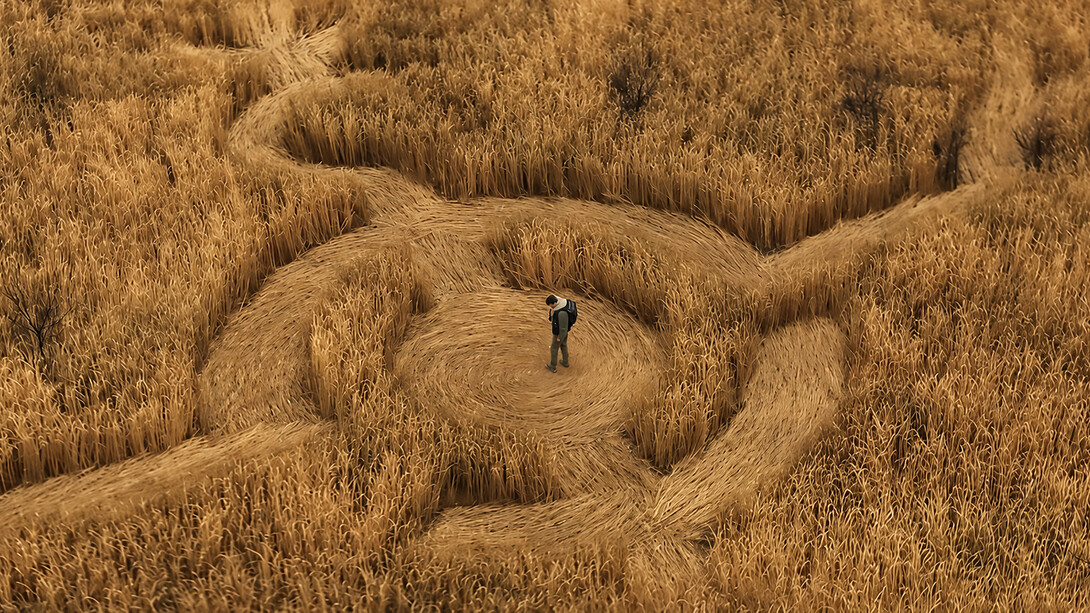
I walked into Disclosure Day with an expectation that was almost unfair. Maybe because I am, admittedly, someone fascinated by conspiracy theories. Maybe because Steven Spielberg returning to the extraterrestrial theme already carries a kind of cultural electricity. Or maybe because, in 2026, talking about aliens no longer sounds like a conversation held in a badly lit garage by someone wearing an aluminium hat.
The curious thing is that I didn't leave the theatre afraid. I left in peace.
And that, to me, is the most interesting thing about this film.
The weather girl and the whistleblower
Disclosure Day doesn't treat the unknown as a threat. It's not a film about invasion, panic, or that old human fantasy of looking at the sky and assuming everything up there wants to exterminate us. Quite the opposite. Spielberg seems far more interested in asking why we are so afraid of something that, perhaps, has been here for a very long time.
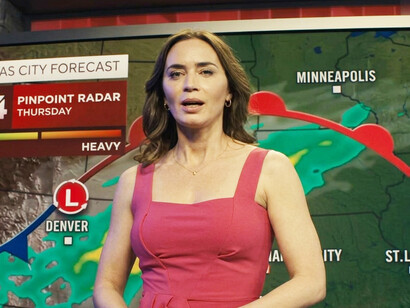
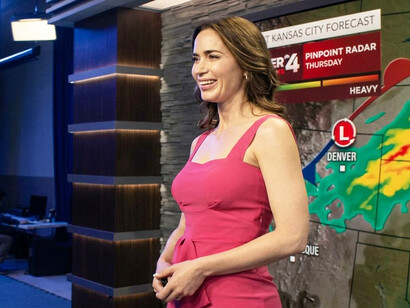
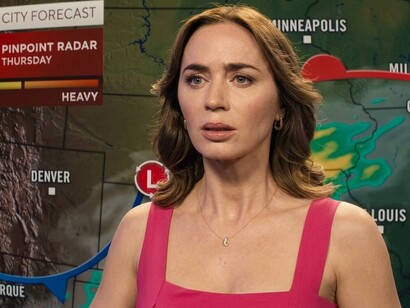
Emily Blunt's character, Margaret Fairchild, is a TV meteorologist in Kansas City. A weather girl. Someone whose job is to translate the sky for the public every single day. That choice is not small. There is something very intelligent about placing a woman who explains clouds, cold fronts, and storms at the centre of a story about something humanity still doesn't know how to name. She was already a mediator between the sky and the audience. The film only changes the scale of the forecast.
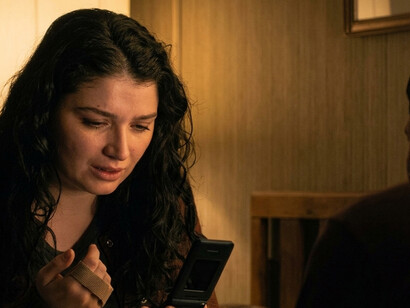
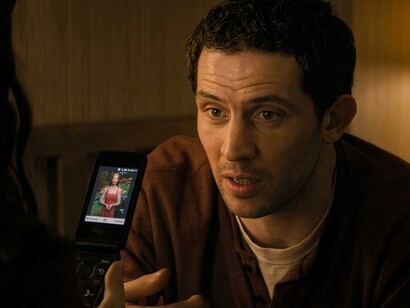
Beside her is Daniel Kellner, played by Josh O'Connor, a cybersecurity expert who decides to blow the whistle on his employer, a powerful agency that has suppressed evidence of alien visits for decades. And here the film starts playing with a fascinating border: the one between what feels like fiction and what has increasingly recognisable echoes in the real world.
When reality became the prologue
Because none of this is born from nothing. In 2017, The New York Times revealed the existence of a Pentagon programme dedicated to investigating unidentified aerial phenomena, the story that pulled Spielberg back into this territory. In 2020, the U.S. Department of Defence officially released three Navy videos, one from 2004 and two from 2015, showing objects that pilots could not explain. In 2023, a congressional hearing put military pilots and a former intelligence officer named David Grusch under oath, where he claimed to have been informed of a multi-decade programme to recover and reverse-engineer crashed craft. His allegations remain publicly unproven, and the Pentagon says it has found no verifiable evidence of extraterrestrial technology. NASA published its own report arguing that the study of these phenomena deserves scientific rigour, better data, and less stigma.
Spielberg has been playing with that border on purpose. He teased the film as carrying more truth than fiction, and he closed one of the trailers with a line that sums up his entire relationship with the theme: "I used to say to myself, 'Wouldn't it be wonderful if all of this turned out to be true?' I'm now thinking, 'Wouldn't it be wonderful for people to know all of this is true?' " With Close Encounters, he invited us to wonder. Here, he seems to be preparing us to know.
So no, there is no official proof that we are being visited. But notice what happened to the conversation itself. What used to be ridiculed is now archived, debated, and investigated. It didn't become consensus. It became an agenda. The language of conspiracy started blending with institutional language, and Disclosure Day is the first great pop artefact built entirely on top of that shift. It's not that the film proves anything. It's that it no longer sounds absurd. And that says less about the movie and more about us.
A strange era to define what is real
We live in a time when nobody knows exactly what to believe anymore. Images can be generated by artificial intelligence. Videos can be fabricated. Voices can be cloned. Reality itself became a slippery, almost theatrical substance. And yet, at the same time, things that once seemed impossible moved to the centre of the stage.
Maybe that's why Disclosure Day isn't really about aliens. Or at least not only about them. Maybe it's about our difficulty in dealing with truths too big to fit into our routine.
The film also refuses to turn the other into a monster. Its energy is much closer to E.T. than to War of the Worlds. The strange doesn't arrive to destroy. It arrives to force us to listen. And that might be the most important word in the entire film: listen.
The ending that refuses to answer
The ending, which frustrated part of the audience, was exactly what comforted me the most. The film doesn't deliver the full answer. It doesn't resolve the mystery with a grand explanatory speech, as if Spielberg were the one responsible for revealing humanity's final secret in a room that smells like sweet popcorn.
And maybe that's precisely the point.
It's not Spielberg's job to give us that answer. If this story is about anyone, it's about the ones the film keeps pointing toward. Cinema doesn't need to hand us the revelation. Maybe it's just preparing us, emotionally, to ask the right question.
For me, Disclosure Day works as an opening, not a conclusion. It is not the disclosure itself but a cultural rehearsal for what living that moment would feel like. How would we react? With fear? Denial? Faith? Anger? Hope? The film seems less interested in proving anything and more interested in preparing us for the possibility that our version of reality is incomplete.
And, sincerely, maybe it is.
I don't say that as proof. I say it as a feeling. As someone who left the cinema with the impression of having watched something bigger than a movie. A work that converses with decades of theories, documents, testimonies, alleged cover-ups, and a question that never fully disappeared: are we really alone?
Disclosure Day may not be a prophecy. It may not be a confession. It may not be a hidden message. But it also doesn't come from a vacuum. Perhaps that's what makes it so powerful: it doesn't demand that we believe blindly. It simply places us in front of a possibility and asks if we are still capable of listening.
I keep the same feeling I had walking out of the theatre. This film opened the doors of the house. We are already seated in the audience. The question now is another one entirely: who is going to open the curtain?