English
 Español
 Français
 Deutsch
 Italiano
 Português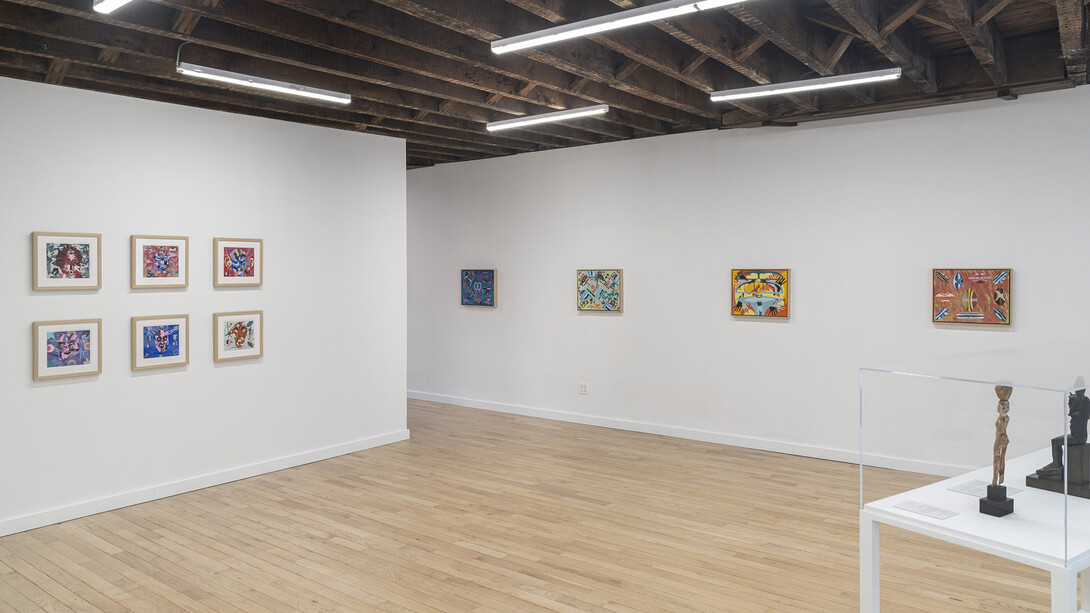
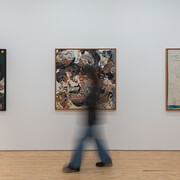
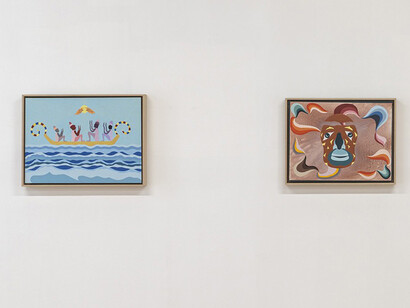
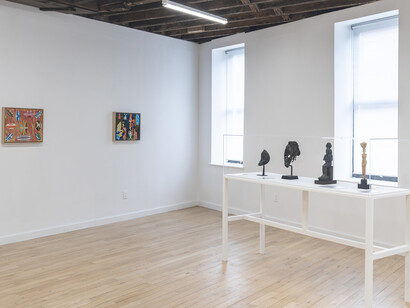
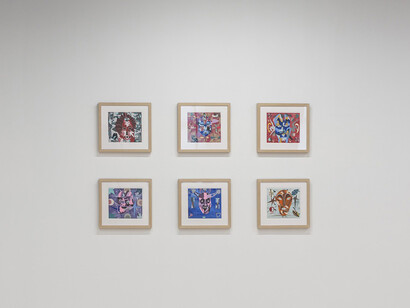
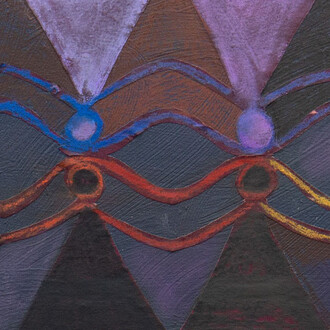
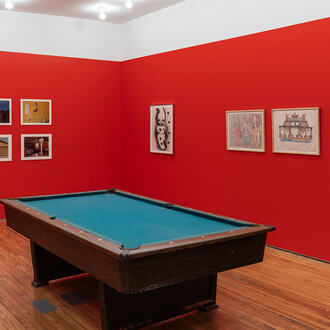
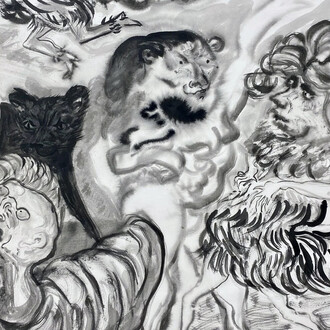
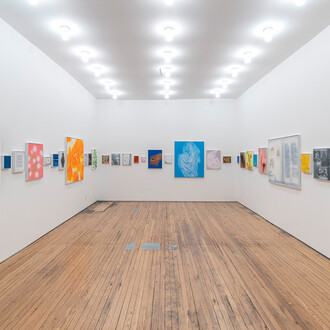
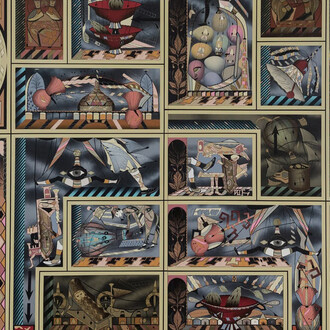
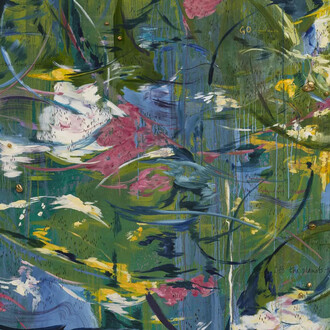
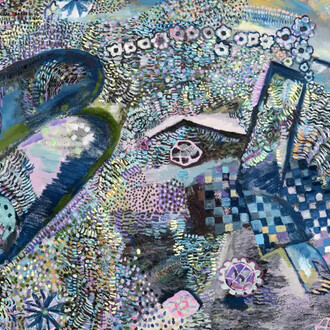
March is pleased to announce Ayé A. Aton: image from the past, the inaugural exhibition in our new gallery location at 211 Canal Street, Number 3. The exhibition includes sixteen paintings which consider various aspects of African visual culture in conversation with abstraction. They are accompanied by two ancient Egyptian sculptures and two West African masks from the late 19th-early 20th century: one Bassa (Liberia) and one Dan (Ivory Coast), in contemplation of Aton’s fundamental pursuit to uncover his heritage and history.
As Ayé A. Aton came of age in the late 1950s, Abstract Expressionism’s hold was softening while the Pop and Conceptual movements were on the rise. The formation of his visual language accelerated in the 1960s, influenced profoundly by the mentorship of Sun Ra, a celebrated musician deeply influenced by outer space and ancient Egypt. In 1961, Russian astronaut Yuri Gagarin had become the first human to visit space, and by the mid 1960s, Amiri Baraka (LeRoi Jones) had founded the Black Arts Repertory Theatre, paving the way for the Black Arts Movement. All this, along with the ongoing influence of the broader Civil Rights Movement, served as backdrop and catalyst for the development of Aton’s style.
Aton was continuously fascinated with the history of visual culture, a collector of books concerning ancient Egypt, late-modern Africa, as well as South America, the Incas, and the Kremlin, respectively. He is known to have visited African markets during time spent in Louisiana, leaving behind photographs of busy and decorated stalls. Throughout his life, Aton taught art classes at schools and community centers and held discussions around Egyptology and Black culture, seeking to empower those around him to recover their lost identities, and when necessary, create new ones. The artist’s son, Ahmosis Aton, recalls that, “the core of [Aton’s work] seemed to be about trying to rediscover your ancient history, a history that Black Americans have no association with at all. If you don’t know, you don’t know where to start. So what you do is adapt to the society you’re in. Other groups already have their own ancient culture.”
Image from the Past examines Aton’s various depictions of African visual culture, placing works like Dan people, liberia or Ivory coast (2012) and Bassa people, liberia (2012) in conversation with the original cultural objects to which they refer. As European colonization spread across Africa into the 19th century, objects like the ancient Egyptian artifacts and West African masks depicted in Aton’s paintings were reduced to symbols of a limited ideal. The growing European interest in collecting such objects along with the strengthening influence of Islam and Christianity across Africa resulted in the sale and movement of animist masks into European hands. There, they served as examples of the aesthetics and craftsmanship of the other, stripped of their cultural value and purpose. In the early 20th century, African masks and other traditional cultural objects became a powerful reference point for European artists and a catalyst for the Cubist movement. Henri Matisse was an avid collector of such objects, and Pablo Picasso, born in Málaga, Spain, was introduced to African aesthetics from an early age, the effects of which are evident in works such as Les demoiselles d’Avignon (1907). In 1926––just fourteen years before Aton’s birth––Man Ray published one of his photographs of Kiki de Montparnasse posing with a Baoulé mask (Ivory Coast) in Vogue. The controversial 1953 film, Les statues meurent aussi, illustrated and criticized the reductionist effects of colonization on these sacred objects, suggesting that it is only when a statue “dies” that it becomes art––“Quand les statues sont mortes ils entrent dans l’art” (When statues die, they enter art). In this analysis, art is considered a disempowered, incomplete state.
However, unlike outside viewers who may have considered such objects to be symbols of a foreign other, and unlike their original African creators, Aton came to the subject as part of a larger campaign to understand the diversity and nuance of his ancestors’ continent. The geographic and anthropological specificity of his annotations reflect this desire, as well as the realism of the designs; while Aton’s paintings show fluid backgrounds and improbable color palettes, the rendering of each mask, sculpture, shield, and symbol is recognizably specific. Attention is paid to the deeper significance of each object; for example, the back side of Swahili names (Tanzania) (2006) is inscribed with the meanings corresponding to each name and symbol. In engaging with as much of their original contexts as were available to him, Aton seemed to be in pursuit of greater spiritual meaning. In chorus with his other paintings spanning abstraction, sound, outer space, and color therapy, this body of work takes on new significance: a lens to express the agony of being cut off from one’s roots, and a profound curiosity to understand one’s ancestry and thus oneself.
(Special thanks to Ahmosis Aton, Mickal Adler, and Colnaghi)