English
 Español
 Français
 Deutsch
 Italiano
 Português
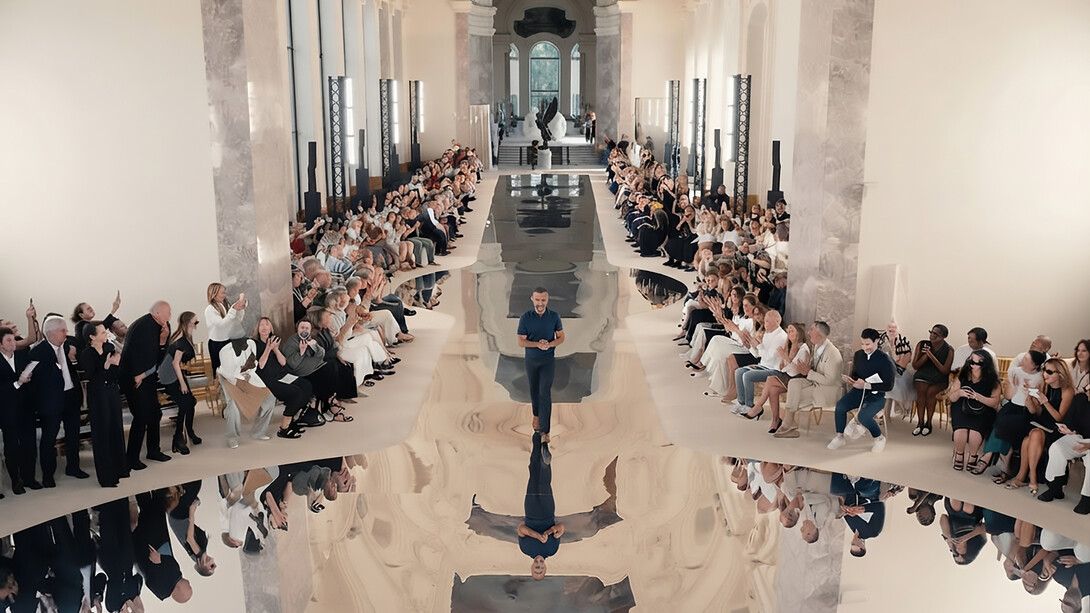
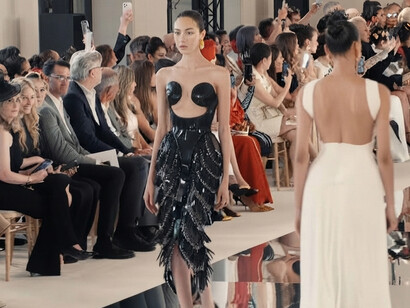
At the Schiaparelli Fall/Winter 2026–2027 show, creative director Daniel Roseberry delivered not merely a collection but a philosophical proposition. Positioned at the intersection of surrealism, couture craftsmanship, and contemporary image culture, the show—titled “The Sphynx”—interrogates the paradoxes that define both the house’s heritage and fashion’s current condition.
Rather than presenting clothing as resolved objects, Roseberry constructs garments as questions: What is real? What is illusion? What is wearable? What is symbolic? This tension echoes the foundational ethos of Elsa Schiaparelli, whose collaborations with Surrealist artists transformed fashion into a medium of artistic disruption.
The FW26/27 collection thus becomes a site of dialogue—between past and future, body and artefact, and fantasy and function.
The sphinx as concept: identity through enigma
Central to the collection is the figure of the Sphinx—a hybrid creature, half human and half animal. This motif is not merely decorative; it is conceptual. Roseberry has repeatedly cited a sculptural brooch of a sphinx as a foundational reference for his vision of the house.
In FW26/27, the Sphinx emerges as a metaphor for identity itself—fragmented, dual, and unknowable. Garments embody this hybridity through:
Sculptural silhouettes that merge organic and architectural forms.
Accessories that appear animate, such as feline-inspired heels.
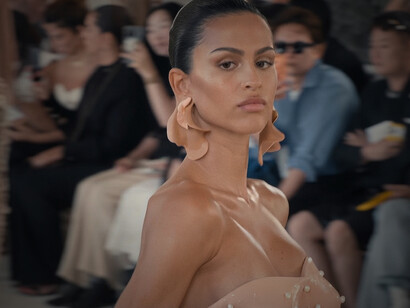
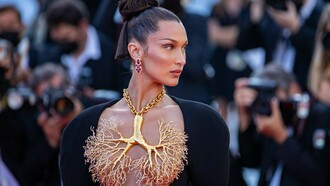
Textures that blur the boundary between skin, fabric, and artefact.
This hybridity reflects a broader cultural condition: the instability of identity in an era shaped by digital projection and hyper-visibility. The Sphinx becomes a symbol of the contemporary self—constructed, coded, and enigmatic.
The return of the keyhole: unlocking the body
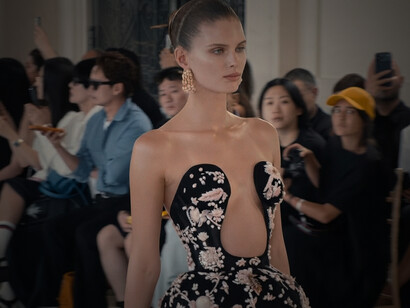
One of the most striking elements in the collection is the resurgence of the keyhole motif, an archival symbol dating back to the early 1930s.
Roseberry reinterprets this emblem not as an ornament but as a conceptual device. The keyhole appears:
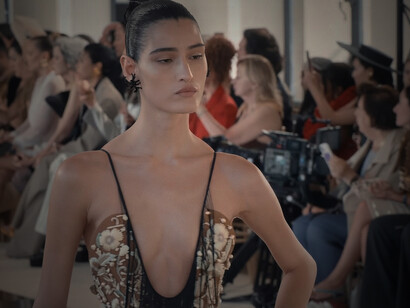
As cut-outs along necklines and torsos.
Embedded within tailoring details.
Transformed into jewellery-like fastenings.
Historically, the keyhole suggested access—an invitation to look closer. In FW26/27, it becomes a metaphor for revelation and concealment. The body is neither fully exposed nor entirely hidden; instead, it is mediated through design.
This aligns with Schiaparelli’s enduring fascination with the body as a site of transformation. Just as Elsa once embroidered skeletons onto dresses, Roseberry now “opens” the garment to suggest what lies beneath—emotion, identity, and desire.
Trompe-l’œil as technique and philosophy
If the keyhole unlocks the body, trompe-l’œil destabilises perception. Long a hallmark of Schiaparelli’s visual language, illusion is elevated in this collection to a defining principle.
Roseberry employs trompe-l’œil across multiple dimensions:
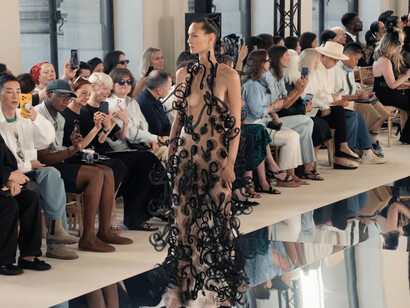
Prints that mimic fur, leather, or anatomical curves.
Fabrics engineered to appear rigid yet remain fluid.
Surfaces that resemble one material but are constructed from another.
For example, glossy black garments evoke leather but are in fact silk-wool blends, while spiral cut-outs simulate corsetry without actual boning.
This manipulation of perception reflects a deeper commentary on fashion’s role in the image economy. In an age dominated by screens, the distinction between real and simulated becomes increasingly irrelevant. What matters is the effect—the illusion of meaning, luxury, or identity.
Thus, trompe-l’œil is not merely decorative; it is ideological. It positions fashion as a medium that constructs reality rather than reflects it.
“Impossible knitwear” and the physics of couture
Among the most technically compelling innovations in the collection is what Roseberry describes as “impossible knitwear".
These garments combine heavy, tactile knitting with ethereal tulle, creating silhouettes that appear to defy gravity. The result is a paradox:
Weight without heaviness.
Structure without rigidity.
Presence without mass.
This contradiction is central to Roseberry’s design philosophy. As he notes, fashion exists in tension—between commerce and dream, function and fantasy.
In this sense, “impossible knitwear” becomes a metaphor for couture itself: a discipline that transforms material limitations into aesthetic possibilities.
Contradiction as brand DNA
Schiaparelli has always thrived on contradiction. Elsa’s original designs juxtaposed elegance with absurdity—lobster dresses, shoe hats, and skeleton motifs. Roseberry continues this tradition but reframes it for a contemporary audience.
In FW26/27, contradiction manifests in multiple ways:
Material vs. Appearance: Fabrics that look like something they are not.
Wearability vs. Art: Garments that oscillate between clothing and sculpture.
Emotion vs. Irony: Designs that are both sincere and self-aware.
Roseberry explicitly frames this tension as central to the collection’s narrative.
This duality reflects the current state of fashion, where brands must navigate the demands of commercial viability while maintaining artistic credibility. Schiaparelli resolves this tension not by choosing one over the other, but by embracing both.
Visual presentation: the runway as mythological space
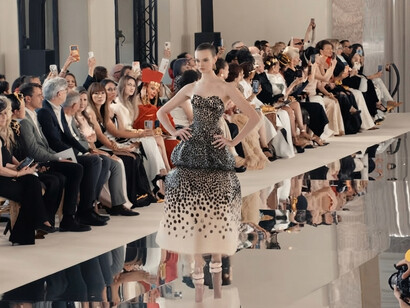
The staging of the FW26/27 show reinforces its conceptual framework. Rather than a conventional runway, the presentation operates as a theatrical environment—an immersive space where garments function as characters within a narrative.
Key visual elements include:
A restrained, almost austere colour palette emphasising black, gold, and neutral tones.
Lighting that accentuates texture and contour, creating sculptural depth.
A pacing that allows each look to be perceived as an individual artefact.
This approach aligns with Roseberry’s broader ambition to position fashion within a museum-like context—an “applied art” that transcends mere utility.
The runway becomes a site of contemplation rather than spectacle, inviting the viewer to engage intellectually as well as visually.
Material experimentation and surreal craft
Material innovation plays a crucial role in articulating the collection’s themes. Roseberry continues to push the boundaries of couture through unexpected combinations and experimental techniques.
Examples include:
Silk treated to resemble bark-like textures.
Crushed CD materials transformed into garment surfaces.
Feathers and sculptural elements that evoke movement and vitality.
These materials are not chosen arbitrarily; they contribute to the collection’s exploration of transformation. Objects are recontextualised, their original meanings disrupted and redefined.
This process mirrors the Surrealist practice of juxtaposition—placing familiar elements in unfamiliar contexts to generate new meanings.
The body as sculpture
A recurring theme in Roseberry’s work is the treatment of the body as a sculptural form. In FW26/27, this is achieved through:
Contoured silhouettes that emphasise anatomical lines.
Strategic cut-outs that reveal and obscure simultaneously.
Layering techniques that create depth and dimensionality.
The body is not merely dressed; it is reimagined. Garments act as extensions of the body, altering its proportions and redefining its presence.
This approach aligns with the legacy of Elsa Schiaparelli, who viewed fashion as a form of artistic expression rather than mere decoration.
Future trends: toward emotional surrealism
The FW26/27 collection offers insights into broader fashion trends that are likely to shape the coming seasons:
Hyper-surrealism as mainstream language: what was once avant-garde is becoming increasingly normalised. Surreal elements—once confined to couture—are now influencing ready-to-wear.
Material illusion and digital aesthetics: as digital environments blur the boundaries of reality, fashion responds with materials that mimic, distort, and simulate.
Sculptural minimalism: despite its conceptual complexity, the collection maintains a disciplined aesthetic. This suggests a future where minimalism is not about simplicity but precision.
Narrative-driven design: collections are increasingly constructed as narratives rather than assortments of garments. The Sphinx becomes a storytelling device, guiding the viewer through the collection’s conceptual framework.
Fashion as enigma: the Paris Fashion Week presentation of Schiaparelli FW26/27 marks a significant moment in the evolution of contemporary fashion. Through a synthesis of heritage and innovation, Daniel Roseberry reaffirms the house’s position as a site of artistic experimentation.
What distinguishes this collection is not merely its visual impact but its intellectual ambition. It challenges the viewer to reconsider the nature of fashion itself:
Is it clothing, or is it art?
Is it functional, or is it symbolic?
Is it real, or is it illusion?
In embracing these questions, Schiaparelli does not seek to resolve them. Instead, it revels in their complexity—much like the Sphinx itself.
Ultimately, FW26/27 suggests that the future of fashion lies not in clarity, but in mystery. In a world saturated with images and information, the most powerful statement may be the one that resists immediate understanding.
And in this sense, Daniel Roseberry has not just designed a collection—he has constructed an enigma.