English
 Español
 Français
 Deutsch
 Italiano
 Português

We live in an era of unprecedented acceleration, where the future arrives faster than our collective capacity to process it. Simultaneously, our aesthetic gaze has never been cast so resolutely backward. Walk down any cosmopolitan street or scroll through a digital feed, and you will encounter a living collage of the past, structural silhouettes reminiscent of mid-century tailoring, corsetry adapted into modern streetwear, and textiles that deliberately evoke the weight and texture of pre-industrial craftsmanship. This is not merely a cyclical trend or a passing trend. We are witnessing a profound, systemic cultural phenomenon, a massive revival of historical fashion driven not by a rejection of the digital age, but by its very mechanics.
At the heart of this movement lies a fascinating paradox: the very technologies accelerating our lives, hyper-optimized algorithms, digital curation platforms, and global online communities are being used to romanticize, archive, and revive the slow, tactile, and meticulous clothing of bygone eras. To understand this phenomenon, we must examine the digital architecture that resurrects historical aesthetics, the psychological craving for permanence in an ephemeral world, and the implications of this convergence for the future of human culture.
Historically, the revival of fashion eras was a slow, top-down process. A designer might spend months researching in a physical museum archive, debut a collection on a Parisian runway, and wait for that influence to trickle down to ready-to-wear markets over years. Today, the archive has been democratised, digitised, and decentralised. Platforms like Pinterest, Instagram, and Tumblr, alongside niche digital repositories, function as vast, open-access museums.
Millions of high-resolution images of historical garments ranging from the intricate stitch-work of 18th-century court dress to the sharp, architectural tailoring of 1940s wartime fashion are instantly accessible. However, these digital spaces do more than just store images; they actively shape how we view history. Stripped of their original linear timelines, historical eras exist simultaneously on a flat digital screen. A Renaissance bodice sits adjacent to a 1990s minimalist blazer in a user’s curated collection, and this flattening of time creates an entirely new aesthetic vocabulary.
The algorithmic curation of these platforms operates on a logic of hyper-specificity. If a user demonstrates a passive interest in traditional lace-making or Edwardian structural silhouettes, the algorithm responds by submerging them in a concentrated stream of that specific imagery. These digital subcultures, often manifesting as aesthetic movements like Dark Academia, Cottagecore, or historical costuming, create self-sustaining ecosystems. They transform passive consumers into active researchers, sparking a collective obsession with the nuances of historical construction.
To understand why millions of people are using ultra-modern technology to look backward, we must look at the psychological landscape of the digital age. Our daily lives are increasingly mediated by smooth screens, cloud storage, and weightless interactions. We work in digital workspaces, socialise via text, and consume media through streams of pixels. This digital saturation has produced a profound counterreaction, a sensory hunger for the tactile, the heavy, and the permanent.
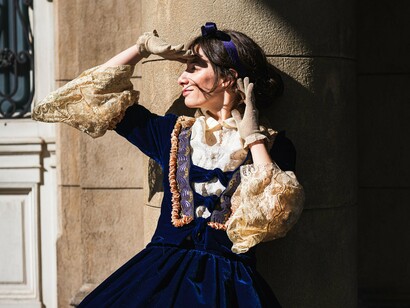
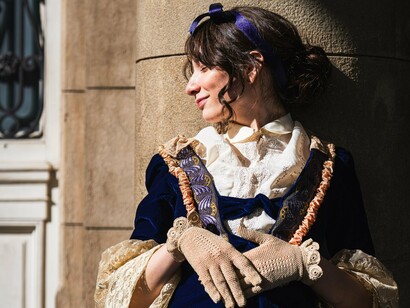
Historical fashion satisfies this hunger in ways that contemporary fast fashion cannot. Historical garments, by their very nature, possess structural integrity and physical presence. They rely on dense textiles, heavy wools, structured linens, stiff brocades and complex construction techniques designed to mould, alter or accentuate the human form. The internal architecture of a historical silhouette, whether achieved through strategic boning, precise pleating, or layered canvas interlinings, demands that the wearer feel the clothes.
When an individual adopts a wardrobe inspired by historical silhouettes, they are making a somatic choice. They are choosing to feel the restriction of a structured waist, the weight of a full pleated skirt, or the sharp definition of a tailored shoulder. In a world that feels increasingly simulated, the physical feedback of a structured, historically informed garment acts as a sensory anchor, serving as a tangible assertion of the self in physical space.
This revival of historical fashion is also a direct critique of the modern fashion industry’s ecological and ethical crisis. Fast fashion operates on a hyper-accelerated cycle, churning out cheap, synthetic garments designed to be discarded within weeks. This model has not only degraded the environment but has also eroded the public’s appreciation for how clothing is actually made. In response, the historical fashion subcultures born on the internet have catalysed a slow fashion counter-revolution.
Online communities have become digital guilds where traditional craftsmanship is decoded and shared. On video-sharing platforms and forums, creators upload exhaustive, long-form tutorials detailing how to replicate historical sewing techniques by hand. They analyse the mathematics of a Victorian pattern, demonstrate the art of hand-bound buttonholes, and explain the properties of natural fibres like flax and silk.
This digital dissemination of traditional knowledge has fostered a profound appreciation for the human element in production, directly challenging the corporate narrative that clothing must be fast and disposable. By engaging with historical construction, consumers shift their relationship with their wardrobe from one of passive consumption to one of active stewardship. They learn to value the hours poured into a seam, the intelligence of a structural silhouette, and the longevity of a well-made piece.
Technology, in this instance, does not automate the human out of the loop, instead, it serves as the vital medium through which human craftsmanship is preserved and passed on. While this movement celebrates beauty and craftsmanship, it also raises important questions about the nature of nostalgia, which is rarely an accurate recording of history. Nostalgia acts as a filter that softens the harsh realities of the past while amplifying its aesthetic triumphs.
When we romanticise the sartorial elegance of the 19th century or the mid-20th century through digital media, we risk divorcing the clothing from the rigid social hierarchies, economic inequalities, and political repressions of those eras. The challenge for modern cultural creators and journalists is to navigate this revival with a high degree of nuance. Fortunately, the current historical revival is unique because it is being driven by a remarkably diverse, global, and progressive generation of digital natives. These individuals are not seeking to return to the social conditions of the past; rather, they are actively decoupling the aesthetics of history from its historical limitations.
We see subcultures subverting traditional gender norms through historical dress and global creators blending traditional, regional textiles with Western historical silhouettes. This is a deliberate act of cultural reclamation. By using modern digital spaces to rewrite who gets to wear these celebrated, structural styles, contemporary enthusiasts are transforming historical fashion from a symbol of past exclusion into a tool for modern self-expression.
The intersection of fashion, culture, and technology will only deepen as we move more into the future. We are entering an era where artificial intelligence can generate thousands of new clothing designs in seconds, and digital fashion houses sell garments that exist solely in virtual reality. Yet, the booming resonance of the historical fashion revival suggests that the human desire for tactile narrative cannot be fully sublimated into the virtual realm.
The ghost in the wardrobe is a reminder that technology is at its best when it serves as a bridge to human intuition and heritage, rather than a replacement for it. Algorithms can categorise, curate, and predict, but they cannot feel the tension of a thread under a needle, nor can they understand the deep cultural resonance of a silhouette that has survived for centuries. That translation requires the human touch. The revival of historical fashion via digital networks proves that our relationship with the past is not a passive one.
We are not just haunted by the ghosts of history, we are actively inviting them into our closets, using the tools of the future to keep the finest traditions of human craftsmanship alive, breathing, and still relevant today.