English
 Español
 Français
 Deutsch
 Italiano
 Português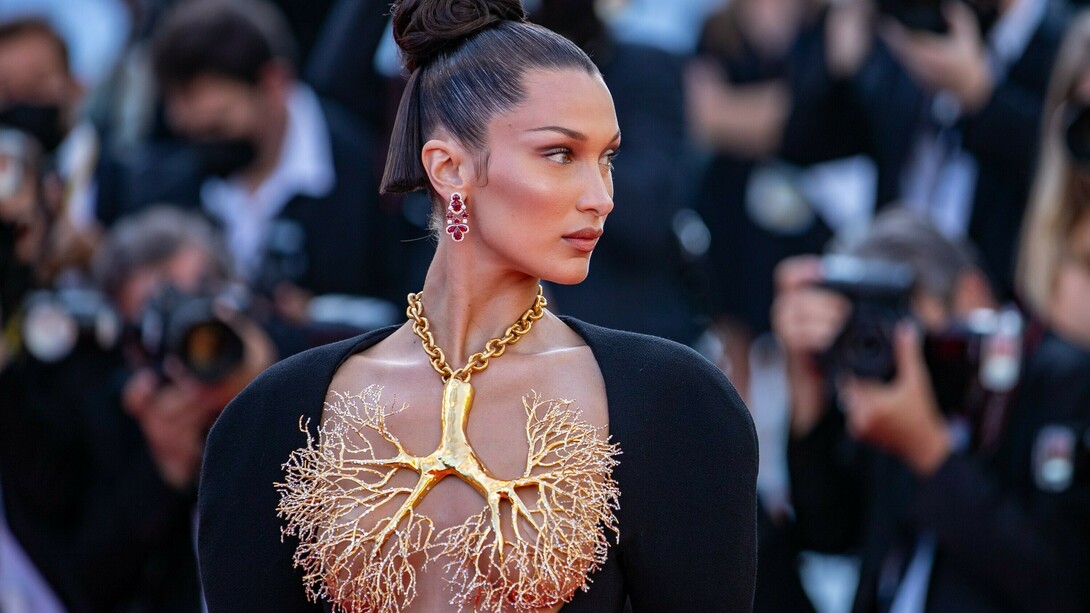
Fashion and art have always been intertwined, but few movements have transformed the language of fashion as profoundly as Surrealism. Born in the 1920s from the ashes of World War I, Surrealism rejected logic and reason, turning instead to the language of dreams, desire, and the unconscious. Guided by figures like Salvador Dalí, René Magritte, and Man Ray, the movement transformed fantasy into philosophy, inviting the world to see beyond the visible.
In fashion, this poetic rebellion found its greatest interpreter in Elsa Schiaparelli—the designer who turned the act of dressing into a dreamlike experience. From her collaborations with Dalí to her legacy in modern haute couture, Schiaparelli’s surreal vision continues to inspire designers who dare to blur the line between imagination and reality.
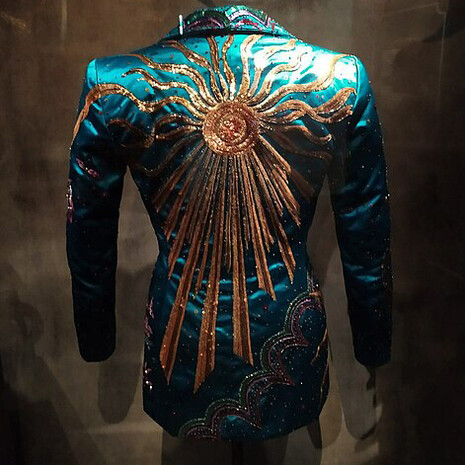
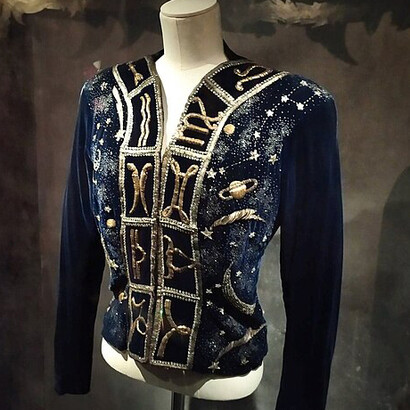
When Elsa Schiaparelli arrived in Paris in the 1920s, the city was a playground for avant-garde art. While Coco Chanel simplified fashion to suit the rhythm of modern life, Schiaparelli went in the opposite direction—she infused it with imagination, irony, and a hint of the absurd. Her friendships with Surrealist artists led to some of the most iconic fashion collaborations of the 20th century.
Schiaparelli understood that fashion could be more than beauty; it could be conceptual art. Her garments embodied humor, irony, and psychological play. One of her most famous pieces, the Lobster Dress (1937), was born from her collaboration with Dalí. A simple white silk organza gown was transformed into a surreal masterpiece through a large red lobster painted across its front—a playful yet subtly provocative symbol of Dalí’s erotic imagination. Similarly, her Shoe Hat, also designed with Dalí in 1937, turned an ordinary object into a bold headpiece, questioning what was considered wearable or absurd.
Another iconic creation, the Tears Dress, printed with trompe-l’œil rips and holes, reflected both fragility and illusion—a commentary on beauty’s impermanence and the surreal distortion of the human form. Through these designs, Schiaparelli made clothing a surreal experience, where art was not merely decoration but a lens through which reality could be reimagined.
For Schiaparelli, clothing was not meant to flatter the body but to express the mind. Her designs were full of contradictions—elegant yet humorous, wearable yet surreal. They spoke the language of dreams, where logic dissolves and meaning multiplies.
The impact of Schiaparelli’s vision resonated deeply throughout the 20th century. In the postwar years, while fashion turned toward restraint and elegance under Christian Dior’s “New Look,” the Surrealist impulse lingered beneath the surface, reappearing whenever designers sought to challenge convention or explore fantasy.
Although Schiaparelli closed her couture house in 1954, her spirit lingered like a perfume in the air. Whenever designers sought to challenge conformity or explore imagination, the echo of Schiaparelli’s influence remained.
In the 1980s and ’90s, Jean Paul Gaultier and Thierry Mugler revived fashion’s theatrical soul. Gaultier’s corseted silhouettes and gender-bending designs embodied the surreal idea that identity is fluid and ever-changing. Mugler, with his futuristic heroines and insect-like couture, turned the human body into a vessel for transformation—a theme deeply rooted in Surrealist art.
Then came Alexander McQueen, whose shows transcended fashion altogether. McQueen’s world was one of beauty and horror, a space where the subconscious ruled. In Voss (2001), models were trapped inside a mirrored asylum; in Plato’s Atlantis (2010), they evolved into otherworldly creatures. Like Dalí, McQueen explored the fragility of the human psyche—using clothing as both armor and confession.
At Dior, John Galliano brought a similar theatrical magic, crafting dreamlike narratives that blurred the boundary between costume and couture. His designs, layered with symbolism and sensuality, reminded the world that fashion could be both spectacle and poetry.
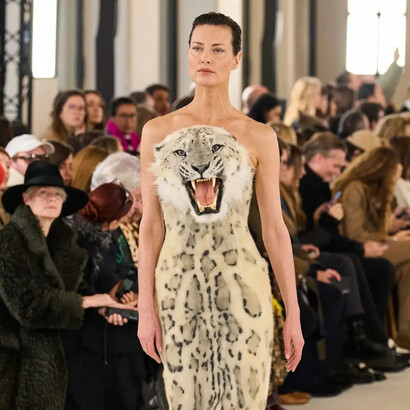
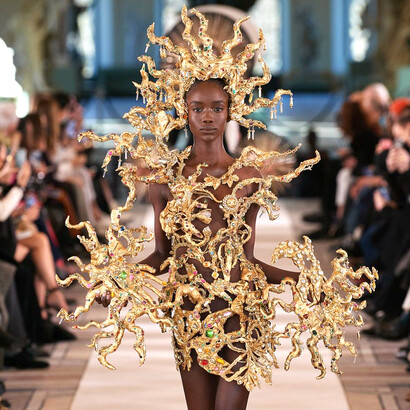
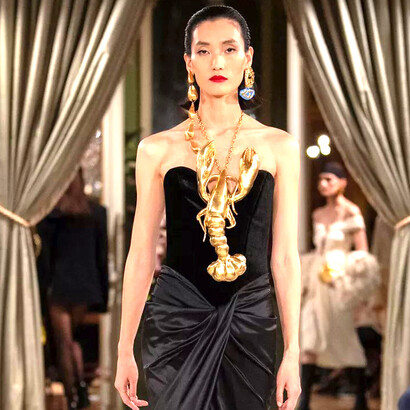
In 2019, nearly seven decades after Schiaparelli’s closure, American designer Daniel Roseberry resurrected the House of Schiaparelli—and with it, the golden age of surreal couture. His vision honors Schiaparelli’s collaboration with artists while reimagining her codes for the 21st century.
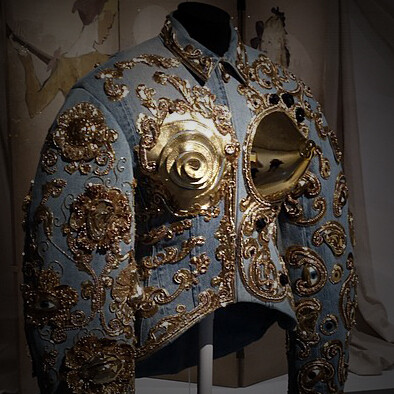
Roseberry’s creations are full of dreamlike tension: minimal silhouettes paired with sculptural gold busts, corsets shaped like faces, and earrings molded from noses and eyes. These surreal elements, inspired by Dalí and Cocteau, have become his signature—turning the human body itself into a work of surrealist art.
Beyond haute couture, the Surrealist impulse continues to shape contemporary fashion. Viktor & Rolf’s Wearable Art collection, where dresses were framed like paintings, turned the body into a living gallery. Maison Margiela, under Galliano’s creative direction, deconstructs garments to question perception itself—faces covered, silhouettes disguised, beauty redefined.
Meanwhile, Iris van Herpen brings Surrealism into the digital age. Her 3D-printed designs seem alive, morphing and moving like dream creatures. Through technology, she explores the same territory that fascinated the Surrealists—transformation, illusion, and the intersection of body and spirit.
Even in streetwear and accessories, echoes of Surrealism remain. Distorted logos, optical illusions, and sculptural handbags challenge traditional aesthetics, demonstrating that the Surrealists’ fascination with play and paradox continues to captivate our collective imagination.
Surrealism’s enduring influence on fashion lies in its refusal to obey reason. It invites us to embrace contradiction—to see the ordinary as extraordinary, to turn a shoe into a hat, a tear into a pattern, and a dream into a dress.
In a world increasingly obsessed with logic, algorithms, and perfection, the surreal offers a necessary escape. It reminds us that beauty is often found in the strange, the irrational, and the unexpected. Like Dalí’s melting clocks or Magritte’s floating men, surreal fashion invites us to look again—and to see differently.
The story of Surrealism in fashion is ultimately one of liberation. It is about breaking free from the limits of practicality and embracing the power of imagination. Elsa Schiaparelli understood this nearly a century ago: that to dress oneself could also mean to express one’s inner world, one’s dreams, and one’s defiance.
Today, as modern designers reinterpret her vision through technology, performance, and art, the dialogue between Surrealism and fashion continues—not as nostalgia, but as evolution.